Episode Transcript
[00:00:02] Speaker A: You're listening to Home Health Revealed, where the business of home health comes to life. Hosted by Hannah Vail, each episode brings real conversations with the leaders, innovators and experts shaping the future of the industry. From reimbursement and technology to leadership and growth, this is Home Health Revealed.
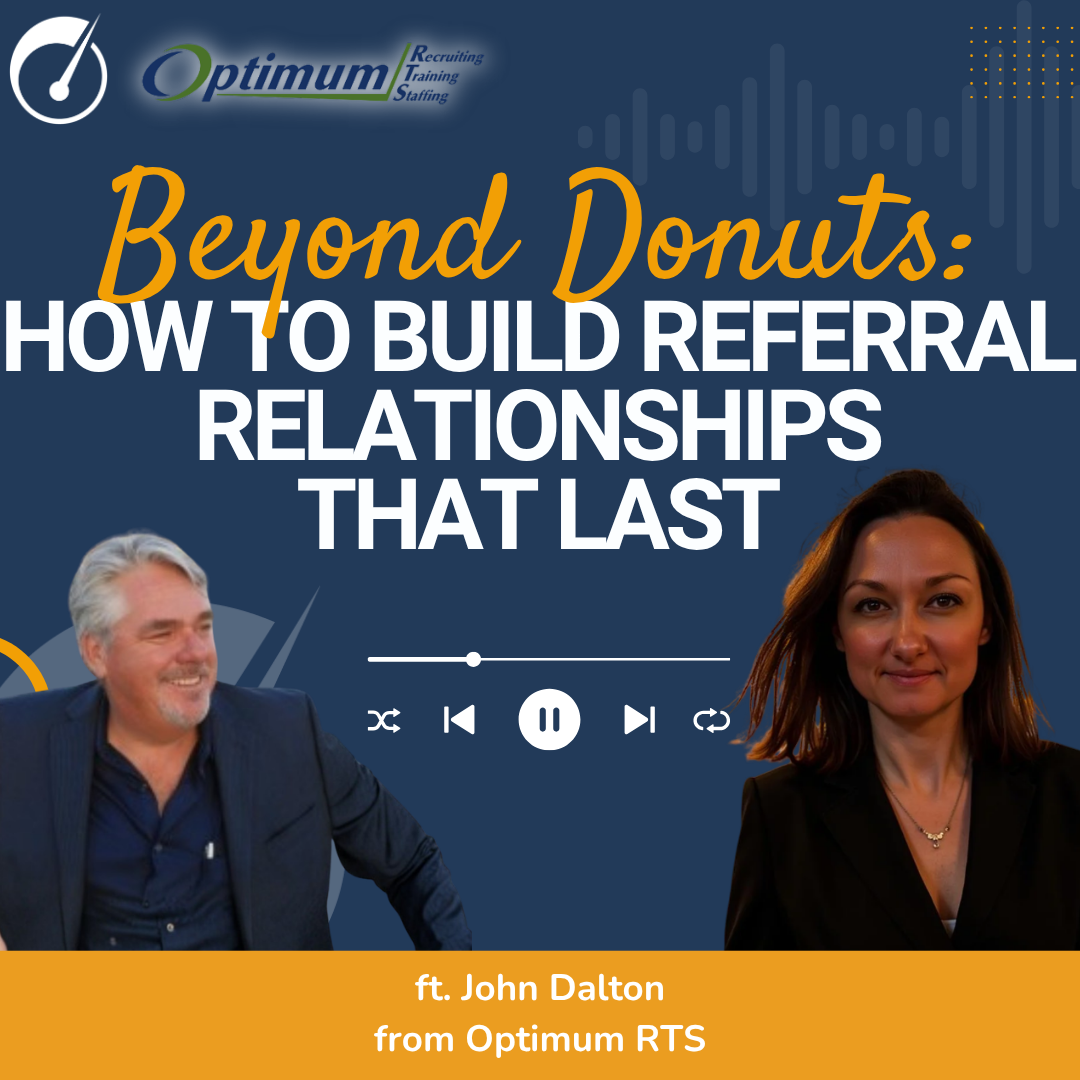
[00:00:17] Speaker B: Hey, welcome to Home Health Revealed. I'm Hannah Vail and our speaker today has spent more than three decades and he gave me permission to say that. Three decades. Helping healthcare organizations grow. Before becoming nationally recognized consultant and trainer, he built referral relationships, led sales teams, recruited talent, and helped healthcare providers grow from within. But today, as founder and president of Optimum rts, he works with the organizations across the country, strengthening recruiting, sales and business development by sharing strategies shaped through firsthand experience.
Please join me in welcoming John Dalton. John, it's great to have you.
[00:01:00] Speaker A: Great to be here. I'm so, so excited and thank you for welcoming me.
[00:01:03] Speaker B: Yeah, yeah. Welcome.
Oh, goodness. I'm really excited to get to talk with you about this topic because I think a lot of agencies have questions about this, best ways to go about it, best practices, and within your experience, you have seen good and bad ways to approach this topic. I'm very interested to see and hear what you have to say today. Many agencies still rely on lunch cookies, dropping things off in the office brochure drops. These tactics often fail. They don't create the meaningful growth or relationships that agencies are looking for by doing these activities. When leaders talk about building lasting referral relationships, what does that look like beyond receiving those occasional referrals or having that salesperson just make routine office visit?
[00:01:50] Speaker A: Well, you know, again, thank you so much for having me here today. I'm so happy to be able to share information. Yeah, there's nothing I really like more in my career than helping others grow and get better at what they do. And this is a topic that I cover regularly when I'm speaking at conferences. It's like, do not let your salespeople become the donut man or Donut person, because that's what they really feel is the key to sales, is how do I entice my referral sources by giving them gifts.
What I liken it to is Pavlov's dogs. We all heard about Pavlov, and when he rang the bell, the dogs would start to salivate and they knew they were getting dinner. What we're doing when we're bringing donuts first is nobody has rung the bell and the offices are using your sales staff as a perk of working in their office because you get free lunch.
So I stopped all of my sales reps when I was actually running sales teams for home care, hospice and infusion for from doing that and really use it as a reward after the referral comes in.
Lunch does not build a relationship. What builds the relationship is having knowledge of your industry and being able to offer something to that office that is going to make their job easier. And donuts just isn't that which.
[00:03:18] Speaker B: That brings me to my next question.
Referral sources do need to know who the right patient is to send. But how can leaders coach sales representatives to clearly describe the right patient so that the referral sources immediately recognize who to send? They come through the door and they they know, ding, ding, ding. This is the person I'm going to call.
[00:03:41] Speaker A: Sure. We have to look at each individual referral source that we're working with.
When I am doing my fractional sales management sales training with my reps, the process usually will go like this. We'll go to a hospital and go to the medical building next to the hospital. Each door that we walk into, we stop beforehand. We say, what type of doctor is this? It's a cardiologist. Great. They work with patients that have vascular and heart issues.
[00:04:10] Speaker B: Perfect.
[00:04:11] Speaker A: What are the symptoms of that? Well, someone that has CHF might be weaker. What services could they need if they're weaker? Well, they could use physical therapy. Perfect. Let's walk into the doctor's office.
From there, we start looking at the patients that they would see on a daily basis.
Have you seen a patient come in today or this week that has an exasperation of their CHF and is weaker and you're worried they might fall and end in the hospital?
That's the patient I'm looking for. So if we paint a picture for the exact type of patient we're looking for, it makes it much easier for the referral sources to be able to go ahead and identify the patient. What I see salespeople typically doing is they're going out, they're just saying, hey, Hannah, how are you doing? It's really great. Thanks. I'm John from Choose youe Home Care Agency. You know, we provide skilled nursing, physical therapy, occupational therapy in the home. If you have a referral, think of us.
Well, we don't need any home care today. That's because they haven't painted the picture of the person they're looking for. Do you have someone that's on daily ptinrs? Are you still using Coumadin? Yes, we're using Coumadin. Oh. So how do you monitor the PTINRs? Well, we have the patient come back and forth to the office.
[00:05:29] Speaker B: Really.
[00:05:29] Speaker A: Do you have issues ever with patients not being able to come here on a daily basis? That happens all the time. There's a perfect home care referral for me. So we lead them to the exact type of patient we're looking for. If we're in a hospital, we're talking to case managers. What are their key pain points? Rehospitalizations. So if we know that a rehospitalization is going to happen between five and seven days post hospitalization is when it's likely to occur. If we're dealing with a private home care agency and we're talking about ADLs, we would ask for that patient that you're concerned might slip or fall or doesn't have care in their home to be able to provide for. If you're dealing with someone that's looking for more of a skilled home care, we go at it from that side and we'll talk about transition to care. So it's all about painting a picture for the perfect patient we're looking for.
And that was a lot of P's that I just used. But we're.
Yeah, yeah, it's really just about painting that picture to make sure that we make it easy for the referral sources. A case manager in a hospital is extremely busy and they're already thinking about something else.
So if we put that picture in their head, it makes it very easy to say, Mrs. Smith in the room, 212 down the hall, that's the person you need to talk to. So that's how we get more specific. But I see too many reps that I've trained through the years and even ones that I'm working with now that do what I call just show up and throw up. They come in and they just start talking about their home care company. They talk about the agency, they talk about what exactly they do. Very detailed, but they're talking about something that is not applicable to the case manager.
[00:07:19] Speaker B: The data that they need before they go out to know what their agency does well, how they are meeting the needs of some of these patients, the outcomes, what are some of those data points that you recommend a sales rep knows inside and out. Before even going to some of these referral sources and doing these business pop
[00:07:38] Speaker A: inside, you have to know your company, you have to know what your services are. I'm dealing with a home care agency right now that's a franchise that provides ADL's help with ADL's. It's a home care company, not a home health care company.
But their franchise model does not allow them to use nurses. So we have to understand or provide nurses or any skilled service, even if it's private paid. So we have to know. Going to a plastic surgeon's office and talking about post surgery care is not something they can offer. They need to be able to talk about the ADL's. How do we help with the ADL's? So learning what the company does and how to explain it, I simply asked them. Hannah, tell me, what did you do the first 20 minutes after you got out of bed this morning when you, after you woke up?
Well, I got out of bed, I went to the bathroom, I brushed my teeth, I got dressed and I ate. There you go. There's ADLs. You don't need to know anything more about it than just paint the picture again. That's what makes it easy for our reps to understand. We need to know what a skill is. We need to know how a nurse can go out and do an injection and train a family how to do the injections to work with infusion. We need to know what Coumadin is so that we know that it's a blood thinner and why PTINRs are important for that.
But I don't think a rep needs to be well versed in what the company does. But through the art of questioning, a rep can figure out what it is to do. For instance, if I were in a cardiology office, I'm brand new to healthcare. Hi, my name's John. I graduated with a degree in geography, urban and regional planning, and now I'm in healthcare. Right.
Walk into a cardiology office and they say, what are you going to do for my cardiac patient's job? So how. I don't know anything. I could tell you about plate tectonics, I can tell you about blood zone.
[00:09:41] Speaker B: Yeah, right.
[00:09:42] Speaker A: But I don't know anything about cardiology. So how do I ask an appropriate question? You know, Hannah, typically for a cardiac patient, we're going to do physical therapy to help with strengthening and we might have a nurse do medication management.
But it's not up to me to decide what to do with your patients. What do you want the home care agency to do now you're going to give me five new things and you're going to educate me to how to learn to work with these companies and work with these doctors and work with the skilled nursing. So it's really just learning how to ask a Question and think on your feet.
That's the biggest part of sales.
Early, early in my career, I was working for paychecks, recruiting for them, and the sales manager had a favorite question he'd ask every rep at the end. Oh, by the way. The oh, by the way, on your way out the door question. Yeah, why is a manhole cover round? And then he just stopped and he wanted to see how the rep would think on their feet. So I'm having lunch with him and he tells me this question and he stops. He waits for me to answer. And I'm like, when they were first putting in sewers, they didn't have the same machinery that we have today.
So they could take the steel manhole cover off the cart and roll it to where they needed to go. He's like, wrong answer.
But that's what we're looking for. We're looking for people that can think on their feet, you know, certainly. Disclaimer. I'm not sure that's the answer. That's what I think. Let me find out. I'll get back to you. Right. So never provide wrong information.
But we need someone that can think on their feet when they're hit with a question like that, how to turn it around.
So when going back to the original question, what do they need to know? They need to know how to think on their feet. They need to know how to communicate. They need to know how to listen. They need to know what the company does, even if it's most basic when we're talking about therapy. If there's any therapists watching this, I apologize already. But, you know, physical therapy, waist down, occupational therapy, waist up. That's an easy way for a rep to remember what the therapies do and why occupational therapy does not would not be a reason to start a home care case. It's waist up. I can walk to a part B.
[00:12:08] Speaker B: Right.
[00:12:09] Speaker A: But how do I get around that? Well, if I'm sitting down and my shoulders hurt and I have to stand up, how do you stand up? You put your hands on the arms of the chair and you push yourself up. Well, if I only have one arm, I'm going to push myself up sideways. So therefore, we are going to need physical therapy because we need to do gait retraining. So it's just a matter of process. And you know, my favorite way to start a new rep is to hire a recent college grad that doesn't have any knowledge in regards to home care and then teach them what they need to know as they move Forward.
[00:12:43] Speaker B: You found that that's been more successful?
[00:12:46] Speaker A: Absolutely. Hands down. What I want to see in an interview for a salesperson is did the salesperson get me talking? If the salesperson got me talking, they're going to move forward. If a salesperson doesn't get me talking, doesn't start to try to bond with me, they're not going to be moved forward in the process. And hiring in home care, in business, if you have a superstar salesperson, you are never going to let them go. You will do whatever you need to do to keep them in your location.
So with Optimum rts, I've stopped recruiting existing home care salespeople very, very rarely. Why?
Because the person that is looking for a job is already on an action plan and getting ready to get fired from their company and they just want to keep their 80, 90, $100,000 salary, even if it's for another six months with your company.
So I saw that happen over and over and over again. You bring someone in, the joke is whatever number they give, you expect half of that number. I guess say they bring in 30 starts a month. Expect they're going to bring 15 and then be happy when they bring seven because they just don't carry that business. But the sales reps believe they do.
[00:14:09] Speaker B: Now these are very interesting points from your perspective and how you've learned some of these. They're going out and asking directly for a referral. What does it mean to directly ask for a referral in a way that is confident and specific while also being consultative and centered on the referral sources? Patient care challenges.
[00:14:33] Speaker A: Asking for the business is asking for the business.
Sales reps that fail don't ask for the business.
So I don't know that we're really asking for the business in a consultive way. I think that everything that we're doing during the call will show that we're being a consultant but then asking for the business. We're asking specifically for a specific type of person. But I was in a training this morning with with a rep that I'm working with in Orlando and she picked up three referrals last week. She's brand new into home care. She is probably five weeks into her career of home care. She came out of being a community advocate for a senior center. Is her background that she came from but never did door to door sales? Just went to the different networking groups and conferences. She said I was there and I asked if they had anyone discharging today and they said yes, right down the hall here.
Go to room 212. Because she's trying to work with them. And this was with a extended licensed hospital that doesn't have an ER like Encompass or Pam Rehab, those types of locations.
And she's working with them to market in the community.
So are you looking for different cardiologists? Why don't we co market together? She's doing those types of things. They're looking for some specific dme. They called her and she's like, well, you can find the DME over on this location.
So we want to be the easy button for our clients. And that could be for whatever it might, whatever need they might have. When I first entered home care as a sales rep way back 2001, my top referral doctor, how I got his business and what started my career in sales training is something I call Circle Marketing.
I was in Dr. P's office. I said to him, is there anything I could do for you today?
His reply back was, you know, I have no home care patients for you. And I was touched by God, I was touched by the world, however you want to say it. And I rephrased my question and I said, actually, Doc, how can I help you today?
Are you looking to grow your business? Is there anything you're looking for in the community that I can help you with? And he stopped and pondered for a second and he goes, well, yeah, I'd love to get involved with a skilled nursing facility and I'd love to get into the senior community right next door. I left that office that day.
I went to the senior community next door, saw the bulletin board, found the diabetic group. This doctor was a cardiologist, Morty, with his cell phone number, join our diabetic group. Called him up, hey, Morty, you don't know me. I'm John with Choose youe Home care Company.
And if I had a cardiologist that was interested in speaking to your diabetic group about the interactions between cardiovascular disease and diabetes, would you be interested? Yes.
Earlier that day, I was in a skilled nursing facility and talking to the director of nursing. And she was griping because her census was low and her management was on her back about picking census up. I go back and I talk to Sue. Hey, sue, if I had a cardiologist that wanted to start a cardiac specific program, would you want to have that conversation? Yes. I went back to Dr. P and said, you know, yesterday you said you're looking for this. Here's Morty's phone number. He's the head of the diabetic group. Next door. He wants you to speak. And I could set something up with a sniff down the street for next week or the week after. He looked at me and said, in two days, you've done more for me than my other home care company did for me in the last two years. You got everything. So that turned into 15 starts of care a month from that one thing.
[00:18:40] Speaker B: One.
[00:18:41] Speaker A: Once I saw that, it was just wash, rinse, repeat.
He would call me, I'm going to Key west and I'm wondering, what restaurants do I need to go to? Key West? Well, Rick's Blue Heaven. You want me to make your reservations? Right. He would literally call me for just about anything because he knew I was going to make it happen. I'd find an answer, and all he had to do was call me and I would get back to him a little bit later. So when you talk about a consultative sale, that's what it's really about. It's finding out what the needs are of the people you're working with. And you don't do that by talking.
You do that by listening, asking questions and listening.
And that's how you become a consultant. Because you can't sell something to somebody until you know what it is you're trying to sell.
[00:19:33] Speaker B: And they trust you.
Because a piece in there, that to me is so very important is you not only asked the question and you listened to, but then you did something to make good on your word. You asked how you could help him, but then you actually did help him, which speaks volumes because lip service is cheap. And then you built that trust factor with him.
My question for you, how do you train that extra something?
Because to me, it is kind of a unicorn factor. You not only ask the question, you didn't just leave it there, you did something and then you followed up on your communication. So you called it a circle moment or circle marketing. And I don't know if that's where you were going with that imagery, but to me, the story really told that full circle. And then you came back.
[00:20:24] Speaker A: The philosophy of circle marketing is when I generate revenue for others, others will generate revenue for me.
So. Right. So that's. That's the basis of that. And you could see that in givers gain. You could see that in, you know, a number of different places. That magic that you're looking for starts with the no, like, trust. No, like, trust. You buy from people you know, like, and trust. Well, you and I know each other, Hannah, and, you know, we're beginning to like each other, right? We like each Other, we're smiling, we're having a great conversation. When does trust occur and how do I know I'm building trust? Well, the more you ask me about me and getting me talking about me, the more I tell you about my daughter and where she works and the concert I was at, the more you can recognize that you're building trust with me. The more information someone gives you about an illness or about a family or about, you know, private information, the more you can assume that you're trusting them. If you're getting those snipped answers, yes, no asking an open ended question, getting a closed ended answer, you know that I'm not building trust. I need to build trust.
How do you find them? It starts in the interview. If they're coming in and they're just talking at me, they don't have it.
They don't have it. Right. They are more interested in just talking about what they feel is important and they're not building the trust. You can teach someone that has two left feet how to ballroom dance. Given enough time. It's, how do you explain yourself? How do you show the steps? You know, showing them once and expecting them to do, it's not going to happen. But when you have a sales manager or a fractional sales manager that's working with them on a regular basis, saying, what opportunities did you find this week? I have a doctor that wants to be in a skilled nursing facility. I have a skilled nursing facility that's looking for a doctor. I have this over here. It's, you're putting new puzzle pieces on the table. And so long as you continually look down to see the puzzle pieces and how they fit together, well, then it becomes very, very easy. And the art of questioning isn't an interrogation. It is an interrogation because a lot of the things that I'm saying Today I've said 10,000 times, but they sound fresh. How am I using my voice? How am I using my inflection to make it seem fresh? How am I making it about you? How am I making it about you? That's really the key. And then once we start to put those puzzle pieces together, it's really about it all just becomes error apparent. In an interview process, I'm looking at, you know, I ask everybody, do you have any questions for me? Are they you questions, Hannah, or are they me questions? If you're my candidate and I'm interviewing you and your question is, tell me about vacation, tell me about benefits, tell me about salary. All those questions are about you. You're coming in Already with you as being the most important person in the room, which is okay, but it's not sales. It's not going to lead to a productive salesperson. Tell me about the last person you promoted. Ah, well, that was this person because they did this, this and this. Tell me about the last person that was terminated. Well, was this person because they did that. What does success look like for you? Well, in 90 days, I think your highs are going to be higher and your lows are going to get higher. So it's going to look like this. Now, all of those questions still benefit you, Hannah, but the way that you ask them, it's showing me that you're interested in my position and what it's going to take to be successful with me. So then at the end of the interview, I'm going to say, hannah, why should I hire you? You could say, well, because I did this. This, Right. And you could just reiterate back to me. So it starts really in the interview process. You know, the next thing is onboarding. You know, people will say, oh, you know those employees today, they all just have short time jobs. Well, we onboard people and we give them paperwork to look at. The first day they come in, they sit at a conference table, you give them all the books and the ceus they have to do and then we never onboard again. Onboarding happens. Five years into their career with your organization, you still should be onboarding them and finding out what's important to them, what's not important, what's going good, what's not going good, listening to them. Obviously as an owner or a manager, you don't want to be best friends with your employees, but you want to be friendly and you want to be friends with them, listen to them, find out about their kids, find out what's important to them. You know, that's where all of this starts. And when you find people that can emulate that, then they're on the right path to success.
[00:25:19] Speaker B: What are those metrics that you look at, aside from referral data? That's I feel like a given to you. What I'm hearing is accountability.
Sure, bi directional accountability from the sales manager position to the sales rep, and then also within the organization, building those relationships, management, and getting to know what matters truly to the organization, what gets measured, gets done. And with sales, a lot of things come back to those metrics because you are the builder and really you're the face of a company out there in the marketplace. And you become a feeling when you walk in the door, when somebody picks up the phone. How they feel about the company can be greatly dependent on how you are on that phone call or the feeling they get when you walk in the door. Which sales metrics do you say should leaders especially monitor most closely so that they could easily distinguish between productive activity and a good salesperson product from other types of empty, let's say empty activity.
[00:26:24] Speaker A: Start with basic metrics. Sales calls lead to meetings. Meetings lead to referrals.
Referrals lead to starts. So in my fractional management and the folks that I'm running right now, I expect that they are seeing a minimum of 15 sales calls a day. They should have upwards of 60 to 75 calls in a week.
I know that.
And once you start that, then you'll see how many calls do I make to how many meetings and how many meetings did I have before I got a referral? And so you could start to track those metrics and they're a little bit different for everybody starting on the end. I know If I have 10 referrals, 30% are dropping off just on average. Three are gone. Not homebound, declined services, went with another agency, whatever. Of 10, seven will normally start. So that's that metric there that we should be looking at. But now meetings to referrals, it's usually going to be three to five meetings gets a referral. So I'm tracking them very, very closely in regards to the calls they're making on a daily basis. More than that, I look at my territories and, and I'm working with an agency now that's in south Florida and they have four reps that have no specific territories. Everybody, it's like a free for all throughout Broward County. I'm like dog eat dog world, right? So now I have infighting in my sales team. Okay. Because they're. Oh, you. That's my referral.
[00:28:02] Speaker B: Oh.
[00:28:02] Speaker A: But I was at the bar on Friday night and I saw the sister of the brother. That's the doctor. And it's really my.
I have them consolidate their territories into smaller areas.
Okay, let's look at Palm Beach County. Let's look at Broward County. It's basically a rectangle. I had four reps. So I divided that rectangle into four territories going north and south.
And then in each of those territories I put an X through it. So I had quadrant one, two, three, four.
Monday I'm in quadrant one. Tuesday, I'm in quadrant two. Wednesday, I'm in quadrant three. Friday.
Thursday, I'm in quadrant four. Friday as a cleanup day, I have them pre schedule their Week. You have to be pre scheduling your week. You cannot jellyfish your way to success.
What do I mean by jellyfish? Where are you going today, John?
I think I'm gonna go to the Good Sam area. Any doctor's plans? Yeah, you know, there's a lot down there. I'll just go and jellyfish around. Wherever the tide goes, I'm going to flow with it. I want to see where you're going during that day. Not only where you're going, but what is your objective when you're there.
So I want to hold them accountable to that. At the end of the week, I want to find out what happened there. Did they have a conversation of consequence? What is a conversation of consequence? You and I met at hcaf. We talked a little bit about your podcast. That's a conversation of consequence.
[00:29:33] Speaker B: Here we are with the consequences.
[00:29:35] Speaker A: The ball moved forward, right? The ball. Did we move the ball forward? This morning when I was talking to the rep that I'm managing in the Orlando area, she was saying, oh, well, I got to the front desk and I found out what the name of the medical assistant is. Perfect. Conversation consequence. You found out who you need to talk to. Now if you go back next time and you can't get to that person and you don't find out any new information, there's no conversation of consequence. So that didn't happen at that point. So we want to track our calls to see that the ball is always moving forward. If the ball is moving forward, I know that I'm going to be on the right track. If it just stalls, that's going to go ahead and fall down and we're not going to get the results that we're looking for from them. So. So that's another metric, right? In our meetings, what are we having the meeting for and is it just a lunch meeting? Okay, I don't do lunch meetings anymore. Going back to your first question and what I've trained my reps to say is, you're the front desk person.
I come in, I say, hi, I'm John, which is your home care agency. I'd love to meet your referral coordinator. You say to me, that's great. I'll be glad to schedule. Once you open your book, schedule lunch. How many people are going to be there, Hannah? 20.
Really? I only see five in your office, but okay. My answer back is, I would love to go ahead and do a lunch for you, but my management doesn't let me do any of it anymore because so many offices took advantage of us. And they tell me there were 20 people in the office and there's only five.
And they're telling me I meet the doctor and I never meet the doctor. So I'd love to, but I really can't. So I'm taking the responsibility. I'm putting it on my management. Because you and I, we're just employees. You and I are just employees having to do what our management says right? Now. If I get a referral, I'd be glad to. I'm sure I could get approval then.
So I'm painting the picture like that with that. And it gives me a nice way to get out of that call and bringing that lunch. Because again, literally 1% of the lunches you do will generate a referral or even put you in front of somebody that can give you a referral. That's another metric that we're looking at. The only thing a rep can do is bring a referral in. That's it. They can't get the start because that's determined by the start of care nurse. That's determined by the family. That's determined outside of the reach of the salesperson. So. So looking at the calls, looking at the territory, looking at the area that they're driving in on a regular basis, looking at the objective, why am I going there? Looking at the outcome and looking at a next step. So each rep should have roughly 120 accounts, in my opinion. Why 120? That sounds like a lot of accounts. I only want my Reps to have 40. Okay. If I'm making 60 calls a day and I have 40 accounts, who am I making them to? Am I seeing the same account every week? Twice a week, you know, then you'll just burn yourself out in the. In the accounts that have an opportunity. If I have 120 to 150 and I break them into an A, B and C account, an account I'm going to see every five to eight days, a B account I'm going to see every eight to 14 days, a C account I'm going to see every 15 to 45 days.
Now, I can have that 60 accounts in a week.
Not overbearing, become overbearing to anybody, but be able to go ahead and manage my accounts.
And I know that initially, if I'm in a medical building and it's four stories and there's five.
There's five offices on each floor, by the time I get to the bottom, I've seen 20 accounts, right? So 15 is a goal.
It's not the stopping point. If I'M just dropping cards. As the new rep, I could probably make 25, 30 calls a day. If I go into a hospital, see a case manager and there's four floors in the case manager, four floors in the hospital. The first case manager is one, second floor case managers two, third floor is three, fourth floor is four, maybe there's two per floor. So the number isn't a high number when you look at it like that. It's a high number if I'm driving five to ten miles in between stops. And that comes down to planning. So that's why as a sales manager, as a fractional sales manager, as a business owner, you need to be looking at where they are actually calling. Because somebody who jellyfishes should be on the road at 8:30 isn't on the road or leave the house till 8:30 and they're on the road 9:30, 10. Then they take lunch at noon till 1:30, then they leave at 3:30 and nobody is watching where the calls happened. The other metric that's really important for all of my sales reps, I tell them you need to be generating three times your salary. You never have to ask me if your job is on the line. You never have to know if you're on the hot seat.
[00:34:43] Speaker B: Yeah, that's a great metric.
[00:34:45] Speaker A: Three times your salary, just that easy. In fact, if you're in private home care, I'm going to take your salary of $50,000. People who are listening go, well, 50,000, I pay 80 to 100. No, you're paying the wrong people.
Pay a recent college grad 50 and make it easier for them and give them a longer Runway than paying someone 80, 100 and firing them after 90 days because they don't have the business. I go back $50,000. Your cost is 40$700 a month. I take $4,700, let's call it 5,000 just to make it easy. $15,000 your goal. When you're billing $15,000 a month, you get commissions. And I always have the commissions go back to $1. If it's. You're getting 3 to 5% of gross commissions. $15,000, you talk about 400 bucks, right? So it's not a lot of money. But then the employee knows that I'm billing 15 up three times my salary. My job is safe now. I was working with a company in Dallas and they had their REPs that were 300% of their salary because they got two 24 hour cases, three 24 hour cases and we saw them start to slow Down.
So now we didn't change their commission plan. We kept it the same.
But we said if you increase by this much, you get a kick.
So they were looking for that extra money on a regular basis, which kept them motivated, generating business coming in. Now, if we're talking about a Medicare certified agency, look what your average buffer is per case. Average profit is $500 thousand dollars, whatever that number is.
How many of those does it take to equal the salary? Times three. Then you're safe. And you let your reps know that right up front. That's part of onboarding. What does success look like? This number right here. Right. It eliminates all of the hard what should we do?
The questions that the rep is asking themselves if I'm in trouble or not. And the owners are asking themselves, should we or shouldn't wait. There's a clear KPI for success.
Did I answer your question? I think a long winded.
[00:36:58] Speaker B: Yeah. And I think you gave a lot of great ideas for even structure.
There are questions out there for how do I structure some of these salaries incentives that people are always working through. And so it's just great to hear different ideas or maybe even what you would call best practice for incentivizing the right kinds of behaviors. And I think when I looked through some of your presentation, that's what you were doing at hcaaf, I noticed that you talked about quite a bit about culture, about building a supportive culture. And this does go back to leadership. And one of the things that did stick out to me as well was that you differentiate and think there should be a significant differentiation between clinical leadership, sales leadership, and I guess operational is what the other one was. Can you talk to me about why you feel so strongly about that?
[00:37:54] Speaker A: Cooks and waiters, if you've ever worked in a restaurant, ever worked in a restaurant, cooks and waiters hate each other. The cook says, I'm back here working in this hot kitchen, trying to make great food, and if I'm not cooking good food, you've got nobody to serve. And the waiter says, I'm the most important person here because I'm out in the front of the house dealing with all these yahoos, keeping them happy, taking all of the heck that they're giving me every day. And if I'm not providing good customer service, you've got nothing to cook. I'm the most important person in the house.
Clinical and sales are the same things. They're cooks and waiters. Clinical is saying we have to live within our guidelines and we have to be this And I'm providing great care and you don't understand and blah, blah, blah, blah, blah. And the sales reps are saying, you don't know how hard I've worked on this relationship to finally get a referral. We need to make a way to have it work. When you have one leader over the two, or you have clinical managing sales, they're always going to default to their own side. So a sales manager is always going to default to sales, and clinical is always going to default to clinical. So you need a referee in between the two of them that both sides can pitch what's going on, and then one person can make the determination to say, you know what? Sales really wins this. Because Dr. P, that's a huge account. And if we can get that, are we going to break rules and take someone on that's not homebound? That's. No, we're not going to do that. Right. But going to the hairdresser, there's. We can do, you know, we can go that extra way. You know, we can do a daily wound care for the next two weeks to get the business, because the other business is going to be.
[00:39:44] Speaker B: Be more.
[00:39:46] Speaker A: So you want someone that's not protecting their own side. You want someone in the middle that can actually mediate both sides and come down to a conclusion that's best for the company.
[00:39:58] Speaker B: Yeah. So interesting. Well, I like that perspective and I, I like the analogy of the cooks and the waiters, because I could, I could see that. I think anytime you have, I'll even say sales and service, you have to have a proper handoff and sometimes, like you said, a referee.
[00:40:14] Speaker A: So you let me just interject right there, because you just said what I've been pushing before.
Paint the picture. You just said it. I could see the cooks and waiters and servers, and you just said it.
[00:40:28] Speaker B: Right.
[00:40:29] Speaker A: So when we're selling, this is how we have to present to our clients simply so they can look at it, they can visualize it and go, ah, I get it. You know, I get that's what you're trying to explain.
And I guess that's one of the differentiators. I was with someone the other day and they're like, you talking analogy a lot of like. Well, yes, because it just is easier that way.
Yeah. So that's, that's, that's good culture. I want to go back to that, though, because I went down one road and culture is super important.
[00:41:00] Speaker B: Right.
[00:41:00] Speaker A: But the easiest way to know how to keep your staff happy is to think about yourself.
We all get Older, we all move into management.
We all think that management is different than being an employee.
And we forget the reasons that the managers made us quit when we were younger. We forget those reasons and we start emulating those reasons and then go, gee, I can't figure out why everyone's quitting. If you know what makes you happy and what will keep you in a job and you allow that for the other people in your office, well then they're going to be happy as well. Culture Things I did for my company immediately when I opened up Optimum RTS back in 2014.
One of the things that drove me nuts is having to ask for my birthday off.
[00:41:52] Speaker B: Hated it.
[00:41:53] Speaker A: Hated it. Right. Hey, can I talk, Can I have my birthday off? Well, sure, John, you can have it off. But how are your numbers doing this month? And you know, I'd hate to have you take some time off and then have to have a difficult conversation with you later on in the month. Blah, blah, blah, blah, blah. So I was always felt guilty about taking my birthday off. When I opened my company. First thing I did, employee manual, national holidays, your birthday, gave it to them off immediately because that's what makes myself happy. And you know what? Every employer that's worked for me is like, oh my God, I can't believe I get a paid holiday for my birthday. So it makes them happy. I volunteer a lot. I advocate for our seniors. I work with the Palm Beach Medical Society, I sit on their board. I'm doing a lot of on that.
Another thing that I do for my employees is I allow them to volunteer up to five hours a month that are paid. You can leave in the middle of the day and go to kitty cat shelter if you want. That's fine, right? I want to know that they're doing it. Of course there's, you know, I want to know that they're doing it. Yeah, right.
[00:43:01] Speaker B: Because I, I could use a five hour nap every once in a while.
[00:43:07] Speaker A: I could use one today.
[00:43:09] Speaker B: I'm not really a napper, but.
[00:43:10] Speaker A: Yeah, but, but by doing that and people are like, well, how can you afford to do that? You can't let them go to the kitty cat ranch. You know that that has nothing to do with recruiting, sales and training. Yes, it does, because they are with people in that organization saying, my boss is the best guy around. He allows me to come volunteer here five hours a month during work hours.
So they're spreading the word of your organization for free.
[00:43:41] Speaker B: Basically, it's a marketing strategy and you're
[00:43:46] Speaker A: keeping your staff happy because you're allowing them to do what they need to do.
Voting, voting to me is very, very important.
Anyone can leave on, on election day. If you want to go vote, go vote. Come back with your sticker. I'm not going to say you had to take PTO for that time.
Right. Everybody can't leave at the same time. But I look at the things that are important to me and I apply them, bring it into my staff. So. So that's part of what we were
[00:44:15] Speaker B: talking about before the golden rule. Do unto others as you would have them do unto you.
[00:44:21] Speaker A: Or oh, oh my God. Imagine that. That's crazy talk.
[00:44:25] Speaker B: I know it.
And you do this, you give these talks, you do presentations. You also do coaching through your company.
If there's somebody list who loves the way you're talking, loves your ideas, where can they find out more about Optimum and connect with you?
[00:44:44] Speaker A: Sure, sure. Well they could go to my website which is Optimum RTS OP T I M U M R for recruiting t for training s4staffing.com I am doing a 5 week sales boot camp that are an hour and a half each.
We talk about mapping out a territory, creating a list, how to market and I go through a lot of this. I do that in a five week period.
I also am doing fractional sales management where I can come out and I can actually train a new sales rep in your location making sales calls with them and follow me on LinkedIn. I'm putting out a lot of information on LinkedIn and on my website and on Facebook and other medias like that.
[00:45:29] Speaker B: Okay. And is it is anywhere in the US and the the boot camp, is
[00:45:32] Speaker A: it virtual or is it boot camp is virtual. This class tomorrow is my fifth class. We're wrapping it up. It is Wednesday mornings from 9 until 10:30. Is this camp. I'll be putting one out that's going to be starting probably in mid October and I'll do another, I'll do another in December, January right after January 1st. By virtue, my in person training can be done anytime. I would love to speak to nationally. I do that for HCAAF in Ohio and Massachusetts and Texas and a lot of other locations. And I'm always looking for new speaking opportunities, also corporate events.
[00:46:12] Speaker B: Okay. And the boot camp, I want to go back to that because I want to ask about who it's really tailored to. Is this new sales staff, is this maybe veterans who need a little swift kick in the pants. Who is where do you see the
[00:46:25] Speaker A: best results right now in this class I have One of my reps that was my first home care rep that I trained when I was with Chooser Agency way back in the early 2000s. And she is coming back in for a refresher.
I have another woman that's out of Miami that's just opened up her agent. She's. She's an owner that's there.
And the other folks are sales reps that are within their first two years that their ownership wanted to have them come through.
This would be great for a sales manager that wants to learn a little bit about a method and track things that I'm teaching and implement it in their sales team.
So really it's for just about anyone. I'm working with another organization that has reps that bring in 60 plus a month on the Medicare side that are all seasoned veterans. And I'm going to be going back in and not teaching an old dog new tricks, but just sort of helping them remember the ones they forgot. Sales career is well over 30 years and I've just been selling my whole life, so I understand what it takes to do that. And health care is my specialty.
[00:47:39] Speaker B: Well, thank you for sharing that information as well as just talking through some of these things today because I think it's important for us to have these conversations, talk about what's working best across the industry and where you're seeing success from a sales perspective, especially. John, thanks so much.
[00:47:55] Speaker A: Absolutely. I really appreciate your time. Thank you so much for asking me. It's an honor, really, to be on your show, so I appreciate it.
[00:48:03] Speaker B: Thank you.