Episode Transcript
[00:00:02] Speaker A: Welcome to Home Health Revealed, where we share real stories from industry leaders about home health, palliative and hospice care. Brought to you by Velocity. Velocity's easy to read coding and revenue cycle dashboards let you grab your cup of coffee and quickly see the health of your organization.
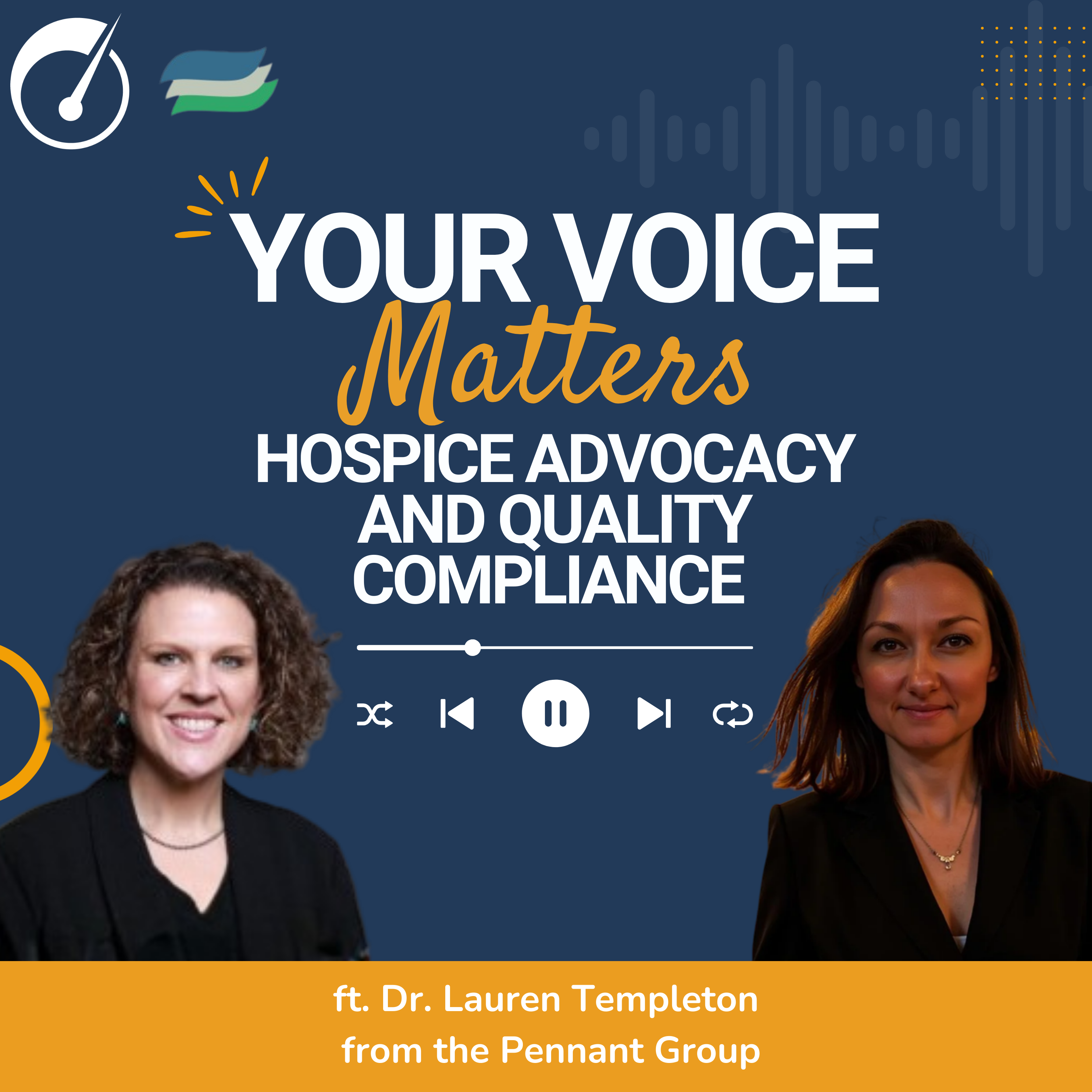
Hey, welcome to another episode of Home Health Revealed. I am Hannah Veale, your host and we have a very exciting show today where I get to sit down with Lauren Templeton. Lauren is a hospice physician, years of experience, who pivoted early in her career to focus on quality and compliance. She's a hospice physician with the Pennant Group as the medical director of education, compliance, quality and advocacy. She also works as a consultant with Weatherby Resources doing hospice audit, defense expert witness testimony and helping hospices respond to Department of Justice and OIG audits. She joined the NHPCO regulatory committee about six or seven years ago and continued through its transition, the alliance, focusing on advocacy around hospice regulations. She met with Medicare administrative contractors, medical directors and MedPAC to help inform Congress about the day to day hospice provider needs. She also speaks annually, so you may have seen her at the alliance and NHPCO conferences and does regional conferences on quality compliance and documentation. I can't wait to dive in.
[00:01:29] Speaker B: Thanks. Boy, that sounds like kind of a boring career.
[00:01:34] Speaker C: I think it sounds great. You've done some amazing work.
[00:01:38] Speaker B: Thank you.
[00:01:41] Speaker C: I want to jump right in and talk about some different avenues, some different advocacy topics and really kind of get to the heart of what you do day in and day out. I think one of the questions that tends to come up, especially within agencies is is does my voice really matter in advocacy and how do I make it count? Through writing to Congress, through rulemaking, commentary and advocacy groups.
[00:02:08] Speaker B: Yeah, I think that's a great question to ask because one of the things that when we get in the trenches of seeing patients documentation and these rules are coming out that are making us change, it's easy for us to feel lost, defeated, like we don't matter, that these things don't make sense for the way our community operates. Maybe that works over here, but it doesn't work over there.
And I think answering that question with yes, your voice matters so much. And advocacy is something that everyone needs to hear, especially the people who are working at the bedside and are seeing the day to day lives of the human beings that we're serving.
So I'd really put that into three buckets. Your community advocacy, your state advocacy, and then your federal or national advocacy.
And really coming back to the origin of hospice, we're a Volunteer grassroots effort in our infancy. And I think that's something important to remember. So if anyone thinks like, well, Congress doesn't care what I have to say, you know, I tell you that you're wrong. They do care what you have to say. But maybe it's a little intimidating to go that far in your community.
Volunteer with the Alzheimer's association and talk to people about what hospice and home health are. Talk to your hospital, get involved with local long term care facilities and how you can volunteer and support and speak up for the options that human beings have for care at home or post acute care.
My particular love is hospice care, but I think as hospice agents we see a lot of the way hospital systems work, the way skilled nursing and rehabilitation works, and we have a lot to say about the scariest part for people, which is end of life. And so that community advocacy can change lives. You can change so many lives in your community by speaking up. And so maybe that's a little less intimidating. So I would encourage people that, that advocacy matters too.
You talking to your local long term care facility, to the Alzheimer's association, it matters.
Then if you want to have something more along the lines of a state input, I'd encourage you to look out, look at your state associations. They would love to hear from you, maybe just your opinion, maybe they want you to serve on committees, maybe there are conferences, maybe you can even go to your state capitol with them. They're always looking for real stories about the human beings that we care for.
And so your voice can be the voice that makes a difference to that state legislator that they're meeting with.
And then for me, a bucket list opportunity that I haven't had is to actually go to D.C. and meet with congressmen or senators.
And so I'm looking forward to doing that in the next couple of years, hopefully with the alliance for Care at Home.
But those types of organizations and there are other national organizations like the American Academy of Hospice and Palliative Medicine, you can get involved in these groups and either again, tell them stories about what you've seen in your community that they may not know you may be the missing key to their argument. When they meet with Medicare, administrative contractors or other groups.
Maybe again, you're going to go to D.C. you're going to meet me there and that's amazing and you have the opportunity to speak up.
So if you're feeling defeated in what's going on, I think this is so important that you remember that your voice matters and that you have an opportunity to speak out because you know hospice, when you work in hospice, you know home health, when you work in home health. And those opinions, the voices of the people that we care for, they matter.
So don't feel like you're not important. Your voice really can make a difference.
[00:06:01] Speaker C: Oh, that's so good. I think a lot of people don't give themselves the credit for being the connection between the rule and the reality.
[00:06:11] Speaker B: Yeah, absolutely. And so for hospice and for other entity entities in healthcare, they have what's called a proposed rule for hospice that's in the spring. And then we have a final rule that comes out late summer, early fall. When they propose that rule, you have an option to comment on that rule. And so they're required to review those comments and the way it is now and if it continues to be the same way.
And sometimes they may make this proposition that they think is so great for quality and actually it's a barrier to the care that our patients need. And so they need to hear from you to say, hey, you, you are well meaning, but this is actually what that's going to look like when I take care of John Smith in hospice care. And you're not going to make John Smith's hospice experience worse because this prevents us from doing xyz.
And so you know that commentary and rulemaking is just such an opportunity and like you said, just that key piece that they may have this, this rule that they think is great, but it totally misses the mark when we implement it on a local level.
[00:07:16] Speaker C: Such a great point. When these proposed and then final rules are created, that's what creates the compliance requirements.
What educational opportunities exist for hospices in quality and compliance that help teams operate better on the day to day.
[00:07:34] Speaker B: Yeah, I think for me, the way I operate, if I want to be successful in something, I need to know the why. I need to know the foundation of it. I am not a person that you just say you have to go do this and expect me to be successful if I don't know the rules around it, the why, the background, how to make it better.
I'm just a little bit OCD in that regard. But what I found in my passion for educating about quality and compliance is that there are a lot of people that way. And so when you try to influence change by telling someone to just do something different without telling them why it's meaningful and why it matters. Why does it matter that we report on an infection? Well, it matters because then we can track to see if there are certain things that are in common, certain things that we can prevent certain things that we need to do better to protect our beneficiaries.
If you don't educate the why behind that, it's just another note that we put in documentation about an infection. And just another note isn't something that's going to help people, you know, really, truly have ownership and accountability in watching out for infection control.
So when you do the education about why things matter, why is this rule in place? What's the black and white of the rule and what are the different areas of opportunity to achieve best practice or where we need to do it slightly, slightly differently and still achieves the rule, but allows us to be successful in our particular community.
Because there are nuances to how you provide hospice care in rural areas, urban areas, in a hospital, in an assisted living facility, those types of things. And so the rules are really the bare minimum standard.
So when you let people be armed with knowledge and a solid foundation and the bare minimum standard, then we let them excel based off of what they need to do with their skill set, operate at the maximum of their licensure to do the best possible care that they can.
When you just expect people to do things because you tell them that's what you need to do, I think you can expect failure.
So for me, I love to do quality and compliance. It's not boring for me. I love it.
What I love about it is making it not boring for other people.
Maybe make it make sense, help them connect the dots or have those light bulb moments to be like, oh, that's why I have to see this patient in this time frame. Oh, that's why I have to coordinate with the hospice physician about this. This is how I am a small piece in a huge picture. And so I need to understand exactly what the parameters are to how I operate into making that big picture a success.
So quality and compliance to me is just a foundation. And you need a solid foundation to build an amazing home.
And so we want our operators in hospice, whether it be leads in administration and finance, whether it be nursing, spiritual support, our aides, they to each scope of licensure, probably a little bit different. They need to be invested in education about what that solid foundation looks like for them.
[00:10:47] Speaker C: Are there opportunities that either you provide or maybe Wetherby provides that give some avenues for this type of training?
[00:10:56] Speaker B: Yeah, absolutely. So when I, I did a hospice and palliative medicine fellowship and I started as a hospice medical director, and I remember sitting in the back row of a weather BE Resources boot camp. They do multiple boot camps a year they call it the A to Z to Hospice of Hospice. And I realized I actually didn't know what I was doing as a physician.
I could take care of patients, I could do symptom management, I could have hard conversations, but I didn't have that foundation.
And so really sitting in the back row as an attendee with Weatherby Resources is what changed the trajectory of my career. To know, like, I can never be the best practicing at the top of my licensure if I don't know these components about hospice care.
And so from there, I practically begged them to let me work for them further on down the road just because I think they're incredible.
So, yeah, I'm a huge proponent of their education, whether it be boot camp, whether it be webinars or any virtual or in person opportunities.
I just think that they really do an amazing job. We do an amazing job. Because I speak with them now, I have the honor of having joined that company.
And they really do the best that they can to present the perspective of what's the rule here, what's the best practice? And then what's the risk to when you have to operate outside of those choices? Because sometimes we need to know what our risks are for not operating within quality and compliance. And sometimes that's an influential factor that we know. Like, hey, this threshold is where you go to jail.
Hey, this threshold is an allowable mistake because we're allowed to work with what's best for the patient here. And so they have lots, lots, lots of opportunities.
Of course, other education can come from your state associations. I'm in Texas and I am just a huge proponent of the Texas New Mexico Hospice and Palliative Care Organization. They do an incredible job. There are lots of other state associations that do incredible education. And then the alliance for Care at Home is constantly doing education.
Reach out to your hospice also, you might have some superstars within your own organization that have a skill set to teach and they just don't know that you're seeking further information.
So don't hesitate to start with, you know, working with your local operators also.
[00:13:27] Speaker C: Yeah, that's a great.
We may have people right in our own backyard that can teach us some things. And I love how you explain experienced weather be and then you have come to be such an integral part of what they're doing. I think that's an amazing story. As a hospice physician, what does an appropriately engaged hospice physician look like? And how can they help teams navigate quality compliance and deliver high quality care?
[00:13:53] Speaker B: Yeah, this is probably the thing I'M the most passionate about when it comes to education is the engaged hospice physician. Actually, my team teases me. They tracker running tally as to how many times I say an engaged hospice physician when I'm speaking.
We need more physician engagement. We just do. It's. We're an integral part as a core member of the interdisciplinary group. And so what I mean by an engaged hospice physician looks different for every hospice. If Your hospice has 20 patients, if your hospice is operating with the census of thousands, each physician may have a different role.
But at its baseline, I think the number one thing that an engaged hospice physician does is you're actually the number one compliance officer. You're the one who determines eligibility. Not a nurse, not an administrator, not a financial department.
While they all have valuable input in how we work as a hospice team, we really need physicians to step up to the plate to say, with my medical expert expertise, with my training, I really think that this patient's prognosis is less than six months. And then if you admit a patient and four months down the road, you feel that that prognosis has changed the physician's voice. There again is the number one compliance officer saying, the prognosis is now greater than six months. We should proceed with discharge. And so I think when you have an engaged physician that keeps that foundation solid of the house of hospice, that you have eligible patients, you really have changed the game of how your hospice operates. Because then when we talk about things like documentation, you need to be able to have documentation that supports a terminally ill status for your patients. For when you're audited, it's not really if you're audited anymore, but when you're audited, if you have eligible patients, it's a lot easier to document eligibility.
It's pretty tricky to teach anyone to document towards eligibility when a patient isn't eligible.
And so I think physicians who are really in it with their teams.
And so what I mean by in it is making that decision, but also saying things like, hey, I see that we don't have an accurate weight on this patient. Let's get a new weight. Oh, I see that there's some discrepancy about a fast score here on our hospice patient. Let's talk about what the real fast score is. So we know how to prognosticate for Alzheimer's disease patient.
But that will require physicians who have educated themselves on the fast score, physicians who are bought into what does a comprehensive assessment look like for each patient. When we should be getting weights and things like that.
And So I think that's the second opportunity for the engaged hospice physician. In that role. You're really engaging in the interdisciplinary group.
So your voice matters as a physician.
Leading in documentation, leading in symptom management.
That's all you being engaged physician and driving the interdisciplinary group. And I don't just mean the meeting.
I mean really being a member of the interdisciplinary group, responding in a timely manner, and being invested. When your hospice has an audit, that's another opportunity for an engaged physician, then the final thing I would say about an engaged physician is being receptive to feedback.
So I think that part of being a leader, which is what we would expect from engaged physicians, is being able to receive when you're not performing at your best.
And of course, we want to celebrate when you are performing at your best. But being able to really take a step back and say, hey, we have this audit. We have these not so good results. How can we all improve?
And being all in on that type of improvement is imperative for hospice physician leaders.
And that includes taking some of that tricky feedback and making sure that we can look internally at ourselves and where we need to do better.
[00:17:43] Speaker C: If one of the listeners wants to get some additional information from Weatherby or reach out to you, where can they find you?
[00:17:50] Speaker B: Awesome. Great question. So Wetherby resource is the website, and you're welcome to email infoetherbeeresources.com for any, any type of support about the things that I've talked about. We do a lot of webinars and. And boot camps, but we also do specialized support for hospices. Let's say you do get into one of those bigger audits that you referenced in the beginning, like the DOJ or the oig.
You can reach out to us and we can tell you about how we might be helpful or not helpful to utilize us in helping you respond. We really care about providers, so feel free to reach out and we can direct you with what we think services are available for you that may be with us or maybe somewhere else.
[00:18:32] Speaker C: Thank you for sharing that.
I'm just curious, when you were meeting with your Mac directors to help inform some of Congress's decisions, what was that like for you? Where was the meeting? What did it feel like?
[00:18:46] Speaker B: Oh, wow. Okay. So that was one of those career moments that I was like, I can't believe I get to do this right now.
It was a zoom call.
We were just so fortunate to have the opportunity, opportunity to speak up about some trends in auditing. They were very receptive to our information.
They wanted to know what our opinion was medically, there was a group of physicians that was on the call.
They wanted to know, you know, our perceptions. And again, it was just another example of what we started this podcast with, is that your voice matters. And it was connecting some of the dots there for them to say, actually, no, you're. You're misinterpreting when you look at it from this perspective. And this is what's actually happening with us.
And so it just. It felt meaningful. I. It definitely was one of the highlights of my career to be able to say, hey, I'm in this day in and day out with hospice patients and. And this conclusion, I don't believe is the correct conclusion. Please listen to us in this perspective. And they were amazing.
[00:19:50] Speaker C: That's really hopeful to hear. I think people need to know that their voice does matter. And thank you for being willing to take the time personally and, you know, to represent Weatherby, I'm sure, in that role, because it's just so important that we continue to get this message across.
And to anyone who is listening, I would definitely take Lauren's encouragement to get involved locally, to get involved at your state association.
And then I hope, Lauren to get to hear about a trip to Washington, D.C. where you're able to share some of these things. I'm rooting for you.
That would be awesome.
Yes. Well, thank you so much for sharing your expertise today. I really appreciate you being here.
[00:20:32] Speaker B: Yeah, thanks for having me.