Episode Transcript
[00:00:02] Speaker A: You're listening to Home Health Revealed, where the business of home health comes to life. Hosted by Hannah Vail, each episode brings real conversations with the leaders, innovators and experts shaping the future of the industry. From reimbursement and technology to leadership and growth, this is Home Health Revealed.
[00:00:17] Speaker B: All right, let's go.
[00:00:18] Speaker C: This is sort of a part two because we just did a recording really recently on palliative care and how that's going to be impacted hopefully by the proposed rule.
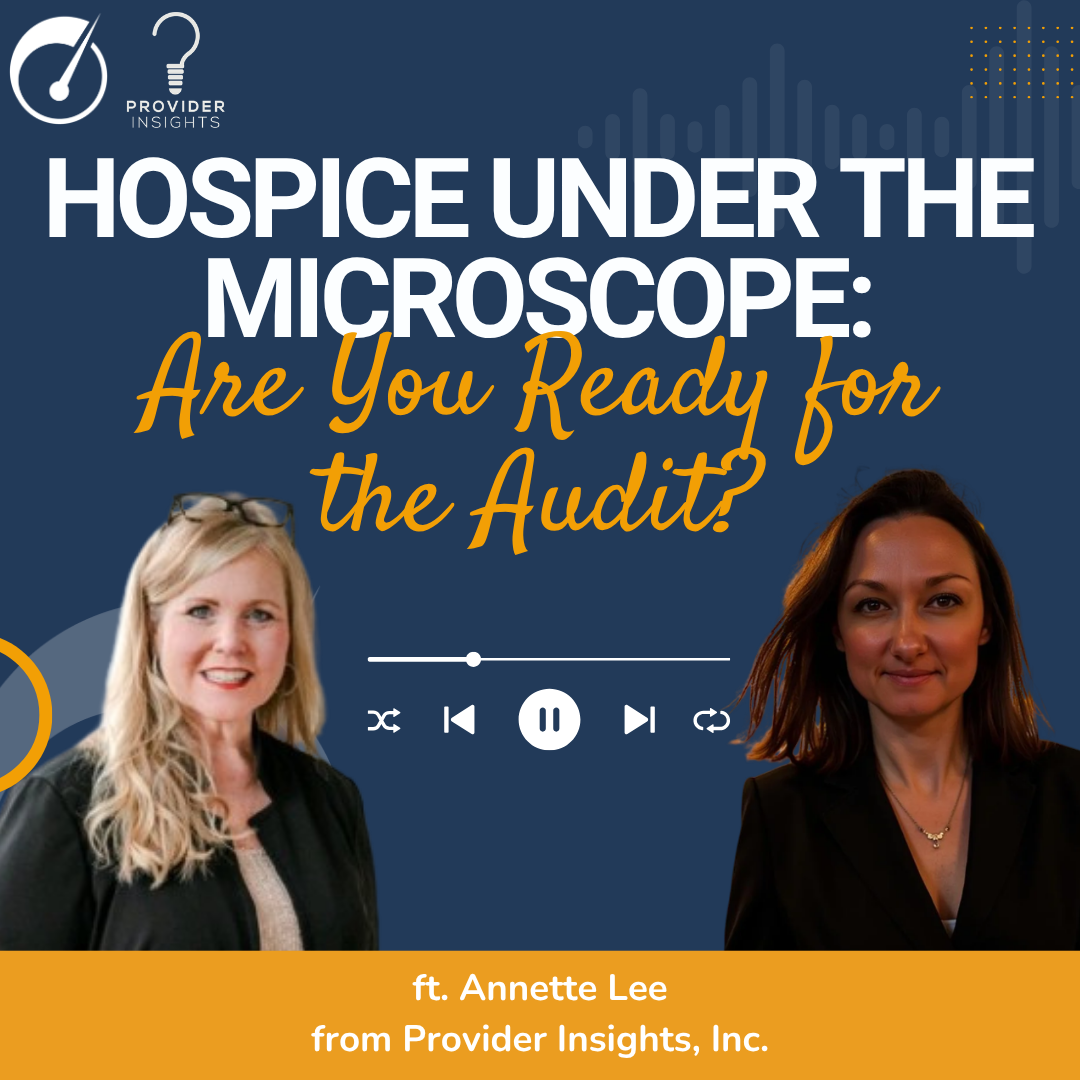
And now we're to talk about hospice. Focus a little bit on hospice, put the spotlight there and kind of what we're seeing. So again, I have with me Annette Lee of Provider Insights. So glad you're back.
Welcome, welcome.
And I want to just kind of jump right in. I feel like the audience knows who you are and if not, if this is your first podcast, pause, go back to the one previous, take a listen, get to know Annette a little bit. The think about some palliative, palliative care and kind of that middle child syndrome that it's going through of like, am I hospice? Am I home health? How can I be my own person in this world?
So with that, we'll jump in.
Hospices right now are facing audits from multiple fronts.
Annette, what trends are you seeing and why is audit readiness no longer something agencies can treat as an occasional project?
Right.
[00:01:31] Speaker B: It used to be so occasional and almost non existent for years. So I just. A quick sidebar. First of all, I had to laugh when you're talking about the middle child of palliative care. I was cracking up. And all I can think of, for those that are old enough to remember it is the Brady Bunch and Jan saying, oh, my nose.
No, that was Marcia, wasn't it?
The whole middle thing with Jan. And yeah, it's she and middle child of palliative care really is going through an identity crisis. And I feel like hospice has tried to fill that gap because there, there isn't a true, like chronic palliative care benefit that really takes care of people's needs.
So because I think partly of us filling that gap, CMS has turned that spotlight completely to hospice. I feel now it used to be home health. You know, I've done home health and hospice for 35 years and for, you know, the first, I don't know, 20 some of it, it was always about home health and home health having compliance issues and questions and documentation issues.
And when I worked for the Mac, in fact, CMS came to us and they wanted data. We were to look at medical review for home health, hospice and snf.
And at the time we weren't reviewing any hospice at all. And CMS was like, tell us about what's going in hospice. And we're like, we don't review hospice. And they're like, this part of your contract. And we basically said, they take care of dying people. We don't have a concern there. And they said, but it's growing. And this was circa like 2000.
And they said it's growing and we need to start looking at it at least. And wow, What a whirlwind 26 years later to go from no looking at hospice to I feel like most of the looking is at hospice right now.
And so yeah, Hannah, you're right, you can'. To be thinking that an audit is just, you know, someone else's issue. It's not a matter of if I have an audit, it's when. For a hospice, you have to know that this is a multi tiered approach.
CMS is telling the maps to look at hospice.
CMS has multiple post pay contractors looking at hospice. So the hospice has been paid. It's water under the bridge. We think it's all taken care of, everything's good. And then we get letters, requests, testing multiple charts for people from two years ago sometimes.
And so that is an operational nightmare because, you know, sometimes we've changed EMRs or you know, obviously our staff has changed. And so it's hard to ensure we have everything we need from that standpoint. And so I think this is the time again, especially as everyone has kind of known to say, let's press pause a little bit. This is the time to really refine processes, be proactive, look at what we're doing, just make sure that we don't have to be just reactive in a situation like that, but to really take that time and put things in place so we can be more proactive and be ready. Because to your original question, sorry for the long way there, but good. Yeah, we can't, we can't wait any longer because it's a matter of knowing we are all going to be looked at. And so it isn't just if I stand out or if I have something, an outlier in data. Every one of us in hospice will have someone looking at us. So it's perfect time to talk about what can we do about this. I love this. So thank you. Thanks again for the topic.
[00:05:25] Speaker C: I think I have a question about how agencies are organizing that because to me, gone are the days where you can have a compliance person who's responsible.
We've moved into compliance and audit readiness. Having to be an across the organization kind of function from, you know, referral all the way through to that claim, being paid and looking at those kinds of measures as well.
So how do you see agencies who are successful setting those operations up?
[00:05:59] Speaker B: Yeah, I love that you said it's not just a person. Now there can be a point person, that the buck stops there and they're looking at things. But you're right, it has to be what I call a culture of compliance. That there is the first of all, the knowledge and empowerment of what are the rules and the why behind them and getting people on board. And you're right, it is from, you know, referral. It's from even before referral. It's in talking to our partners in the community before referrals. It's the sales team, it's the intake and on up through the care. Absolutely. I love that. That's the perfect way to say it. In idg, we revisit it. Instead of just thinking solely clinically about the patient, which is important, I think it's important to look at compliance even during idg and take that opportunity for a little additional training and support and just again, have the whole team be thinking about this.
Yesterday I was on a call with multiple hospices and we were talking about their SSVI scores, that service spending and, oh, gosh, variation index.
But it is, you know, looking especially at, like, outside spending, what the hospice isn't covering. And that can be a trigger for an audit.
They've said this isn't a quality measure, but it is a risk measure. And so CMS has made it pretty clear like that is the sort of data that we're looking at to determine if we should look at you as a hospice. And so this, this group of agencies were higher than what they wanted to be. And so we talked about how to try to leverage the whole team. And it was fun because everybody started to really get involved. And then it wasn't just someone coming and saying, we need to do something different, but it was brainstorming as a team, like from the sales team, like, oh, well, then we shouldn't be saying, yeah, the patient can still do outpatient therapy. Exactly.
We should be taking care of any therapy needs because those therapy needs should be basics like ensuring that we have safe transfers, the right equipment, things that are. That make sense for a patient who has six months left to live, not getting them up and, you know, running down the block. That isn't necessarily the goal for Most hospice patients. And so, you know, so it started there with the sales team really starting to catch on. And then the nurses were catching on. We were talking about how, you know, if we were more comfortable as clinicians talking with the patient about things like de prescribing and, you know, so again, trying to rid that poor patient of all the medication burden of meds that aren't even working anymore, you know. And so little by little, we just kept chipping away at this. And so that's the sort of kind of mentality when we talk about compliance, that if we could ensure that the whole team sees that everybody has a piece of this, everybody has direct impact in it, that that's a key and that will be sustainable versus one person trying to come in and strong arm right into compliance. Because that will never work. It has to be done on the ground level, on up, because otherwise, you know, you, you can't force compliance after the fact. It just doesn't work.
[00:09:26] Speaker C: No. And, and you're reworking. Right. You're costing yourself additional. It may not come out on a P and L as a line item, but the cost of rework is a real cost because of the time that it's taking.
So I love that you're having everybody brainstorm together because that really does bring everybody into a, a unified solution oriented conversation as opposed to a finger pointing conversation for who dropped the ball where.
[00:09:52] Speaker B: And most of these things are so multilayered that it can't just be one person that I pointing too. It just. That just would never really be true or accurate. And it's definitely not going to work. That's right.
[00:10:05] Speaker C: No.
So next question. When a hospice receives a denial or an audit finding, what are the most common operational breakdowns behind it?
[00:10:17] Speaker B: Well, let's start with the top denial reasons.
So if we think about Those historically, for 30 years, the top denial has always been that it didn't look like the patient was really dying in six months.
Yeah. So that's a hard one to break down because again, it goes from, again, are we bringing patients on too early? Was this the exact right time, but the patient just surprised us. And then, you know, those. That's hard. We don't have a crystal ball.
Was it that the patient didn't truly have the decline or was it that I didn't capture the decline? And that is a question only your team at the hospice can answer. You know, I know when I worked in medical review that the verb around that denial was saying that the documentation didn't support the six month Prognosis. So when I work with hospices, a lot of times, leadership, without having maybe sometimes the insight, they're just pointing at the nurses saying, well, they're not documenting it. And I'm like, well, is it really the documentation? Let's. And sometimes it absolutely is. But I think we have to peel that back and not just, again, like you say, finger point, but ask the hard questions like, well, hey, how are we getting all of our patients from these same three ALFs knowing that ALS have the longest length of stay?
And they don't seem to be that acute when I get them either. I mean, I'm thinking from the grassroots of sales. Like, we need to be more diversified. We need to think outside the box here from sales and have knowledge and empowerment about what sort of triggers would bring a patient to hospice. Not just maybe, maybe an ALF request, like, hey, this person's having more behaviors. Can you help me?
So, yes, we have to look at what is the root cause of that sort of denial. Is it the actual patient is. The documentation is a combination of both. And the other denials are all those technical nuances. And so, again, there needs to be something really concrete on the front end that every admission is being looked at, that there are eyes on every admission, ensuring technicals are met. From the election to now, of course, beginning October 1st, every single admission is going to have to have that election addendum that explains what we aren't covering because it's not related to the terminal prognosis, and that is a condition of payment. So we'll have to ensure that's tidy. So as especially here, you know, come October, which I hope everyone's practicing now. Right. Give yourself a good month, Runway, at least if you haven't yet. That's right. So. And the logistics of just, you know, how are you going to provide it? Most of our EMRs do a great job of pulling the information forward and putting in a form, and that's all good. But the logistics of being able to show, yeah, I provided it within that five days for every admission is a. A big deal.
So. And I can't necessarily do that at the exact same time as the election because I might not even have the complete and thorough med list yet.
So, yeah, there's definitely barriers
[00:13:36] Speaker C: and then communicating some of that with the patient.
It's paperwork, but we forget sometimes that, yes, we have to have a signature on that dotted line, but also having patients understand what's happening, what they're signing, there's so much uncertainty, really only get to do death once in this life. And so how do we make that process with all of the operational stuff that we have to have in place, but how do we humanize it? How do we communicate, talk to them about those meds, the things they're signing, those kinds of things?
[00:14:11] Speaker B: That's right. That's right. And sometimes I think, ensuring that our teams feel really comfortable and are knowledgeable.
A few of the folks that we were working on this SSVI yesterday, we were talking about deprescribing, and then we did talk about the form and having to provide it to everyone in October.
They were saying, I'm not comfortable as a nurse. They were saying, I'm not comfortable saying, we need to get you off these meds because I don't know enough. So we were like, hey, let's get, you know, let's get education on the calendar. We're going to do a little webinar next week on that and make sure that you're really collaborating with your pharmacies, because the pharmacists know this stuff. And so to feel like they have really good, valid information that they can be helpful, of course, as a clinician, that's always their desire to be helpful. So if they can feel like, yeah, I'm being helpful to this patient and family moving forward, that's a key when you're talking about humanizing this. That's, you know, help them make those decisions that will reduce some of that burden. And it's a good win, of course, for not just, you know, it's a win all the way around for Medicare to have less meds if they're not working well at this point, what's the point? And for the patient and for us. And so, yeah, I think that this change in the reg will be a good catalyst for hopefully really lifting up everyone's consciousness about what are we doing here at the end stages of life. And like you say, you only have one shot at this. Let's get it right. Let's be really knowledgeable.
Let's have the right approach around it. So the form, that's, you know, that's government regulatory paperwork. But you're right. I hope it brings a process in place. When your question started out about what processes should we have in place for these things, that's going to be a big one. And then all of the other technical denials seem to sort of thing as far as ensuring that we're getting that verbal cti, you know, timely. So looking at our process on the front end about does the nurse call or Communicate with the physician at the time of admission, document the cti, but also then good time to collaborate about meds and about terminal prognosis. And is this patient really right yet for hospice? And so hopefully, hopefully again, that's a, a great, you know, one and done to check multiple things off of our list and really try to get those things right on the front end. So it is going to take a, a tiered approach for sure that again, we want to look at those processes and make sure we haven't gotten complacent about those things. There needs to be that collaboration at the front end and making sure that I get it right then. But then of course the eyes to double check that yes, these things happen. There's some great tools out there. And eventually as these tools continue to improve, different AI programs continue to improve.
Some of those things can really assist us in, you know, being able to do some of that, you know, technical lift that we need. But then there's still going to be the need for that critical judgment and really ensuring that we're getting that right again. So the patient is right and the documentation is right. That's the key.
[00:17:46] Speaker C: Do you think that the public awareness, I know it's changed. I even think President Carter's experience in hospice brought a very public eye to hospice, to the length of stay specifically because, you know, he did live longer than anticipated. And like I said, we don't have a crystal ball so we're just documenting as much as we can. But I think that was a great example of hospice being utilized not just in those last few hours, very few single digit days of life, which is what in my mind growing up, you know, going to church and if I heard that somebody brought in hospice, it was like, oh no, like, you better go say your goodbyes tonight because.
[00:18:32] Speaker B: Right, yes, that's right.
[00:18:34] Speaker C: Yes. So I think we've definitely changed some of that for sure. And I think with increased technology we have some more data and ability to say, you know, to do some predictive types of analytics, but there are so many variables. And so when you're talking about medications and what they're doing and how that's impacting, how that's impacting life, either, you know, things they shouldn't be on any longer, they're not giving a benefit or they're, they're conflicting. And nobody's ever taken the time to really do a good hard audit of what all medications you're on. You come in and you're on 17 different medications and nobody's considered how Those might be interacting or thought about, hey, maybe already before we even got to this point, we should have taken a good hard look at all of that.
But it's definitely going to impact quality of life and finishing life.
[00:19:29] Speaker B: Well, that's right. Oh, I love that. I love that. Hannah. Yes. I think everyone needs, everyone needs a hype girl like you talking that message. Because it's true, right? I mean, it could be such a positive impact if we took a step back.
And so again, I, I so thank you for this conversation because it's just something again, even to bring to the front of my mind in talking to agencies about deprescribing and ssvi. But, and the form, you know, this is all, it's like the perfect storm of why aren't we talking about the necessity of these things?
That we really should be really focused on the patient and doesn't make sense clinically and you know, again, really giving them the right information. And it's, it's just, I know it might feel like bad timing for the hospice. They might, this might be the first time they've ever heard any of this. So then it seems like, well, is there a motivation that it is just financial in the hospice's standpoint and while that, you know, many of these meds aren't covered by the hospice anyway, and yet it impacts that outside spending measure.
It shouldn't have been a conversation just now happening, but unfortunately that is our health care system at work. Every time you go to the doctor when you're elderly especially, and you have a new problem, they just give you one more med. And, and part of it is our problem as a, as a, you know, society, we're looking for one more med. And so next thing you know, they have 40 meds. Right. And they can't work together. They can't.
Yeah.
[00:21:07] Speaker C: Yes, for sure.
[00:21:08] Speaker B: Great point, great point.
[00:21:11] Speaker C: Now, as far as like let's say daily habits, controls, cross functional kinds of workflows within the hospice, what should your clinical teams, your intake teams, your billing, your leadership teams really build in to create that documentation flow that can stand up to an audit.
[00:21:34] Speaker B: Oh, I love it.
So first thing I would say is again, ensuring that look and see what your EMR has for protections in it, first of all, because then I know I have some reliance on these things, but everywhere else I need to build, right? But before I'm worried about checking and balancing the front end is just trying to get it right from the, from the get go. So again, you know, the education with the sales team, the education to the intake team. You know, our structure as organizations is so different everywhere. Sometimes the intake team is all clinical, sometimes it's all non clinician.
So still making sure, no matter who's doing that piece, that there is some clinical inputs and that even the non clinicians can really have a great understanding of the LCDs and what makes sense. And while I wouldn't decline referrals just because I don't have what I need to show that they check the box. Right. But I'm gonna ask more questions then and maybe the nurse needs to go out and evaluate and I get more information then. But somewhere along the way, I need to build in a process that I feel confident that I have enough information that it justifies the original admission itself. And gone are the days to say, well, bring them on, we got a referral. Bring them on. And then we'll see how it goes for the first three months. You know, gone are those days. Yes.
And then from there on, then we get into more technical to begin with. You know, again, regarding the verbal CTI and ensuring that there's again, checks and balances that we've got. This technical piece is right. If there's an attending on the election form, then we have to make sure that we have the Attendings. Okay. The certification from them as well on that initial certification. If they. Obviously in the past we've always said if they select did the election addendum, we have to make sure that's documented as provided. But now that's just part of our overall audit daily. Right. Is that I want to make sure we're doing this on each and every admission.
We move into, I think the best place for that ongoing oversight is the idg.
So again, taking the time to really look at, especially the longer lengths of stay that in idg, I am really looking at data points across time because again, I think we get into storytelling in idg, which is great, but you know, I really need some good data also.
So while this is a human story, the human story is also told in data points that I can see the trajectory here. And if the trajectory is fairly flat or if it's even just improved, then of course we need to know that, okay, this is not yet the time or place for this patient and what are we going to do to ensure the right timing when they return?
And so again, I'm really hopeful about our prior conversation, the palliative care in home health and hoping that there'll be that safety net that CMS is developing.
We need it so bad.
[00:24:58] Speaker C: We Do. And I think in this conversation, I'm thinking through some of the things that palliative can provide, because I think there's. There's a perception, true or not, that there's not enough definition around palliative. Well, I definitely think that's true. There's not enough definition around palliative, around what that provides frequency, and then you get to hospice. So it almost feels like palliative could be that step, but there's just so much gray right now. So thinking of the transition into hospice as no longer being a curative process, but we've really accepted that as a patient, we've done pretty much medically everything that we can do. And. And it's not a giving up. I don't mean it like that, but it's a peaceful idea or should be, that we can do the rest of this life.
Let's max it out, right? Let's make in six months or however long it is, and do the best with what we have left.
And as hospice leaders, there are so many things vying for our attention.
The paperwork, the new stuff coming down the pipe.
[00:26:15] Speaker B: Always, every day, conversations every day.
And just in the headlines.
[00:26:20] Speaker C: Always having to have your armor on, your defense up, ready at any time to defend that this patient needs the care that you're providing, the care appropriately, that your plan of care is in place.
And then when you're maintaining all of that audit readiness, where do they even begin? What metrics on the daily. If I'm using dashboards, what routine reviews and metrics should they be looking at every day, every week? Whatever the cadence is, I love it.
[00:26:56] Speaker B: So again, you should have dashboards for those technical things to see if there's any outstanding, because obviously we have hard black and white deadlines on some of those things, so those things are easy. The rest, I would say, look at SSVI that they've identified as a risk measure that they're using. Look at the hci, look at your pepper. So all of that claims data, how it intersects in the final rule for 27. CMS said it's not any one data point, which is not quite clear because. Because they also suspended about a thousand agencies for one data point. But.
And that was, of course, your live discharge rate. But look at how that intersects. Look at how. How does your length of stay intersect with your live discharge rate? Where are you on the pepper as far as above the 80th percentile in any one of these things? And do you have multiple things that seem to make sense? Like, oh, yeah, if I have A long, long length of stay. If I'm longer than the average bear here, then that would make sense that I'm going to probably have more live discharges as well, because I have patients who, you know, now have exceeded, you know, they don't appear terminal anymore. So I discharge them or they've been on a long time and now they've revoked because, you know, they wanted to try a different avenue of care or, you know, there's a multi. Multitude of things that these things end up intersecting. And so those would be my metrics is the metrics that CMS has already been providing us would be the things that I have on my dashboard. So, like the utilization measures within the ssvi, you know, looking at how often nurses are visiting, how many minutes on average per day of hospice are nurses interacting with your patients? So again, not saying that they have to see your patient daily, but I'm saying that that's one of the measures that CMS does is they look at, well, how many routine days did you bill and how many nursing visits did you bill in the same amount of time divided out. So, you know, you should be at a rate that is not in that bottom 20%. That's what makes this meaningful. Because if I don't know where I stand according to the rest of the nation or the rest of my state or jurisdiction, then I don't know, is that enough minutes? Don't know. But if I see that I'm in that bottom 20% for those things that lower is worse or top 20% where those things that are higher or worse, then that's, that's the tripping point. That's the concern. But of course, I'm always aiming to be the best at this. You know, I want to do better care. And so, you know, I, I probably will be setting my own goals, not just to skirt under that, you know, under the radar, but to say, what would we think is appropriate for our patients? And again, getting the whole team in the conversation, why would this be important? What would that look like? You know, California put forth these emergency regulations for hospice because they found such dire needs out there with folks who are not doing the right things.
And, and I think eventually when this comes all the way around, it is putting them in a place where California could be a leader. If they embrace this, California hospices, they could be a leader and set new standards nationally because they do have now regulations that say you should have a 12 to 1 ratio for nurses and patients, you know, and that is not the standard or norm anymore. But if that became the, the norm and they can prove it can be again, that we can do this. Because it used to be years ago, but hasn't been in years now it's more like 15, 18.
So I think really looking at what are the metrics that CMS is using, use those on my dashboard. But not just to look at where my risk is. That's important. But to really say, where do I want to be? So this is the time to really aim towards that best agency that we want to be.
[00:31:10] Speaker C: Yeah. And California has kind of been put in the corner.
[00:31:13] Speaker B: Oh yeah.
[00:31:15] Speaker C: And we're watching.
But that's such a great point. They have the opportunity with the changes that are being implemented and the way that the data is being collected to really turn it around.
And I do think we've had a little bit of stain on the industry and I, I don't want that to become something from public perception. Especially people who are not in this industry but would still utilize a home health or hospice benefit.
Is everybody. But, you know, I don't want them to feel like, oh, I. That's so corrupt. Because that is truly not the case.
That this is not.
This is a problem.
But it is a very concentrated problem and we are doing everything we can. The last couple of even conferences I've been at, I feel like there is a unity that I have never felt before in this industry in a. In a very powerful way.
Everybody who's collectively coming together to put.
To talk about their own experiences, to talk about their data, to influence new policy, to respond to these proposed rules, proposed changes.
I think we're going to see a step in the right direction. And I do love that. You said California could lead that charge.
[00:32:44] Speaker B: Yes. Wouldn't that be a great story? That'd be an amazing narrative to go from what we feel has really brought us down as an industry to be the ones to turn it around. Because there are those superstars out there, there are those amazing providers out there, just like there are across the nation. And so I feel badly for them that they. I feel like everything is on their shoulders. Right. That they really have to rise up higher than anyone's had to in the past to really try to. And we as. I think that's that unified feeling that we have is we all want to not defend. Because I don't feel like we should have to defend it. We should be able to. We want to showcase. We want to shine a light in a positive manner on what is really happening in the real world daily in home health and hospice and I, I do love, you know, obviously I've shared with you that I had an amazing personal experience with it with my father recently. They did an amazing job and, and every opportunity I get when someone finds out that this is my world, you know, when I'm like on a plane on the way home from Seattle this week, I was talking to a gentleman and he said, oh, he says, I just went through with my mother in law and my father the hospice experience. I said, how was it? Tell me about it. And we just kicked back and chatted, you know, and he shed some tears, but it was all good. He was like, they were like, like amazing and angels and taught me so much. And I was like, I'm so glad to hear this. And I said, I'm going to be sharing your experience. I didn't know I was going to do it today, but, you know, I thought I'm going to try to continue to gather those stories as I can because it certainly lifts my spirits about what's happening. And I think we need that PR campaign as a nation, you know, as, as providers and everyone that supports those providers, I think we need to continue to shout it from the rooftops that good things are still happening. So I love that. And that's why we do what we do for sure.
[00:34:48] Speaker C: Aw. And that was probably so therapeutic for him to get to share that with somebody who understands it in a, in a different way. I think until you've walked through that journey, it is, it's not very relatable because there's so much to it.
Last question I wanted to ask, and I think this kind of segues right into it. But if you were talking to hospice leaders who felt discouraged right now with business, with future, what would you say to them?
[00:35:24] Speaker B: I think this might seem a little cliche, but it is true. At least it is for me that we have to go back to the why. Thinking about why did we start this in the first place? Why did I get into this, this in the first place and getting back to that and getting excited again, trying to. Being aware of what's happening around us, but trying to shut out some of that noise sometimes that if I can get back to the why and really think about what am I doing, how do I put these things in place to ensure that I'm giving the best care to my patients, but also, of course, being in tune to know these are those indicators that can cause a concern about me as an agency having dashboards and things in place. And again, if we can be proactive and know the rules, know what people are looking at, know what the concerns are and again, really be working that into our day to day operations, which again, most of the time really, really good patient care will support positive measures and positive compliance in those things that they are looking at.
So again, this all feeds the same positive purpose.
And if we can again get to that proactive role with a bigger, bigger line in sight, I think that again, they will definitely come through that feeling downtrodden with all the negative PR and all the push of all the additional regulations. But again, just continue to, to rise above whenever we can. It's about, it's about the patient and family, how you're making a difference every day.
[00:37:07] Speaker C: Yes. I love that. Thank you for that.
Thank you for this conversation. Is there anything I haven't asked you or that you would like to share about hospice, about audits?
[00:37:19] Speaker B: No, I love the opportunity. So thank you. I think again, just working it in your daily routine, identifying who are the right people to be working the process. And then there's of course, oversight. But again, if we can have it at grassroots, from everybody from sales to intake to the nursing team to qa, you know, all the way through it, doing those little pieces will take the pressure off. Like you say, it won't be just one person that's pointing fingers because that won't work. It's that proactive role of just making sure that we're, that culture of compliance all throughout every day.
[00:38:00] Speaker C: So, yes, and now you help agencies with these things. So if somebody's listening and they think, I, I need Annette in my life in a more in a daily way, where can they find you?
[00:38:15] Speaker B: Oh, thank you, Hannah. So you can find me on LinkedIn @Annette Lee, or you can find me, my website is providerinsights.com or my email is just Annette providerinsights.com any one of those three ways.
[00:38:32] Speaker C: Awesome. Well, thank you so much. I appreciate it. Annette.
[00:38:35] Speaker B: Well, thank you. It's great to see you as always.
[00:38:38] Speaker C: Yes, you too.