Episode Transcript
[00:00:03] Speaker A: Welcome to Home Health Revealed, the podcast for home health and hospice leaders who want to stay connected to the industry and ahead of what's next.
[00:00:10] Speaker B: Hi, Yvette.
[00:00:12] Speaker A: You're back. Hey. It's so good to talk with you today.
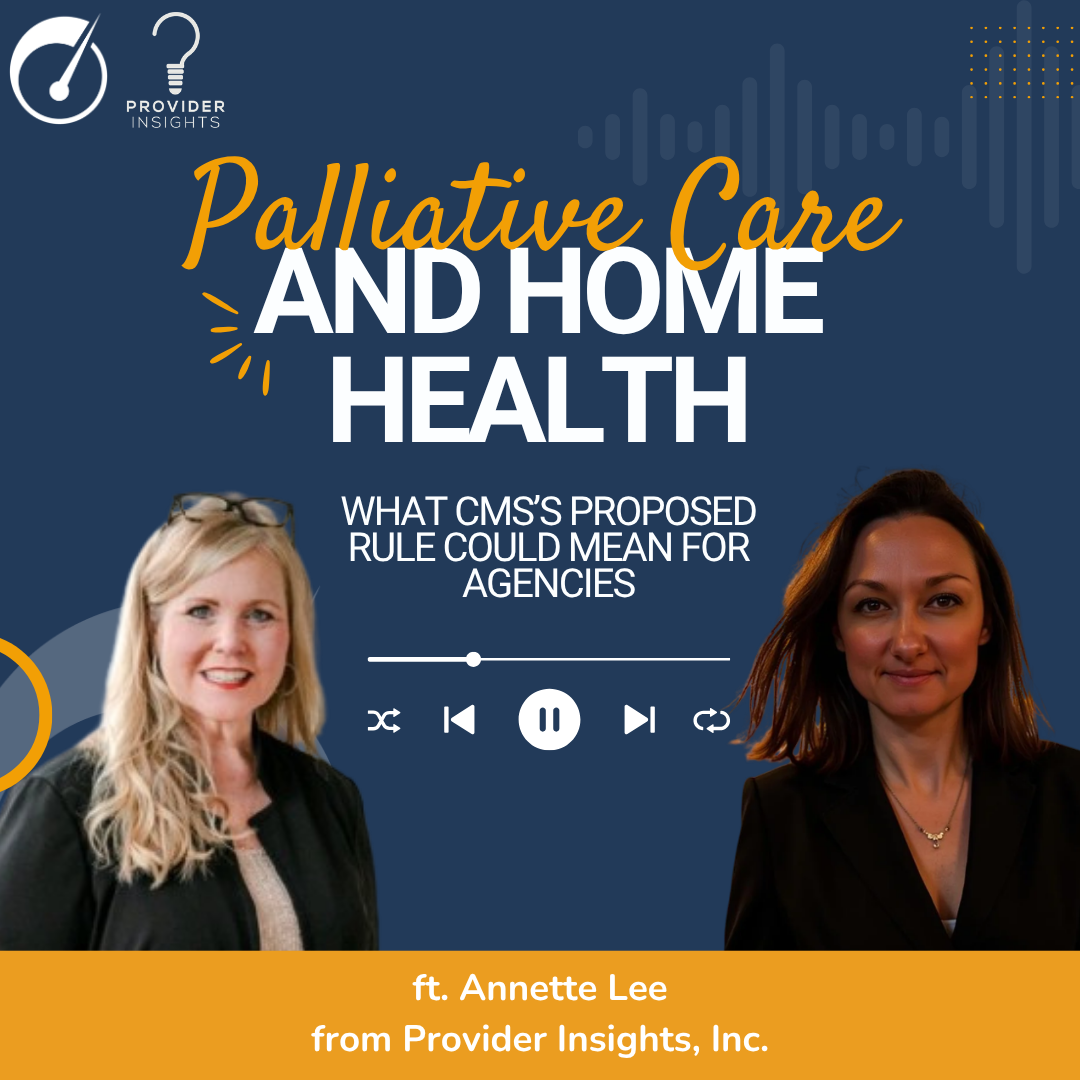
I know we're doing an episode of Home Health Revealed, but I wanted to get you on here. You've been on here before, so you're a repeat. I love a good repeat. And we've gotten to see each other in person, which is really so awesome. It's always good to see you and hear you. I got to hear a session that you did recently. I think that was in California. I don't even recall where I was, but yes, but today we're going to be talking a little bit about the proposed rule as it relates to palliative care. So have lots of questions, maybe more questions than answered, but we're going to talk about them.
Will you start? I know I laughed earlier because you called yourself an old medical review nurse, although you're not old at all. None of us are.
We're all aging so gracefully.
But go ahead and give us your intro. Tell us what you do, kind of your background for anybody who might not know.
[00:01:06] Speaker B: Oh, thank you, Hannah. It's always delightful to see you.
So my name's Annette Lee, and I've been in the home health and hospice industry for well over 30 years. I kind of hate to say hopefully I'm still weathering okay, but I love post acute continuum. And so, so about a decade of that, I worked for the Mac and I did medical review and appeals. And very quickly they were like, hey, you're not the best bad cop. You're not great at denying these things. Because I came from the provider world, I'm a clinician. And so they moved me to education, and that's really my passion. So now I help home health and hospice across the nation trying to be compliant and give the best quality care. So that's where my heart is. And so I'm very excited that CMS is dipping their toe into the water. Water to say, what can we do differently about palliative care? Because this has been such a nebulous thing. There's so many different ideas of what it is. And so I think starting with a definition would be fantastic. If I may.
So palliative care is just an approach to care. Right. It's not necessarily a palliative care benefit. We'll talk about that in a minute. But palliative care in general, anybody can provide care in a palliative manner oncologist. And you could say I want to approach this differently. I want palliative care, which means I'm not actively trying to conquer the disease, but I am trying to live my best life as comfortable as possible. It's about the quality versus the quantity.
It is about palliating symptoms and feeling like you are really trying to address the whole person. So I think again, whether I'm a health or a hospice or a physician or, you know, any setting can really provide care in a palliative manner. The problem is, is that historically CMS has had very little true palliative care benefit.
And so, you know, I think people wonder, well, what is it? And that creates all kinds of confusion.
So right right now, the only thing that they truly pay a palliative care benefit is physicians and other sub providers, PAs, NPs working with physicians, seeing that patient. And there is a code for palliative care for those providers, but it is not real well defined as far as can a home health or a hospice provide and bill it differently. Some insurance companies allow you to, but Medicare historically has not had that right.
[00:04:03] Speaker A: And it's definitely not standardized.
So from my perspective, billing wise, right. What we have seen, and you may have more to add to this, is people using the palliative care as a bridge for their continuum, maybe not even billing for it.
So it has been a loss leader, but it does provide that continuum of care, maybe even to bridge home health to hospice during what I'm just going to call in my own world, a maintenance period.
[00:04:34] Speaker B: Yes, yes. And I love when providers do think outside the box, but it's a shame that they many times do have to take a loss to do the right thing for patients. Right?
[00:04:45] Speaker A: Yeah.
[00:04:46] Speaker B: And so like you say, it does create a funnel for their hospice and that's good for business, but in the meanwhile, there's a lot of expenses that they incur to just do the right thing by the patient. And so of course they can bill for the physician, they can bill for the np, but they are many times supporting just out of their own pocket, maybe some support from just a nurse or an aide or a social worker. And so, you know, that's, that's problematic, that is not sustainable.
[00:05:16] Speaker A: Right.
So interestingly, proposed rule, right. There were some things in it. Let's talk a little bit about that. And that's where you and I connected because you had made some comments on LinkedIn, I was like, yes, this is what I'm thinking about.
Let's get together and talk about it. So I Want to hear all your thoughts on the proposed rule as it relates to palliative.
[00:05:35] Speaker B: So in the proposed rule, CMS basically projected that they feel this has always been part of the home health benefit. It wasn't a new benefit that they're proposing. Right. They were just like, hey, this should be done under home health. And I thought that sounds fantastic.
If there was clarity, if it was supported, if they train their max to ensure that there's not denials.
Because again, I am that old medical review nurse. So I know that if it appeared that I had the patient under assessment because of course there's four buckets that the home health benefit pays for for nursing and it's assessment and observation for teaching or a hands on skill or management and evaluation of the care plan.
So if it was under assessment, we certainly can admit a patient and provide care in a palliative manner when there's been changes in condition, changes in treatment, changes in meds. But chapter seven speaks to this and says you should have had some sort of change in the last three weeks. They'll pay for care for at least three weeks, but after that it's pretty questionable. And we're seeing a lot of denials for medical necessity. In fact, the number one denial for years now has been face to face when home health agencies get reviewed. Now it's changing and medical necessity of nursing, medical necessity of therapy is now rising to the top as one of the top denial reasons. And so I'm very concerned that we can't set people up to say, yes, you can provide this and then end up getting money taken back or end up, you know, with scrutiny and on an audit because you know, there's not that clarity. So I am pleased that CMS said, hey, we'll update chapter seven and we'll give more context and examples and clarity. So I'm looking forward to that. So I'm kind of reserving judgment until we see that
[00:07:44] Speaker A: because really we would be looking at services that provide more of that symptom management long term without a lot of changes.
Right. Or just even medication oversight.
[00:08:01] Speaker B: Absolutely. Just that support.
Right. Answering those questions, being that support the, the care plan might be working for them. So there might not be major changes, sometimes for months. That would be the beautiful thing if we just had the right care plan.
But right now, as the home health benefit is written in chapter seven, if this was under observation and assessment and teaching, there's an expectation that there are changes happening. So I would be concerned that we're going to get mixed signals from CMS One side says, oh, you should do palliative under home health. The other side says, we're going to deny because this patient doesn't look complex enough. There's not recent changes.
And again, if they cite chap 7, which is the conditions of payment, if they look at that, I'm concerned that that would put us in a predicament. Now, the other way they could go with this. And again, we'll just have to see what they update is. It could be under management and evaluation of the care plan, which historically we have all shied away from because it's very, again, it's a little bit ambiguous. It's difficult to document to.
It basically says it takes the skills of an RN, not even LVNs takes the skills of an RN and the physician has to document a little extra certification about the need for management evaluation to basically be like that conductor of an orchestra of a bunch of non skilled people. And we're not talking our aids, not the home health agency's aids, but like the neighbor, a spouse, a son or daughter, someone from church. So all these people come together and this patient's so complex that it takes the skills of an RN to direct them. That's hard to really find those cases.
[00:09:59] Speaker A: Yes. Now, do you see palliative being an entry point or do you see palliative more of a bridge from maybe a home health episode that becomes palliative?
[00:10:13] Speaker B: Oh, good question, Hannah. I think it could be either, but I think it's probably going to end up being someone who's already been in an episode. Because usually the thought process as we, you know, go through life and we have chronic progressive diseases, as almost every American over the age of 65 does, we end up in crises, right? So we end up in the hospital and some things are happening. And it is usually when people are sick and tired of being sick and tired that they're like, I don't want to do this anymore. I don't want to go back to the hospital anymore. And so home health, we know, can be a vital part of keeping people at home. But if we were allowed to do that from this palliative care model, it would be even more beneficial. So I could see after a crisis, they come to me from the hospital, I get them stabilized, the plan of care is working, and they say, hannah, I don't want to do this again.
Right? And you're like, okay, okay, let's talk to your doctor and let's, you know, and we can move to. Have you heard of palliative care? And so I think that that's how it will go for many people. I'm very hopeful about that because again, so much better for the patient and family and that unit. So much better for business for me as a home health agency because I can maintain and keep the patient, you know. And I also am hopeful that CMS will think patient is under palliative. There needs to be a way to denote that from the quality side.
So that way there's not an expectation of improvement and they're not weighing down my five star because that would be a big deal. And some, I think agencies would shy away from patients that are palliative care. Then right now if the patient elects hospice upon discharge, I would as a home health agency I would be given grace that that patient would be exempt, their outcomes would be exempt from my five star and from value based purchasing because of the election of hospice. So that's kind of what I would hope for, for CMS to do for palliative care benefit as well.
[00:12:37] Speaker A: Or we weight the patient experience.
I'll tell you, I've been thinking a lot about this from the perspective of the patient and as you know, I'm not clinical. So I definitely think about it more from a relationship standpoint. And so I'm just going to tell you, if I had like big picture thinking, I would love to have home health, home care, even now, and I don't have any chronic conditions, but I would love to have more of a relational check in from my primary care physician where I'm at, as opposed to having to go into a clinic and sit on a nice crunchy piece of paper and have them ask me for really seconds. Right. It's not even a 20 minute visit. It's maybe, I don't know, 10 plus minutes and it's a series of questions and they don't really get to know me.
I was lucky enough all the time, I lived in Missouri to have the same primary care physician for 19 years.
So I felt like before we moved he said, hey, can you bring in the kids? Like he had been my kids physician. So we had really gotten to know this person and he was a fantastic doctor. And I felt like he met my level, he met my sense of urgency, especially when my kids were young. And he would say, you know, but do you like, if you want to go at this aggressively, I'll meet you.
Not to get sidebarred, but the point is he got to know me, my parenting style. He could speak to me in a way that was like, you know, your kids Getting to this age, these are the important things you need to be talking about, looking for, paying attention to.
[00:14:23] Speaker B: Wow, how active he very holistic.
[00:14:28] Speaker A: Yes, yes. And part of a large hospital organization. So I feel like I was very, very blessed to have had that. Having moved to the Cleveland area, we have a lot of options for care here, but I haven't found that person just yet. How cool would it be though for us to think about people not episodically, not as their condition, but as their person? And so I'm in my early 40s, right. I already want to try and live as healthy of a life. I want to die as slowly as possible. We're all dying, right?
[00:15:02] Speaker B: But dying after 25, it's all downhill, girl.
[00:15:07] Speaker A: Dying as slowly as possible. But how cool would it be to have home options from even now and being able to get care as I need it in my home if I have an episode, employee home health if I become chronically ill and need to symptom manage and medication manage employee palliative care.
Right. All through my stages of life.
To me, that's a holistic way of thinking. Do you think we will ever get to that point?
No.
[00:15:48] Speaker B: Okay, this helps.
[00:15:49] Speaker A: Dreams are too big over here.
[00:15:51] Speaker B: Ran by insurance.
[00:15:53] Speaker A: Yeah.
[00:15:53] Speaker B: And insurance is not that forward thinking. You know, I asked a dear friend, a physician, like, why isn't, you know, why aren't insurances more forward thinking? Like for instance, when all the GLPs came out and they knew that they were having amazing benefits for so many people and then could show a huge decrease of different diseases and stuff. And even thinking about the population that we're talking about here that maybe could have seen staved off some of these things that are happening.
And.
And he said, because I'm like, it would be a great investment, you know, a thousand bucks a month for an insurance company compared to having all these chronic progressive diseases that obesity brings and then the cardiac issues and you know, everything else that trickles down. And he said, but Annette, think about it very a small percentage anymore of people are on just traditional Medicare. Everyone else is on some other insurance plan that may change next year. So why would I, as the insurance plan pay for all of this up front knowing I'm not probably going to reap the benefit because they're going to be on some other plan in the future.
I was like, yeah, well that is such a disservice that you're right. People are not as proactive because they're looking for the ROI right then, right there.
And so unfortunately I hate to break the news, Hannah. I don't think it's going there, but
[00:17:31] Speaker A: my big dreams are, my big dreams are not happening.
I just think in the long term it would be such an overall savings, truly if we could get preventative and proactive care at the forefront, help people make good decisions early on in life so that they can manage their own symptoms more effectively.
A lot of what we talk about in home health especially is prioritizing care, right? Prioritizing the sickest patients, the ones we need to get to the fastest. And so I think some of that getting to know your patient and allowing your patients to get to know themselves from a better educational lens would be an overall savings and having a healthier and more quality of life in the long run.
[00:18:27] Speaker B: Yeah, I agree completely. I would advocate for that.
But until we have like a one payer system, I don't think that's going to happen because it will benefit a one payer system because they would see the ROI because they keep you. But if they're not going to keep you, then that's the problem.
But I'm still, I'm pretty excited because this is still a huge step for cms.
[00:18:51] Speaker A: It really is.
[00:18:53] Speaker B: Yeah. We were chatting offline, you and I, about how medpack years ago I was on a med pack meeting and they basically, after their review of if this was regarding hospice, they said, and this is probably five years ago, they said there's clearly a shift in who hospice is taken care of. You know, back in the 80s it was cancer and you were dying in a week, you know, but now there's a huge shift. And they said it makes sense because there is no chronic care benefit. Not. I mean we're doing some different innovation, you know, beta tests and things like that right now. But as far as big picture chronic care in the home, there really isn't a benefit like that. And they said hospice has clearly filled this need. It wasn't intentional, but that's what they've done. And I wonder if CMS heard that and is now wanting to shift that away from hospice to say we would rather home health fill that need.
As far as that kind of chronic care, that bridge, like you say to this patient, might not have a six month prognosis. So they're not right for hospice hospice yet. But they have custodial needs, they want a palliative, you know, approach.
So again, if they do it right, it's very exciting. But I also know that, you know, they're obviously concerned about budget, things like that. So we have to show the proof that it will benefit. Just like we know hospice is cheaper than a patient who has these same needs, who are, is not on hospice. You know, they talk about all the hospice spending and yeah, we don't want to pay for hospice that wasn't needed. That, you know, it's someone just lining their own pockets and maybe they're not even seeing patients. That's a whole different game. Right. But for, you know, the benefit in general is far more economical than having patients in and out of the hospital, in and out of the icu. And so I think this, this palliative approach, this palliative benefit that they're saying is there and they want to define further in home health could be super beneficial for the Medicare trust fund as well.
[00:21:17] Speaker A: Yes, yes. So I think that also is a question, Right. Does it fall under home health? Does it fall under hospice? And I know the home health proposed rule does have a request for information from. And it's interesting to me that it was almost like, oh yeah, we've been assuming all along that that palliative care has been part of what's been going on with, you know, symptom management and things like that.
[00:21:40] Speaker B: Yeah.
[00:21:41] Speaker A: So I think agencies are a little gun shy to utilize it because of, you know, the things that you've already mentioned.
But how can agencies or even states give information in response to the proposed rule that would help this to progress and gain some clarity?
[00:22:05] Speaker B: Oh, I love that.
And I think our feedback is vital to ensure that CMS understands the concerns and gaps that there currently are. Because I was a little blindsided that they came out and basically said, oh, it's already part of the home health benefit. I'm like, yeah, is it? Are you sure?
[00:22:22] Speaker A: So didn't know.
[00:22:24] Speaker B: I think asking the questions of them to, you know, please ensure that it's clearly defined in chapter seven. What would be those triggers? What would you know, obviously the patient saying this is my approach, I want. But how long can a patient stay on? Is this indefinite? Are there things that we would have to say it's no longer medically necessary? What would that look like?
They really need to give these examples from all facets, all points of view, so we have something to rely on. And then we have to have the assurance that the, the maps are going to be trained and all of the post pay auditors that are out there, that they have the understanding that the benefit has been updated and there's clarity that we won't face denials then. I mean otherwise this is a Silly exercise to, you know, say yes, we can do it but then no, we're not going to really pay you. So that needs to be really clear.
And I am holding helpful when they recognized. Oh, we do need to update Chapter 7 in order to really be sure that we're clear about this is allowed. I'm hoping that they address those questions, not just yes, the patient wants a palliative approach that we can do. But you know, what's the expected.
Is there a length of stay that they would be concerned about?
What is there a number of.
Does it still be. I would hope it's still patient specific, that it could be all different disciplines based on the patient needs, just like regular home health. But I would want to know that it doesn't hinge on the fact that there was a condition change or a medication or a treatment change like skilled observation assessment does.
Yeah, that would be important.
[00:24:21] Speaker A: I think especially with all of the conversations we're having around fraud, waste and abuse.
We definitely want to have parameters around definitely what it is, what the benefit would cover, disciplines, frequencies, length of time, documentation required.
The way it does impact, you know, value based purchasing would have to be definitely a consideration if that's if we're looking at a value based care model. But then how the patient responses, patient surveys, I think that should play a very big part in judging whether or not it's effective.
[00:25:02] Speaker B: Oh yeah, and I hope they have a different caps for that patient population because our current caps, even though they just revised it a year ago, it's still, it's so lengthy, it's so cumbersome.
So create a shortened version of how did this agency make you feel? Did they respond right? I mean, keep it simple. But I do feel like you're onto something big, Hannah, that it needs to be about that patient and family experience and you know that that should really be the litmus test for palliative care.
[00:25:42] Speaker A: Agree.
If you were talking to agencies, which I guess we are, we're talking to them.
[00:25:47] Speaker B: Yes.
[00:25:47] Speaker A: What kind of feedback? Because I think some agencies don't give feedback to the proposed rule just because either they're not connected to their state association or to the alliance or they just don't know what to say. What examples would be beneficial? Can you think of any scenarios or ideas for where they can, what kind of feedback they can give that would be useful?
[00:26:10] Speaker B: Oh, I'm so glad you opened that door because I will also put a plug in that. CMS does read every comment and I feel that they do give greater weight to actual Providers.
So consultants can come in. You as another, you know, adjacent business can come in. But I think they really do want to hear from providers. So I encourage it because I have seen single comment from a provider, this was several years ago, shift their point of view. It was about an OT initiative several years ago because a provider brought it up. And so I encourage it strongly. Even if you're providing comments and you're part of your state association and alliance, good for you. They're going to provide comments. But if you add that additional emphasis that I took the time as a home health agency, I own an agency. I'm a director of nursing at an agency. I am a field nurse at an agency. This is what I see. I love it. And I would, I would ask that we just consider what you would have for concerns. I think your concerns would be that we need to know, you know, obviously, is the payment going to be the same? I assume so. How would we delineate those specific patients?
How would they be different?
They should have some sort of shield around them. Right. They would be different than our normal restorative rehab sort of folks. And again, I would bring up the facts about, you know, that I need to be ensured that there's clarity about those eligibility triggers, that it doesn't need to be an ongoing changes in care plan. If things work for them, I should be able to continue just to support, support and monitor and be the eyes and ears for the physician. And I shouldn't have to try to prove medical necessity. This patient has a chronic progressive disease. They no longer want actively treated. They don't want to go to the hospital.
And if I can keep them home, this is a big deal on an ongoing basis. And then the other advocacy would be that portion that we're talking about regarding quality measures and how they would be measured differently for quality. And I love, you know, Hannah, I hadn't thought about that, so I'm so glad you said. I'm adding it to my comments. But I love the fact that we really need to amp up the focus on the experience for these types of patients because we're not looking for improvement in ambulation, improvement in transferring. You know, I might not have improvement in dyspnea, but maybe, maybe because of really good clinical care, right. And getting the right meds and maybe even deprescrib some things and getting the right fit for that patient, it might be beneficial from a clinical standpoint and many times is.
But yeah, some of those functional things, they're not going to improve. That's not where we're at, but, you
[00:29:26] Speaker A: know, we're also seeing more answers that come through with depression, mental health kinds of considerations when it comes to. And it does connect to ambulation. It does connect with somebody's ability and desire to be active and to feel connected. So I wonder if there's not a way where we can pull in some of that data to really start to think about long term benefits of palliative care when it comes to mental health.
[00:29:58] Speaker B: Oh, it's huge. It's huge because palliative health should be that full 360 holistic approach. Like what you were sharing is that I would want that relationship.
That's huge.
And so relationships, especially in our elderly who feel very disconnected and increasingly so since COVID is such a huge factor of being able to age in place, if we have those relationships impacting positively the mental health that impacts my ability to take care of myself and my desire to take care of myself.
I mean, it makes sense.
[00:30:35] Speaker A: You're right.
[00:30:36] Speaker B: Absolutely. I love this.
[00:30:38] Speaker A: And I think some of those things could even be part of the comments that you send in. I, I think people think, oh, mine won't matter. Oh, I don't, I don't really know. You know, we have ideas and we have thoughts and maybe we get them off our plate because we just don't think they're going to make a difference. But they really do read the comments. And also if you have specific examples, you don't have to name a patient but, but give specific examples with some details around something you've seen that you think could be impacted by palliative care and the benefit that we could see.
Comments have to be submitted by August 31st and then we're going to look for the final rule somewhere around Halloween.
Halloween.
[00:31:19] Speaker B: I always say it's always scary. Right?
[00:31:21] Speaker A: Yeah.
[00:31:22] Speaker B: Like I hope it's merry, not scary.
[00:31:25] Speaker A: Yes. Well, it is looking more promising to add to the comments. Right. We're seeing a bit of an increase, but we do have some other proposals with the -3%.
I think we need to continue talking about how that's really unacceptable with the increased cost of giving care, the increased acuity of patients that are coming to us out of the hospitals.
And we need to keep fighting and advocating for the role that home health health plays in the entire healthcare ecosystem. You know, one, one stay in the hospital that's a mere two days is going to typically.
[00:32:08] Speaker B: Oh yeah.
[00:32:09] Speaker A: Cost more than. Right.
[00:32:11] Speaker B: More than a 30 day episode of Home health.
[00:32:14] Speaker A: Yeah.
[00:32:14] Speaker B: Multiple times more.
And you know, we as an Industry, home health agencies finally got a seat at the, the adult table during COVID because they needed us. They didn't have beds, they needed us. And they finally then acknowledged the benefit we could provide.
But I feel like we have lost that benefit of the doubt over the last several years as we've continued to see those temporary and even worse, the permanent cuts because they thought that the data was getting manipulated.
Thankfully, in this proposed rule, CMS finally, finally admitted, hey, we don't think that this is just behavior. We think this is just the structure of pdgm. It's like, well, yeah, before you had six diagnoses that you got and that's all you had. Right? Because they were coming in on the OASIS and then the OASIS was populating the claim. So no matter where they looked, they usually had six because that's what we put in.
But now you have 25.
So for them to say, oh, it looks like you're, you know, you're trying to game the system because you have more comorbidity adjustments than what we anticipated prior to pdgm, well, yeah, it's a whole different setup.
So I'm glad that they're finally acknowledging. I mean, of course we hate to see any temporary cuts, any cuts at all because again, you know, the little 2.4% improvement that we're seeing is not enough to balance out what our costs have been incurring, especially after facing multiple cuts in the past three years.
But I'm really glad to see that they took the permanent off the table for now because the permanent impacts every year in a trickle down effect. And those temporaries, at least they do remove that when they recalculate the new rate. So that's a good thing finally.
[00:34:11] Speaker A: Yes.
[00:34:11] Speaker B: Yeah, a little bit.
[00:34:13] Speaker A: So we, it is hopeful. I do feel like that's a, that's a win, that's a step in the right direction.
And I also think that with our continued input and we have to be pretty aggressive, I think we're gonna have to be aggressive to get our point across to continue having our voice be heard. Because a lot of times people who are making the real rules, they're not in the same position. And everybody has a different perspective, whether you're, you know, Annette and you have experience with the max and your clinical or your, you know, Hannah, and you are looking at this from a billing perspective and some of the complexities there that we're continuing to see and have to fight for on the billing side, medical necessity and things. So we really do need to know how to create defensible documentation in a way that truly shows the paper patient that I like to always talk about. Right. Because that's really all that they see.
But we want.
What we have. Out here are people who are wanting to do the right thing.
I realize that there is real fraud, waste, and abuse. I think of some of it is truly just ignorance as opposed to intentional.
But even that, let's. Let's get clarity. Let's get rid of the ignorance as well, and make sure that we know what we have to do to get paid to take care of the patients that are in our community.
It really is a mission that these. That we're on, you know, to be in our communities and do the right things for patients, keep them as healthy and comfortable, living their best lives as we can.
So we're all in it together. I think it's just, let's get some answers. Let's figure out how to do it the best way.
[00:35:57] Speaker B: You've got me fired up, Hannah. You've got me fired up because you're right. I think in the past, writing the comments was just like something. Yeah, I'll send them in because it's the right thing to do. But you're right, we do need to be more vocal. We need to. And it's not just the association being more vocal because they always push back. Right. But we as people need to bring the human factor. And I do think there has been some brain drain at the federal level of the government. We know that there's been lots of shifts, and I think people with lots and lots of experience may not be there anymore. I know I'm seeing that at the max. My old alma mater, all these people that knew all this stuff, they're all leaving. So it's like, oh, gosh, then we need to fill in and ensure that we educate them as well and say, here's the impact. This is what we're doing.
Yeah, I love it. Thanks for firing me up.
[00:36:53] Speaker A: Yeah, no, I'm glad you came on. I'm glad we got to talk about this. Anything I haven't asked you that you want to talk about?
[00:36:59] Speaker B: No, no. I think we need to come back on when we see the Chapter 7 revision.
[00:37:04] Speaker A: Yes, yes.
[00:37:05] Speaker B: Okay.
[00:37:06] Speaker A: Do that now. If anybody wants to find you or talk with you, because I know you have lovely expertise and you have a company. Do you want to talk about that for a moment?
[00:37:16] Speaker B: Oh, you're so dear. So you can find me on LinkedIn, Annette Lee, or you can look at Provider Insights, Although I'm much better about posting stuff under Annette Lee. And I try to just provide a lot of things of value, tools and updates and things like that. So please, please follow that.
But Al also you can just reach out. My website is just providerinsights.com There's a contact us there. I also provide a lot of resources right on the website, so let me
[00:37:43] Speaker A: know if you're useful. I love to follow you on LinkedIn. Always looking at, oh, there's the Oasis stuff that's coming and the different things that you share. So I appreciate that. Thank you so much. I have loved having you on here to talk to.
[00:37:57] Speaker B: Thank you. Always good to see you. Take care and have a coffee for me.
[00:38:02] Speaker A: Of course.