Episode Transcript
[00:00:02] Speaker A: You're listening to Home Health Revealed, where the business of home health comes to life. Hosted by Hannah Vail, each episode brings real conversations with the leaders, innovators and experts shaping the future of the industry. From reimbursement and technology to leadership and growth. This is Home Health Revealed.
[00:00:19] Speaker B: We're at the alliance in Washington D.C. and I would love for you to introduce yourselves and tell me what it is that you do.
[00:00:27] Speaker C: Sure.
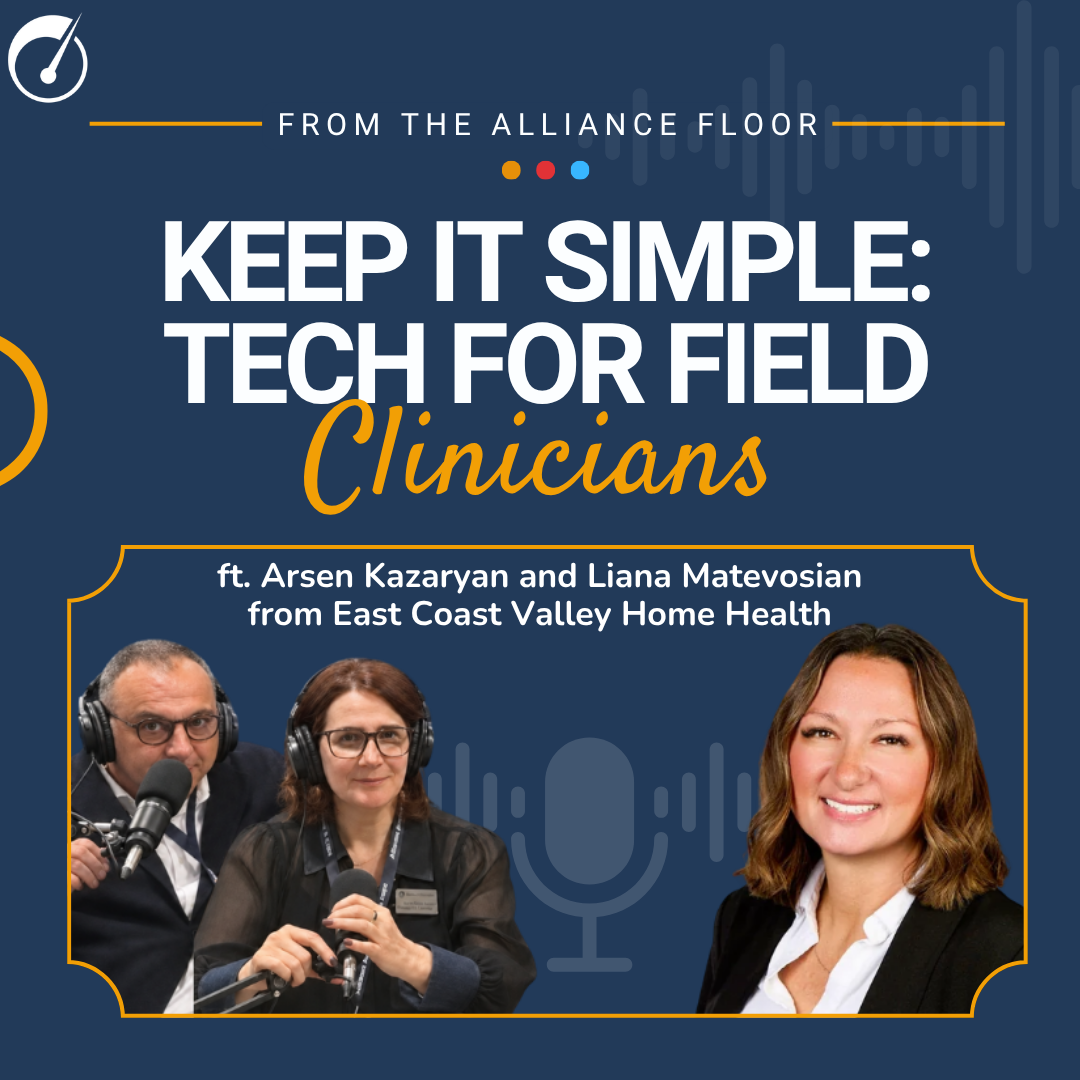
So my name is Arsene Kazarian and I co own three companies. Two home health companies, one in west coast, one in east coast called West Coast Valley Home Health and East Coast Valley Home Health and a software company that is a home health software company called Curasoft Inc.
[00:00:45] Speaker B: Wow. Okay. Did you develop the software for your own agencies?
[00:00:49] Speaker C: Well, that was the idea initially, but now that it went to become a way bigger thing that we initiated, we've decided to make it more public, so to speak and so we can sell it to other agencies. Because the way we developed this software was our vision of daily issues that we, you know, that occur during our day to day operation when we run our agencies.
So every little issue we addressed in this software, so it's all in one. It's the one that has a big screen over there, you've probably seen it.
[00:01:28] Speaker B: Okay, so you're on the, on the showroom floor in here. Yeah. So you get to attend as an attendee as well as getting to share. If you created it for yourself, knowing what you needed, there are other people out there who likely need
[00:01:43] Speaker C: those same things,
[00:01:44] Speaker B: right?
[00:01:44] Speaker C: Yep.
[00:01:45] Speaker B: Okay, let's get you introduced here.
[00:01:48] Speaker D: My name is Liana Matteozian. I'm a CEO and the nursing director of East Coast Valley Home Health.
The Home health is the sister company from West Coast Home Health company and we do skilled care, nursing pt, ot, speech therapy, social worker to like a care at home for the patients.
I have more than 17 years of healthcare experience. Started as a registered nurse, then became a nurse practitioner.
Practice in three different hospitals. But currently my major job is main job is the home health and I love it. It's interesting
[00:02:32] Speaker B: you do so between the hospitals and home health kind of. Tell me your observation.
Just between those two different environments.
[00:02:39] Speaker D: The environment in a hospital, if you can think of someone being very sick from just an idea of oh, I'm hospitalized, they're so anxious. Even the youngest population goes through anxiety.
Those people are sleep deprived from being waking up from the nursing aide to nurse, the doctors different consults. Regardless how much the nurses provide an education in the bedside.
I would say like 70% of that information doesn't get where it has to be.
Then when I started a home health what was interesting, they're in their comfort zone.
You are not rushing them.
You have time from each visit to identify their problems and target start with a small example is diabetes. Diabetes for me became in a home health is like minimum four visits because you cannot walk in and say you have to do this and that and that these are the meds. Because it's very interesting.
I see more compliance in a home health than in a hospital
[00:03:54] Speaker B: really. And the education piece really saturates Then you see in home health that they're able to actually learn more about what they're dealing with and their issues so
[00:04:04] Speaker D: they can take better care of themselves to keep them home, prevent re hospitalization.
And then it's very interesting area of practice.
[00:04:14] Speaker C: Yeah. The quality of the level of service that we provide here in East Coast Valley Home Health is to the point where proudly can say that we got 4.5 rating in CMS.
[00:04:27] Speaker B: Amazing.
[00:04:28] Speaker C: Yeah. So they do take their time. And that's what I like about this agency here in east coast because they, you know, fairly. You know we've been around for just over two years now. But I'm talking about in east coast. Right. I mean the west coast we've been for around for a long time. But. Okay. But I mean in this short period of time they were able to achieve a level of service that others don't. And that is why obviously we have on board here in East Coast Valley Home Health we have two nurse practitioners.
Liana is one of them and she's the administrator CEO. And then we have.
Our designee is also a nurse practitioner. You don't get to see many nurse practitioners in home health business. There's mostly registered nurses at some level. But yeah. And they do take their time. We make sure our patients are pretty comfortable. They get whatever they need. Right. And you know, we have. We're looking towards the future and I think we are gonna be right there with other bigger companies because of the quality. And we, because we do take. You know, our philosophy is we do take for each patient we, we have separate. We look at each. Each case separately, individualize the service.
We call it
[00:05:58] Speaker D: tailored.
[00:05:59] Speaker C: Right.
[00:05:59] Speaker D: Each person. And
[00:06:01] Speaker C: yeah. And so for that reason hospitals like such as Inova and big companies, you know, big healthcare companies, they develop some kind of trust already. And so they do refer us patients because of the quality of services that we provide.
[00:06:20] Speaker B: Trust is such a big deal when it comes to care, especially in Home health, where you're going into their comfort zone, you're going into their space, their world, and invading it a little bit to help them get better and educate them. But the fact that we have to talk about policies and some of the payment things, and we're talking about a lot of different things at this conference, I think it really does boil down to the simple fact that they have to trust. And so building that trust, not just with your patients, but also, like you said with your referral sources, that you're gonna do the right thing and really care about the patient getting better.
Such a good point to have made.
[00:07:04] Speaker C: Just the idea is spend as much time as patient needs.
You don't think about. That's, you know, we've been around for a long time. And in order the path to success is make sure to understand what your patient is in need for. How can you do one step more, a little more? And that little is what matters
[00:07:31] Speaker B: when you talk and are in some of these sessions. Have you gotten to go to any of the sessions since you've been here? Because I know you're a vendor and
[00:07:40] Speaker C: we haven't been to any sessions because most of the time we're here with Curasoft, and these guys just came in to do a little walkthrough.
But, you know, we're here with our booth is we're presenting Curasoft mostly today, but next year when we're in Seattle, the national alliance, we're definitely gonna get three booths. One for West Coast Home Health, one for east coast, and one for Curasoft. And that's when we will attend all these different type of
[00:08:08] Speaker B: the sessions and things.
Yeah, I'm looking forward to Seattle next year. That should be a good one. Now with Curasoft, what do you feel like it solves? What was the biggest problem in your mind that you thought, we have to have this solution?
[00:08:21] Speaker C: Very cool question.
So here's what we did.
I can tell you think of it the way I simplify the understanding of Curasoft compared to other softwares that are out there today is I bring a Porsche 1993 to the picture.
So say you have that car, but you drive in 2026.
Now in 2026, you need a camera. You back up and then you need also a navigation system, Right? So in today's market, we have these Porsches 1993, which are very cool cars, and then they start implementing separate third company navigations, third company cameras and all. But it doesn't really click because the initial car was not made for those systems. So what we've created with Curasoft, we created 2027 Porsche that has everything in it in one and the system works perfectly fine just simply because it's, it's the whole thing in one system. So we have an AI interpretation for our nurses. We, we have it, we've created that AI. We've created an AI that does something called sonar AI that finds all the issues throughout your agency, whether it's HR based, whether it's patient service based, whatever it is, it would anyway, so that's what, that's what Curasoft does. It's, it's all in one and you know, on a very, very high quality of technology.
[00:10:07] Speaker B: So when you say AI, it's referral documentation that's coming into your nurses that are.
[00:10:13] Speaker C: Yes, that just like there's other companies, some of them are here, as a matter of fact, that do that. But again they are, they are like plugins implemented into certain softwares. In our case, our AI is part of the software.
So just like that Porsche I was mentioning earlier.
But that said, our software does allow to separate that piece of technology and we can easily implement that to other EHRs, for example.
[00:10:47] Speaker B: Okay. And then so for agencies who are utilizing the software, maybe from your own experience, what does it make so much easier that you think, I could not do this without it?
[00:10:59] Speaker D: I have to.
We use a different software currently.
And that was actually the idea of creating Curasoft because I as a nurse practitioner used to work with epic, a wonderful software for hospitals where it's such a user friendly. And I think on top of being user friendly, having the AI to listen when you are at the patient's home and help with the documentation, not to think about for you, but just help with the documentation, I think we can concentrate more on patient care instead of just sitting in front of the patient and writing it down. So that is a great tool to add. And then I think the major challenge in home health not having a proper software is a documentation piece that keeps the nurses behind.
But having a software like Curasoft, when I just, every single time when I get a challenge, like see challenges even from the patient's home, I call them, I'm like, this is. We need to create a different tool that can be more user friendly for the nurses or the pts. And it is a very user friendly tool. It
[00:12:20] Speaker C: all came out. It all came out because exactly what she mentioned is how our field nurses, field healthcare professionals, office healthcare professionals, were having a difficult time understanding the inside out. It was just Way too many little tricks that you need to know they would get lost throughout. It's not user today at least at that time when we started out at the market did not have proper user friendly UX UI type of softwares. And you know if somebody's interested to look into deeper they can easily go to curasoft.org c u r a s o f t dot org and they can read and learn more about what how we we're different than others and how user friendly we are. And Liana mentioned that. Yeah currently we're they still using that other software because we are in a better pilot process.
So but hopefully soon with Diana's help we'll go public. We will start utilizing for all of our agencies on top of already some of others that we are currently meeting here at this alliance.
[00:13:31] Speaker B: Yeah and this has been a great place to connect. Sure. The alliance has brought together a lot of really great people.
What are you kind of hoping to learn or get to know over the next day and a half that we have left?
[00:13:42] Speaker D: I'm sure there are great ideas out there if we have them. I'm sure there are a lot of smart people and know what is new in market. You have to be on top of the newest technology, newest ideas to help for the company. First of all is the patient safety and the quality of care. What else we can add to help our company to grow patients to be safe and then help our clinicians to stay happy and stay with your company. So technology not to use new days technology is will be very bad for it's always you have to be on top of what's new.
What's the future Even about the future you have to know what is the future is holding you. When it comes to documentation or patient care or hearing different companies, new ideas will come up.
[00:14:44] Speaker C: Leonie, I think you should mention the areas that we cover at East Coast
[00:14:48] Speaker D: Valley Home Health. We cover a large area of northern Virginia from Alexandria to Prince William county and Loudoun county is like large. I have clinicians in different areas.
[00:15:00] Speaker B: So for people who are like looking at new technology, looking at AI solutions, what do you really think should be part of their evaluation process for what they're looking for?
[00:15:12] Speaker D: It's very difficult question. I
[00:15:15] Speaker B: know, I know. Sorry.
[00:15:17] Speaker C: I think. Well, I think what would be the question is what would be the main thing during the eval?
How to make the software work properly? Is that what you're asking?
[00:15:31] Speaker B: Well, I'm saying there are just so many different AI tools that you can choose from. Right. I'VE been walking around on this floor, there are so many different solutions. I actually love to see the creativity, to understand the innovation and really what drove somebody to that? Because like your story, which I love, you know, you saw a problem and so you came up with a solution knowing that other people are also going to need that solution. Right. I think people are bringing creativity to the table. They're bringing a lot of different ideas and things.
So when other agencies are looking at, okay, they're doing it this way, this is how this is working over here.
What should they be thinking about to evaluate? Okay, which of these solutions would work for me?
[00:16:11] Speaker C: Okay, I can tell you that.
Here's what I think. I think that one of the main things that an agency owner or an administrator, director of nursing, whoever is the one that is shopping for a solution is gonna have to look for is simply simplicity. Right. Simplify the day to day operation of their field nurses. Why?
So in my, the way I'm looking at this, you know, we have people who are office employees, they're sitting in front of the computer 9 to 5.
You can give them a complex software. If not the first week, the, the second week they will accomplish without an issue.
Right?
It's in front of them. They're using it every day, all day. Now I have no problem having administrative side, meaning office, to have a complex UX ui, complex features of a software and advanced. Right. But when it comes to field now, many agencies out there are working differently. Some of them are. Some field nurses are just working as per diem. So they have to work in several different agencies by utilizing several different softwares. So do you really think that these people would want to have to learn software after software after software is just tiring. So what do you want to give them? You want to give them the most simple possible access that you can just, they can just open and say, okay, so this looks just like my Facebook account. Let me just do this and this and that's it, right? That's what you want to do. Focus on. You want to simplify your day to day operation for your field nurses. And that's what I think that that's the way to think about how to, how to, when you're an agency, which one to pick?
[00:18:16] Speaker D: I would call it all in one. If you can have one tool that does 70, 80 or even 90% of your job instead of having a software, but in addition have another app who creates a communication tool for you, it's exhausting. If you can't have, because that can create an extra job for your office person to upload patient's information to another app. But if you can have one tool that helps everyone, starting from the admin to the field nurse or a pt, I think that's what we're looking for.
To be user friendly brings a wonderful tool even to show a clinician how far you are from another patient's house.
Or simply sending a text saying I'm 15 minutes away from your house, I will be there. So it's a great tool. Or even simply saw the patient communicate with the team saying I just saw the patient, patient needs to be seen by rn. It's like to make that communication faster, easier. At the same time eliminate that documentation piece.
I think that's what I can help. I will not agree that AI has to think for us because in medicine I cannot think they can give an idea what else to look for. I utilize AI in a hospital to be honest, but the only area that I use is to when I take the history from the patient, I turn on my camera, I talk to the patient instead of just writing in on a piece of it because that creates that communication that my clinician is listening to me. They are not just typing the information. Because if you can think of health care, you see 20 plus patients, you will not remember every minor detail. The AI can listen at the end will give you a brief summary what you talked about it. But at the end the plan is you, it will help you to just eliminate that piece. When you're just writing information, you can just take that and concentrate on the plan of care or just I think AI utilizing in a right way will really help the clinicians.
[00:20:42] Speaker C: I, I agree in some portions of it but I do also want to mention, mentioned this part that a lot of people do not believe in self driving Tesla. So in, in Liana's case, she doesn't still believe that AI can think better than some, you know, healthcare professionals. Unfortunately that's where the technology is going and, and we have to accept it. I'm not saying we should, you know, we, we should never double check. We definitely need to double check. But you know, the information that educated AI can agent can provide to healthcare professional, help them out to simp, you know, to, to make their work easier, simpler for them for themselves. So obviously you, you, you won't say no to that. So whether it's our technology or it's somebody else's, that's where we go. You know, all the even, even surgeons nowadays are using AI and learning from AI because it's got, you know, you have split you know so much capacity in your brain to to learn things, you forget things and AI is there you can ask questions it will tell you in a heartbeat, you know any kind of answer or previous experiences of that matter. Right.
[00:21:53] Speaker D: I do agree arson I do agree with you that piece but I hope you know the the humanity have a tendency of just relying on technology too much.
I hope they will not just click yes they can really proofread to before they submit to agree with that because at the end of the day it's a technology and we are dealing with a human human's life.
That's my hope in the future that I don't want the AI to create too easy for people to just rely on it because case it will help. Definitely will help. I'm not saying it will not help but
[00:22:36] Speaker B: we still have to have our critical thinking.
[00:22:38] Speaker C: That's a very long conversation. I don't think we're going to be done today. So. So I think. I think at this point we just want to say that East Coast Valley Home Health is here in Virginia, in Northern Virginia and anybody that is interested in in to learn more they can log into WCVA and if they need our services by all means they can contact Liana is our director of nursing administrator and all questions will be asked. So that's all I can tell you today and hopefully to see you guys in Seattle next year. Yeah.
[00:23:18] Speaker B: Yes. Amazing. Well, thank you guys for sharing your perspective. I've really enjoyed
[00:23:21] Speaker C: getting to getting
[00:23:22] Speaker B: to talk with you.
[00:23:23] Speaker C: Thank you so much.