Episode Transcript
[00:00:02] Speaker A: Welcome to Home Health Revealed, where we share real stories from industry leaders about home health, palliative and hospice care. Brought to you by Velocity. Velocity's easy to read coding and revenue cycle dashboards let you grab your cup of coffee and quickly see the health of your organization.
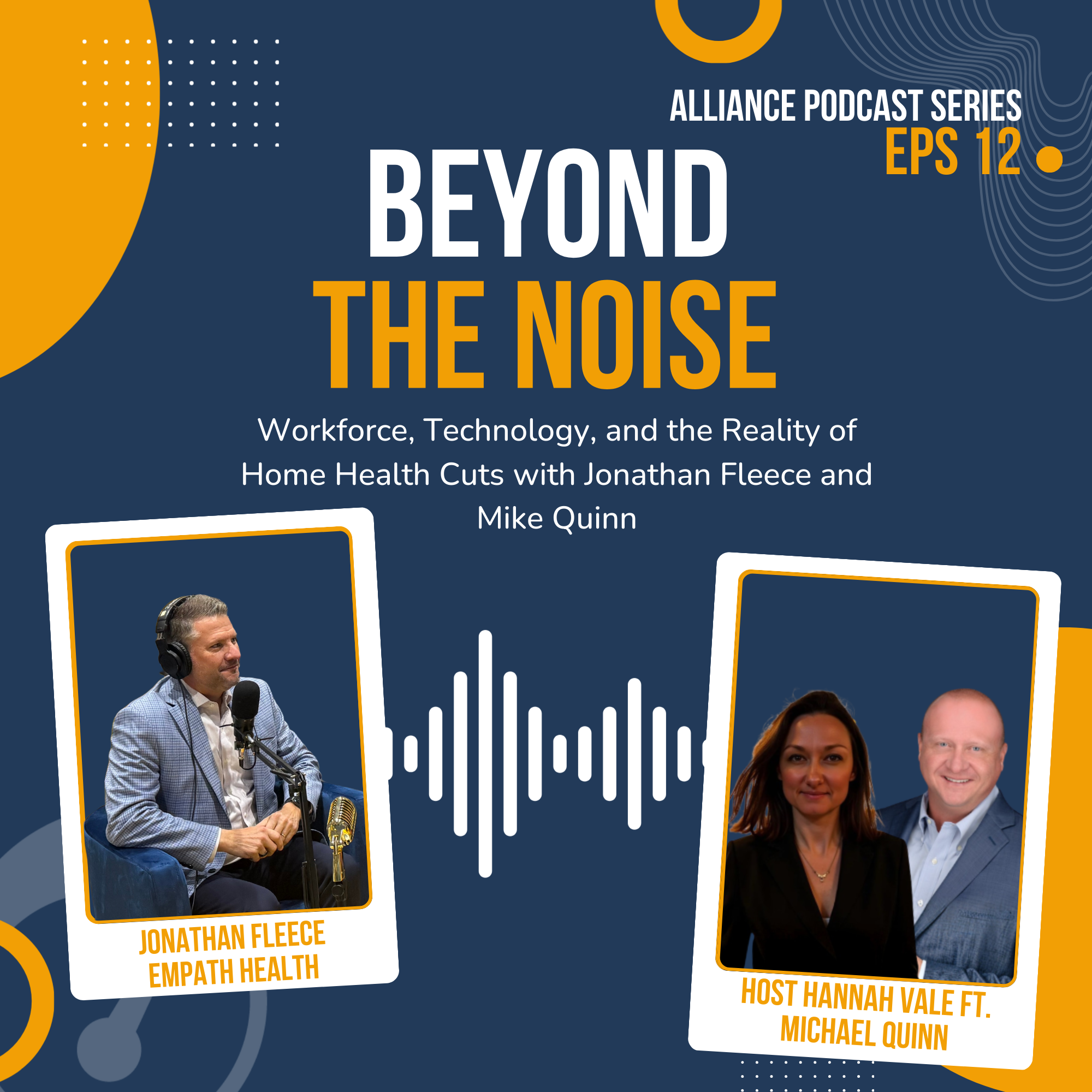
All right, welcome to Home Health Revealed. We are at the alliance conference in New Orleans 2025. And I am Hannah Veal. I am your host and I am here with a couple of cool fellows. I am here with Mike Quinn. Mike, tell us who you are and who you're with.
[00:00:32] Speaker B: Hi, Hannah. It's great to be here. My name's Michael Quinn. I'm the VP of our partner division at Invoke. And what we do at Invoke is we provide speech dictation, speech text recognition primarily for the post acute space. So it's certainly a very interesting time to be doing what we're doing. So glad to be here. Thank you.
[00:00:51] Speaker A: Yeah, great to have you. And I also have with me Jonathan. Jonathan, tell us who you are and who you're with.
[00:00:57] Speaker C: Thanks, Hannah. Jon, President, CEO for Empath Health. We're based out of Florida but with a lot of relationships across the country now specializing in end of life care. So do a good bit in the hospice space and have been a rooted hospice organization for decades now. But also do a good bit of home based care beyond hospice and a lot for senior care services, value based programs and also have an area that serves the HIV AIDS community as well. So pretty diverse.
[00:01:30] Speaker A: Very nice kind of suite of services you have there.
[00:01:33] Speaker C: We call it full life care for all.
[00:01:35] Speaker A: I love that.
[00:01:36] Speaker C: Yeah.
[00:01:37] Speaker A: So I want to jump right into the proposed and final rule. I personally, I was hoping by the time we got to this conference, beginning of November. Right. We would have a final rule in our hands so we could all come together like the family that we are and really discuss it and talk about what we were going to do. But we're not there yet.
[00:01:55] Speaker C: Yes, you're not alone in that wish.
[00:01:57] Speaker A: What are your thoughts right now with where we are, the possibilities that are ahead of us. And you described it earlier as really a fork in the road and I think that's so spot on.
[00:02:08] Speaker C: Yeah. So first I want to certainly highlight the alliance for all the incredible policy work that has been going on over the last year in light of the proposed rule. Because, you know, if the proposed rule is truly final and CMS and Congress support a 9% reimbursement cut to the home health industry.
Catastrophic is not a dramatic word. It will be catastrophic. I can certainly speak on behalf of Empath Health with a home health division that we are already having significant fiscal issues operating ineffective I think and, and focused home health division with some of the cuts that have been going on in the past several years trying to face some of the managed care cuts as well.
So another 9% for us, at least I can speak would be catastrophic to the level of.
It would impact access to care on the home health side for our community. So it's very, very significant.
I think the alliance and the industry has done as much as we know to do to make our case for the importance home based care to the country. Fingers crossed they've listened and if not, we're in for, we're in for a rough 2026.
[00:03:29] Speaker A: Yeah, unfortunately I think you're right and I, I know with talking to different agencies you're not alone. In addition to some of the cuts we've also had increased costs everything right from staffing to supplies across the board. And there's, there's opportunity I think within any challenge to rise to the occasion. And I do thank you for bringing up the alliance and the work that they're doing because I do feel like as an industry we really have rallied. We've come together to be a voice to be heard and at least make it known that hey we're and from my perspective they should be kissing the ground that we walk on in home health and hospice. We're truly saving absolutely these payers money, these insurance companies, we are contributing, we are in the community doing work, we're saving hospitalization. I mean we could go into a lot of the dollar amounts if we, you know, if we really wanted to pull up those good old spreadsheets, we could go there. But I think all in all, you know, we are providing this as an industry and so coming together, rallying and really putting together the case for what we do. Let's talk about staff retention.
[00:04:40] Speaker C: Big issue.
[00:04:41] Speaker A: Yeah. What are you hearing? What are you seeing? What are you doing?
[00:04:44] Speaker C: So we have several strategic imperatives and investing in our colleagues and volunteers is absolutely one of the cornerstones at EmpatHelp. So some of the sessions here actually for the annual meeting have, have talked about the importance of the basics and certainly we absolutely focus on the basics. So to your point earlier, we have had to keep up with the inflationary pressures around market compensation and benefits and super proud that we were just recently named one of the US best places to work as a healthcare organization.
[00:05:19] Speaker A: Congrats.
[00:05:19] Speaker C: And you know, certainly there's a lot that goes into that. But making sure that people are paid competitively and feel valued for the work that they do is big. So that's a big part of making sure that you're focusing on retention. We are very fortunate that our turnover rates are below the national industry standard. So, you know, the days of having single digit turnovers I think are gone for, you know, as far as we can see, pre Covid kind of, kind of conditions. But the industry turnover rates still hover around 25%. So we at Empath are super proud that we are below 20% from a organizational turnover rate and have focused a great bit on that. So some of the more innovative things that we're doing around retention first is investing through workforce development. So one example of that, we're one of the only hospices nationally that has an accredited nurse residency program. So we will hire nursing graduates right out of nursing school, enroll them in a nurse residency program, put them on full compensation while they're going through that additional training.
So that's one example of what we do for workforce development that's pretty innovative. And then also just culture and engagement. So we invest a lot in technology.
So everybody's comfortable, familiar with what social media represents in today's society, Whether you're a TikTok person, Instagram, whatever your flavor is. So we have what's called Empath Connect, that's sort of our social media platform. Internally, we celebrate birthdays, anniversaries, milestones, award recognition. Certainly it's also a way of informing the colleagues about updates and policy changes or events or things like that. But that's been a really, really innovative thing that we've done to almost create our own sort of social media product that's an internal product. So we've done that a good bit. And then as the CEO, I am very, very supportive and encouraged that we have to be in sync with our colleagues. So we have what's called a council. It's called the C3 Council.
It's made up of colleagues and it's very much a council that meets regularly with senior leadership, including myself. So we're always trying to listen in and feel the pulse of what's going on across our 3400 colleagues and drive changes, policies and innovations and benefits and things like that through C3. So one example is we this past year implemented a parental leave policy for both fathers and mothers and felt like that was coming right out of what the colleagues were looking for was an expanded parental leave policy. So really excited about some of those things.
[00:08:19] Speaker A: So it allows you to listen absolutely.
To your employees, because what's good for your organization isn't necessarily the perfect fit for another organization, but the fact that you're willing to listen and think about, disseminate that information in a different way is really incredible. I know you have a technology question in your pocket.
[00:08:42] Speaker B: Well, of course. And what I will say too is I was actually a customer of Empath at a hip surgery earlier this year, and the work that you're doing with your clinicians shows because it was.
It was a fantastic experience. And so certainly I'm not an aged person where you're providing the, you know, it was more physical therapy, but it was refreshing to see these individuals come twice a week. And they were fantastic. So I can attest that what you're doing is working. So, you know, at Invoke, what we do is provide speech to text and really focusing on how can we help you and your mission to help patients. Right. To get better by freeing clinicians to focus more on the patient, which means they have to be present when they're with the patient, but then also not take time into their evening when they should be relaxing and spending time with their families, catching up on documentation. So that's our mission, is to help your clinicians give patient care better. And so recently we have entered into an agreement with Empath. They will be leveraging Invoke as their speech to text technology. So certainly you're also continuing to walk the walk of what you're talking. So from that perspective, I'm just curious, where do you think some of the values and the strategy around implementing something like Invoke is super important for your clinicians to enable them to focus on those patients, but also do it well and make sure they're not missing anything. Right. Because there's a lot that happens in a visit.
[00:10:23] Speaker C: Great question and thank you for your kind words.
Many people assume that as a CEO that I know when we care for people out in the community clinically and under patient privacy rules. You know, I didn't even know that till you shared it. So I know it's always an honor and blessing to serve in what we do.
So glad you you had that great experience. You know, your question, it was actually one before we started the podcast today that Hannah and I were talking about. You know, what's been some of the value that I've gotten out of and I others from the alliance annual meeting. You know, there's a lot of technology floating around this exhibit hall where we're. We're taping the podcast And I think part of what now we need to do as an industry, which is why we've certainly aligned with a company like yours, is try to separate out, you know, noise from reality and what's really working and what's going to create that best return, not just on investment, but return on time and return on engagement.
And I think to your point, we still at Empath, even though we've got a lower than industry average turnover rate, we have very competitive comp and benefits packages.
We still have a lot of open clinical positions that we have challenges filling because there is just a healthcare workforce shortage that we don't have enough healthcare workers to fill the needs. So where I think products like Invoke and others are going to just be absolutely not just optional, but like a lifeline to survival, is how can we do more with less and leaning into artificial intelligence and products like Invoke for transient listening and things like that, because ultimately that's going to allow the same number of healthcare workers to do more in the time that they have.
We looked at, I won't mention the name, but we looked at a product recently that, that, that the team came back and shared could literally take perhaps you know, like a three hour visit, kind of documentation process and cut it down by at least 2/3. So there's so much of that kind of innovation that is going to be really, really important. So thanks for everything you're doing and let's all keep working together to try to do more with less.
[00:12:48] Speaker B: Absolutely. And we feel like we know a lot about the space in the industry, but one of the, I think, unique factors within VOOQ is we truly need our clients to help us make the product better and to really serve the needs of the clinicians, which they're really doing the most important work of all, taking care of our population.
[00:13:09] Speaker C: Absolutely.
[00:13:10] Speaker B: Thank you.
[00:13:11] Speaker A: Well, I just want you all to know that I had no idea that Mike had hip surgery. I definitely didn't know that he utilized Empath. And so I feel like this was.
[00:13:22] Speaker B: Just sort of like you bring people together.
[00:13:25] Speaker C: Universal. Yeah. Universal message. Yeah, that was really, really special.
[00:13:30] Speaker A: Yeah, it worked out really well. So I'm glad we got to have this conversation. Thank you so much for sitting down with us, for talking through some of these issues that I, I think a lot of people are really facing. It's good to be able to have these conversations as the final rule is released. I really hope we all kind of have a platform, a town hall in some way through the alliance or somewhere to kind of say, okay, so now what? Right. Depending on what actually happens, I feel like we have situations of scenario planning.
[00:14:00] Speaker C: Yes.
[00:14:00] Speaker A: On, you know, on our spreadsheets and in our head for where we're going to go with conversations and strategic pivots. But I think we. We're gonna have to face some of those. And we will. Together. I feel better than ever that we are going to do those things in a way that's more meaningful in the. In the future. So thank you both for being here.
[00:14:18] Speaker C: Well, thank you, Hannah, for facilitating this and all the work you do.
[00:14:22] Speaker B: Yeah, you. You do phenomenal work. And thank you for continuing to push the message out. So it's. It's extremely valuable. Thank you.
[00:14:31] Speaker C: Yeah.