[00:00:03] Speaker A: Welcome to Home Health Revealed, the podcast for home health and hospice leaders who want to stay connected to the industry and ahead of what's next. All right, so welcome back to Home Health Revealed podcast. I am Hannah Vail and today we're diving into a topic that I think every home health agency is feeling right now. And it's this shift towards higher acuity patients being discharged for hospitals. And I just got back early this morning, actually wee hours of the night where it counts you night or morning, it doesn't matter.
Back from CASA and got to sit on a session about this very topic. And so I know these conversations are happening, there's rumblings, but patients are coming home sicker, coming home faster from the hospital and with more complex needs. And that is changing how agencies are having to operate across the board.
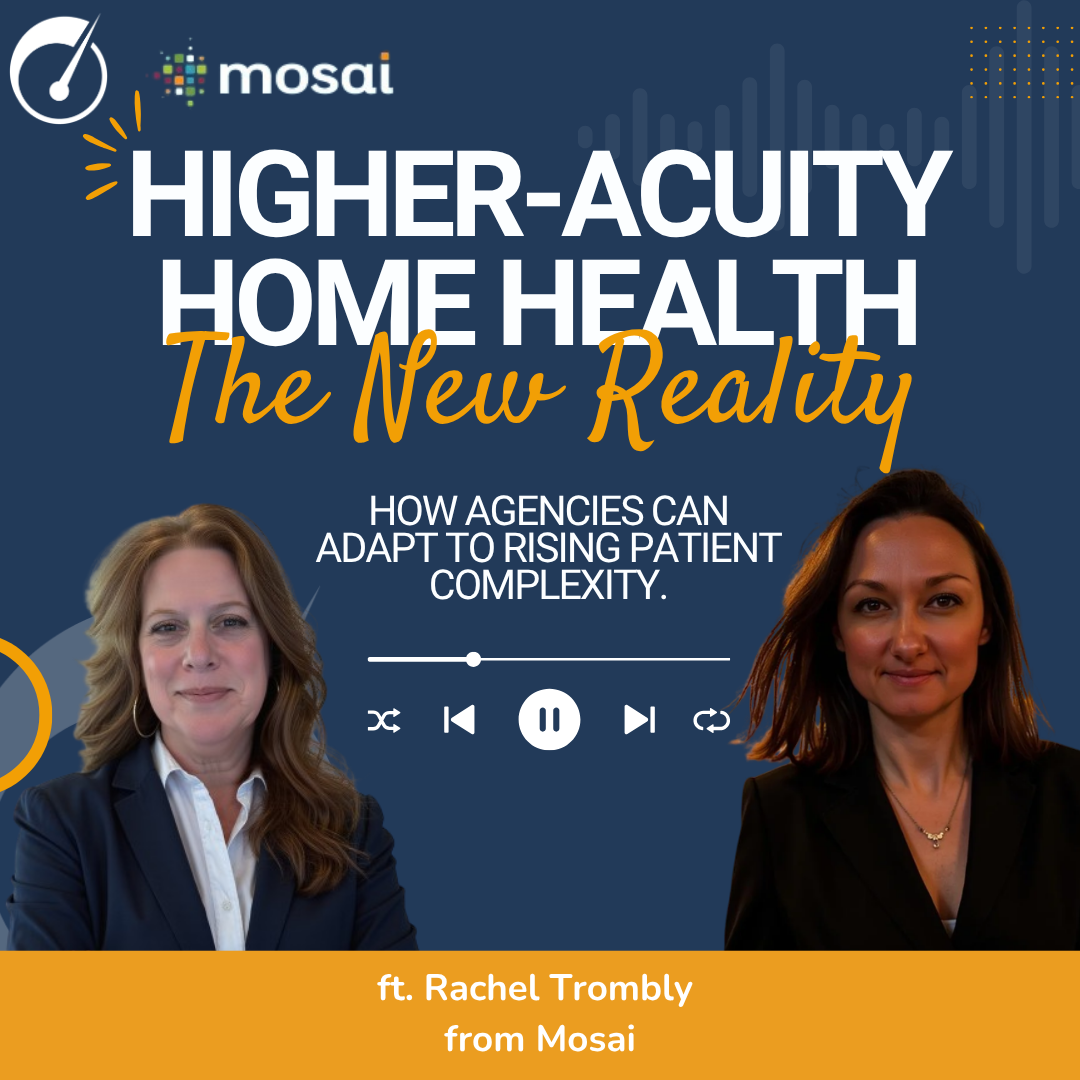
I'm really excited to be joined by Rachel Trombley of Mose. And Rachel is the director of Clinical services at Moses, the company formed through the merger of Forcura and Metalogix. And we have enjoyed partnering with Forcura for a long time, are very excited about this new company, Mosai, that's been formed and with more than 20 years of experience in home health operations and leadership, she specializes in clinical strategy, quality improvement and care delivery across the post acute care continuum. Prior to Mose, Rachel held leadership roles with home health organizations across the Northeast. Rachel, thank you so much for being here.
[00:01:36] Speaker B: Yes, thanks for having me, Hannah.
[00:01:39] Speaker A: So before we jump in, I'd love for you to give a quick introduction, tell us a little bit about your experience.
[00:01:46] Speaker B: Yes, so certainly. So I am a registered nurse and I've spent the majority, actually my whole career in home health.
I have both been in the field as well as at branch leadership positions, but the last 17 years or more, I've been spending it in both clinical and operational positions, as you said, here in the Northeast, both for smaller agencies as well as for national agencies. And today I have the pleasure of working in a clinical strategy role at mosai. The company, as you did say, formed through the merger of Forcura and Metalogix. And I work with providers across the country to advance best practices and drive innovation and care delivery. So I think I bring a unique perspective back to these home health agencies I'm working with both as a technology and innovator support, but also having been in the field and doing just what they do.
[00:02:40] Speaker A: Agree, agree. Great experience and the wealth of knowledge that you have to talk with these agencies is just so valuable, especially in the time we're in right now. Couldn't be better positioned. But to start out, I want to get some definition around our topic today. When we talk about higher acuity in today's environment, what does that actually look like in the home setting?
[00:03:02] Speaker B: Yes, well, home health has always cared for medically complex patients. And what we see that's changing is the volume and the sense of urgency that is coming with these patients to the home health area. So I think the biggest thing is it's not a matter of are they coming, but what they're coming with and the level of care they are now expected to manage with these home health agencies. So they're coming with multiple chronic conditions and much greater symptom burden that needs to be managed by clinicians and more complex care coordination that comes across providers, caregivers at home, and each interdisciplinary team member. The earlier hospital discharges means that as agencies, we're caring for patients who historically have remained in inpatient settings longer. So before just a few years ago, they would have been in a few more days or even a few more weeks, but now we're getting them, which would almost equate to a level that's very close to almost an ICU level. And so these agencies can't control them coming through the door. They're coming, but what they have to do is evaluate their operations, are set to support these patients. Well, because complexity is just not simply about volume. It's becoming the defining operational challenge. And we're seeing that agencies that are thriving are the ones that are adapting their processes, their staffing models, their care coordination strategies to meet this growing complexity head on.
[00:04:26] Speaker A: Yeah, complex and urgent. You use the word urgency and gosh, I hadn't thought of it that way, but you're right, they're coming. What are you going to do about it? And you have to meet that sense of urgency as the agency.
Are there specific patient conditions, complexities or trends that you're seeing more frequently now in comparison to a few years ago?
[00:04:50] Speaker B: So absolutely, one of the biggest trends we're seeing is the increase in patients with multiple chronic conditions. It's no longer unusual for a patient to be managing heart failure, diabetes, COPD and other comorbidities all at the same time. And so that requires a much higher level of coordination across those providers, both internally and externally to the agency, and that is to make sure that they're having a care plan that stays aligned to these patients complex needs.
[00:05:19] Speaker A: How is that shift impacting the day to day reality for clinicians and for agencies?
[00:05:25] Speaker B: Oh, it's having a significant impact on that Day to day reality, the complexity of care has increased faster than many of the processes these agencies have that were originally designed to support them. So for clinicians, the job today involves much more than just delivering a visit, as we thought of before.
It's what makes this particularly challenging is that capacity isn't just simply a staffing issue.
It's about making sure that clinicians have what they need in time, resources and support to effectively care for their patients. And those needs are just so complex. So it's a constant reevaluation.
As a result, many agencies are recognizing that their workflows originally built around those patient volumes just don't account for the realities of higher acuity care need. And agencies that are rethinking this approach on their overall operational processes are who are going to be successful.
[00:06:21] Speaker A: Yes, and this can be in many forms. I know you're talking about having resources, but some of that is time to actually talk with the patient, care for the patient ahead of time, knowing what you're walking into. So you have supplies in your car to do the things that you need to do and have the appropriate conversations and follow up. And then of course, education, because especially when I can imagine when you're caring for patients who are so complex, those conversations can get lengthy, but you're having to get very specifics, clear as kind when it comes to those things. And a lot of patients don't fully understand or may not fully understand how to take care of themselves and their caregiver. You're also educating their caregiver in a lot of cases, correct a lot of aspects.
[00:07:09] Speaker B: Absolutely. And I think what we see too is for home health clinicians, they have to be the Jack of all trades.
So they're walking in and like you said, the preparation going into a visit, they need to make sure that they feel comfortable in discussing and managing those different situations, whether it be a chronic condition or a complex wound or even IV treatment. And not every nurse or therapist has that background or insight. And so they're often having to go and educate themselves while coming into a home. They have the foundation, but maybe they haven't seen a patient like that or it's been a while. So it's constantly having to realign their own abilities as a clinician to what the patient needs as they're walking in the door.
[00:07:53] Speaker A: Yep, much need for critical thinking, clinical judgment.
Very important for home health nurses. I've said this before, I think I've even said it on a podcast. Getting to watch them is almost like getting to watch an improv Broadway show like they're amazing.
So they are, yes. Let's talk about documentation, because this is where we see a lot of the downstream impact for the care that's truly taking place in your experience. What separates documentation that simply checks the boxes from documentation that really captures the patient's acuity and tells that full story?
[00:08:30] Speaker B: Yes, absolutely. So that's a great question. And documentation's often viewed as just a compliance requirement. But the best organizations, the best clinicians know that it is a way to have a clinical tool first. And to me me, the difference between documentation that just checks a box and documentation that truly captures a patient's acuity comes down to whether it tells the patient's story. Each note should be able to, on its own, have a clear understanding of what the patient's needs are and the changes they're experiencing.
And so it just doesn't record what happened during a visit. It's what's going on, clinical decision making, what was made, what communication was communicated out to other providers, what risks were identified, and just overall, how's the patient's condition evolving over time? So when the OASIS assessment, the clinical notes, the overall patient story align, the documentation is an incredibly powerful tool and it's going to help everyone on the team understand that patient's needs and be able to support it through the continuity of care while creating a very clear picture. So that of course, we can identify risks and keep that patient from having a further decline.
[00:09:46] Speaker A: Yes. And identifying risks as soon as possible can really help extend care in the most appropriate way. And I know we talk a lot about reimbursement as well, because that, that's a parallel factor.
But overall we're in this for the care of the patient. And so making sure that we've identified those risk factors as early as possible means we're able to do intervent interventions and things that are going to help the long term care of the patient as well.
[00:10:13] Speaker B: Absolutely. I heard early in my career someone say something to me and that was that we're in the business of caring for sick people. And that is true. And as a nurse first and as an operational leader second, I always felt that if you did the care right through both not only the care you gave, but the documentation that supports what you did with that patient and the work that that patient and caregiver are also providing during that care time, the rest will follow, which means reimbursem and the ability to make sure that you can care for all your patients because your reimbursement aligns with the care you're providing?
[00:10:50] Speaker A: Yes. That reimbursement should match the complexity of the patient if we document it appropriately.
Where do you tend to see the biggest gaps or risks when agencies are managing higher acuity patients?
[00:11:04] Speaker B: Yeah, when I think about the biggest risks that we face with higher acuity of patients, I think there's two areas that immediately come to mind for me, and that's identifying risk before it becomes a crisis and understanding whether the organization truly has the capacity to support the patient's needs.
On the risk side, most agencies actually have a tremendous amount of information available to them, but the challenge is that it's spread across all different aspects of the agency, whether it's in notes, it's in a scheduling system, it's in communications.
So when those pieces aren't connected, those subtle warning signs that we have that will help us to identify the patient's risk, they're lost and missed.
So I do believe that risk stratification is really becoming the forefront of what's so important now in home health. And it's going to help agencies move from reactivity to problems before they occur to being able to proactively identify those patients and what interventions are needed sooner. The other area is also capacity, and that's a reality, especially with staffing shortages.
And I think it's important to recognize capacity is much more than just about how many patients do you have today or this week? Talking either to an individual clinician or to the branch manager as you're trying to figure out what you can take from referral sources.
It's really based upon knowing the care that these complex patients needs through those risk stratifications.
It's based on the measurement, not just a visit volume, but making sure complexity is part of the conversation.
You know, through those operational issues, you're going to see things that are going to emerge, like scheduling gaps. You know, you go from seeing a patient, you have maybe them scheduled twice a week, but you do two visits, Monday and Tuesday. That doesn't make sense. A patient's going to go another five to six days without a touch point with a clinician, and then you could have delayed visits because you're not looking at when that patient has scheduled appointments, either with other providers, externally to the agency or internally within your own team, and that's going to create problems. Either visits get pushed out or they altogether get missed. And of course, any missed opportunity for follow up or communication, those are breakdowns that operationally challenge agencies and they can ultimately, as we know, lead to undesirable patient outcomes.
[00:13:26] Speaker A: Yeah.
How important is it when the clinician takes ownership of the plan of care in this environment? And what does that look like when it's well done?
[00:13:38] Speaker B: Yeah, this is a tough one. I think it's probably the biggest thing that most agencies have struggled with. I know it my entire career and we're talking 20 plus years.
The ownership by the clinician is truly important, especially as that patient acuity continues to increase.
And I think one of the biggest mindset shifts we're seeing is recognizing that the plan of care isn't just a one time thing. You don't establish it at admission and then just go, you know, cookie cutter through it until you come to a discharge date. You have to look at it with higher acuity patients is that it's a living and fully moving and evolving roadmap of care. And you need to make sure that you're absolutely identifying those changes in condition through your documentation that you're looking at the caregiver challenges that are going to present. I mean, I always call it the honeymoon phase. When someone first comes home, everyone's excited, everyone's going to be there. Oh, everything is fine. I can guarantee you within the first seven to 10 days, things are going to fall apart quickly. And they usually do so making sure we know what the caregiver challenges are and any barriers to treatments like transportation, literacy, things like that. So when a clinician feels ownership to that plan and they're empowered to be a part of it, and making sure that their interventions make sense, you know, challenging themselves, like you said, using, you know, clinical judgment and critical thinking, and making sure that the approach, every time they come into that patient re observing them, assessing them to make sure does this still align with what our goals are, what this patient's goals are. So when a care plan is done well, when the actual case management is done well, clinicians are going to be continuously reassessing and communicating to the broader team, just not internally, but externally, to other providers, and making sure again that that care plan is consistently being reviewed and updated to align with that patient's needs.
[00:15:36] Speaker A: Yeah, it is almost like every visit you have to kind of put your fresh eyes on to see what's changed in their environment. You know, are there new people involved? Have their conditions changed? There's so much to the environment and things that are happening externally and internally with our patients that are dealing with some of these complex cases.
[00:15:58] Speaker B: Absolutely.
[00:15:59] Speaker A: You know, you mentioned this a little bit. A big piece of managing this higher acuity of patients at home is the caregiver Dynamic.
From your perspective, what role do caregivers play in keeping these patients stable at home?
[00:16:16] Speaker B: They, they are incredibly important, but probably the most important, very honestly.
And you know, especially when we're talking about higher acuity patients, it's just so easy to want to just pick up the phone and call the ambulance. And you really have to set the role at the very beginning and really align them with understanding that they're a critical extension to our care team because they're the ones who are there all the time between all of our visits. And our visits may only be a half an hour to an hour in time. And so that's a long time for a rest of a day or a week to be with that person who has critical needs.
So I think the biggest thing is that we have to teach them right up front.
We need to make sure that they first notice any sort of subtle change that may not necessarily be apparent to us as we come in, in these small touch points, but understanding what it means. Like say, for example, if a patient has a change in appetite or some new fatigue that's presented or new confusion, it may even just be the caregiver's gut that just something isn't right. And I love that. The gut feeling, I can tell you, is usually pretty spot on. And those early observations are so important. So when you bring the caregiver in early, teaching them what to watch for, making them feel comfortable to communicate concerns, be that early warning system, know when to call you, when to call the agency. Their insights can allow us to intervene sooner, adjust that care plan, always comes back to that care plan, and involve the provider outside. Maybe it's a medication change or maybe there does need to be another visit with the physician earlier than what was scheduled. All of these things are going to lead to preventable rehospitalizations and of course a more serious decline. So that's why I think that that caregiver, they are spot on. Number one on our team covered all the great things.
[00:18:12] Speaker A: I love the caregiver gut. I think that's probably one of the most dependable guts.
[00:18:18] Speaker B: Absolutely. Never discount it. Never discount it.
[00:18:21] Speaker A: You never think you're going to get to get on a podcast and talk about guts. Guts. I know what, what with the caregivers are some of the most common miscommunications or communication breakdowns that you've seen.
[00:18:35] Speaker B: Yeah. You know, I think what happens is in the world to level set clinicians have a lot on their plate and they are forced, you know, with having to meet productivity Standards, because that is a reality. And making sure that they can get to the next place on time, you know, and just so there's a lot going on. So for them to come in, they have to, you know, kind of bring down the tone, set the opportunities with the caregiver, and make sure that it's not all at once, because that's where we make the mistake. We kind of come at them with a lot of information that first visit. And it's a long visit. The admission visit is long. It's a couple of hours.
And so making sure that we don't give them that overload of information, we have to help them process what a diagnosis means. Sometimes it can be something that we simply think we understand. I always think about a patient that I went out with one of our field clinicians to do a site observation, and in speaking with the wife of a patient, her husband had come home with a new diagnosis of chf. Well, think of what CHF is. It's congestive heart failure. Well, what she heard was failure. And so she hadn't shared with anyone. And I could see the amount of stress that she had on her face and in her inner body language around us, being there. And as we're talking about chf. And I finally asked her, do you understand your husband's diagnosis? I know this is new. And she started to cry. And she says, his heart is failing. She thought he was, like, going to die imminently. And all this fear and so breaking it down, keeping it simple, letting them understand the why behind these diagnoses. Understanding medications. Often they don't understand the complexities of medications, the importance of time. You know, things that can't be eaten or drank at the time that they're taking this medication, making sure they have appointments set up and just changes to their daily routine. Because when someone becomes ill, it's a change for everyone in the house. And so aligning what a daily routine looks like is really important for them. But all this information can get lost if it's given all at once.
So just, you know, aligning the expectations, I think keeping it really simple, keeping it a conversation that happens every visit by everybody who's seeing this patient so that they understand what is normal and what is not, so that they feel good about communicating what they need to. And that way we can not miss those early signs, but also not make it so. It's an alarm bell every time something normal does occur. So finding that balance for them and understanding the difference between those changes and, you know, and I think Just again, it's always about communication. As I said, it's that building of relationship communication. And two, when communicating amongst each other as a team or calling the doctor, do so in front of them to help them so that they hear what you're saying and understand the feedback you're getting from the person you're talking to. Because again, they're a member of our team. So the more that we can draw them in so that they feel empowered is very, very important. Because once this person reaches their goals and we leave, they're the person left.
So they have to have that full capacity to be able to manage the person they live with and feel comfortable and confident. And
[00:21:58] Speaker A: I really do like that best practice idea of having those phone calls in front of because sometimes just hearing the information again as a report out as a reminder, being a part of the conversation and being respected as a very important piece of this puzzle, a very important caregiver part of this plan for the loved one. I understanding that one, it's transparent. But also that we're on the same team, we're trying to head the same direction. We have these goals in mind and together we're going to get there. Because I think sometimes it can feel lonely as a caregiver.
[00:22:32] Speaker B: It sure can.
[00:22:35] Speaker A: Now, re hospitalizations are obviously a major concern with these higher acuity patients.
What are some of the biggest drivers and avoidable rehospitalizations today in home health? We know some of them aren't avoidable, but what are the biggest drivers behind the avoidable ones?
[00:22:55] Speaker B: Yeah, so I think one of the most important things I've learned over the years that I'll probably challenge you on that is rarely do they happen without warning. And so I would say the majority of them are absolutely avoidable outside of those things that are traumatic, you know, but those are not the usual. And in many cases we do see that there's been signs of clinical decline that have been developing over days or even weeks, but it will result in them to the emergency room obviously often being hospitalized. But I think it's because we didn't have an ability to identify and act on it quick enough and early enough. So I think making sure that we definitely identify where we can make the impact in showing signs of how the condition is changing. So you have to think about all those things, those worsening symptoms. It could be just a slight change in their functional status, it could be medication changes or, or not taking medications as they should be. Could be the caregiver even telling you they're stressed out and they're having a really difficult time, and the patient is getting up more at night, or things are happening that don't align with how the picture first started. And, of course, always adherence, making sure that the care plan, they're aligning to it and they're bought into it. And sometimes you have to change that care plan not only just to align with what your clinical goals are, but what their goals are, which will align adherence.
So I think it starts with that, but it's also about that miscommunication around that fragmentation of information, aligning to find those changes, both what the caregiver is going to report to you, but in and amongst your own team, you report to each other. And when you don't see how each of those pieces are starting to affect that patient and will have the ultimate unfortunate goal of sending them to the hospital, it makes it much more difficult to rein it back and be able to handle it at home. It becomes a level that we just don't have the means, the oversight, the interventions to manage that patient at this point.
So, again, it's always about interventions early.
I think it's about adjusting the care plan. It's about making sure you're increasing monitoring with any changes that you may see and making sure you also speak to the physician, keep them in alignment, make sure they know what's going on. They're another very important, important part of this, and providing, if needed, any additional caregiver support. Because when you put this all together, it's going to decrease the risk that that rehospitalization is going to occur.
[00:25:37] Speaker A: Yeah, Those are some great strategies for being more proactive and really making a big difference in keeping them out of the hospital. And I think if I've learned anything on today's podcast, it is check in with your caregiver gut.
[00:25:52] Speaker B: Absolutely.
[00:25:53] Speaker A: That's our big takeaway today, and it's a great one.
I want to zoom out for just a minute because this isn't just a clinical issue. It does really impact the entire organization and your unique perspective, clinical and organizational. I want to know how agency leaders, especially on the operational and revenue cycle side, can be thinking differently about their patient acuity.
[00:26:21] Speaker B: Yeah. I think one of the biggest shifts that agency leaders need to consider is that, like you said, it's not a clinical issue. It's operational and financial as well. And historically, capacity has been measured, as we know, by staffing levels, visit volume, and a census number. And those metrics, they're still very important because you need to know it, but they no longer are the whole story anymore. And so today's patients, they're definitely, as we know, they're medically complex.
And that complexity is going to require time coordination and even clinical judgment that you just can't see in a vis account alone. So you need to be able to talk about capacity planning by simply not just asking, how many patients can we take today? It's more about do our clinicians have the time and support needed to effectively care for that complex patient that we're not only going to take, but we're currently serving. So it's a balance between who's on census and who you can still take.
And I think you also have to look at the travel. I mean, if you have a large area of coverage, you have to be mindful that these clinicians have to travel there. Then they have documentation requirements around that time that they're in the home. And I know we all put time frames, especially now that, you know, no longer the days of paper, but we're all on electronic EMR. But there's still that FaceTime that's needed because you're in a very personal space, you're in a patient's home. And so they want to see you and they want to engage with you, they want to feel respected. And then of course, to the care coordination that goes into it, you know, reaching out to the rest of your team members to tell them what's going on and making sure too, that the physicians know. So you take all of these complexities together and it creates a great strain on the clinicians and the operational team. So, so agency leaders, that means we need to regularly evaluate is that staffing model we have now, does that work? Is the workflow that we're using, is it effective? And are the operational process that we have in place, are they keeping pace with the level of care that we are continuing to take on and are delivering? And then, of course, to spend time with your clinicians, find out what's going on out there. Because it's so hard when as an operational leader, you sit back and you try trying to see that big picture. And I, I feel for these leaders. I, I was in their shoes. At the same time, make it real, get out there with your clinicians, do that, ride along, do the observations. Don't just rely on your branch leaders or your clinical team leaders to do that as a checkbox. Get out there, spend time with them, know what true capacity is, understand the challenges they're having each day and look at it through their lens as well. Because Again, complexity is where it's at, it's not volume. And when we truly as leaders understand the effort that's required to care for these patients, we can help them to make much better positioning to support the clinicians at the agency level and improve of course, the patient outcomes, which is what we're all striving for. We're all there to care for these patients. And then of course too, the reality is, as I said earlier, we are in the business of caring for sick people.
So making sure you are creating and sustaining operations across the organization that will help you continue to grow and care well for those that not only take care of your patients, but the patients themselves.
[00:29:52] Speaker A: As you're asking these super important questions, making these observations, and I couldn't agree more with you with these leaders being involved, do a ride along, be a part of the day to day grind so that you have some different perspective to apply to strategy, to apply to processes and things. But what are some really simple ways that leadership can, can better support their teams in managing these complex patients?
[00:30:17] Speaker B: Yeah, so there's some really easy ways that they can make an impact and be seen as aligning with their teams. And I think first of all is making an investment in clinical education and keeping that ongoing training not just about oasis. I know we all get really focused on making sure we're doing OASIS correctly and that the documentation is perfect, but also too making sure they have the right tools about the types of disease processes they're seeing or the equipment that's coming home. I always think about, I was part of a situation very early in my career that we had the first LVAD patient come to New Hampshire and to have the support, and at the time I was a field clinician, to have the support of our leaders come in and help us not only bring an LVAD representative, but the clinician who supported LVAD at that time to come and help us to understand this very complex cardiac patient, but also even took it to a new level and even brought in the fire department that was in the town that this patient lived in.
It still sticks with me. It was the most amazing and empowering opportunity because I was afraid, I was afraid of this new device that was going to be part of this patient to keep him alive and to know that I was going to be one of the first, first points of contact with this patient and support him and his wife and so to, you know, to make sure that they have any type of education that is needed to be able to care for these patients. Because they are coming home with more complex wounds, more complex equipment. IV devices change frequently. Important to keep them up to date on the different IV vendors they may see out there. Those are all really important because as acuity rises, they need the opportunity to strengthen their clinical judgment, their assessments, skills, their knowledge. I think that's really important. And then of course too, this just the one that's always the bane of any clinician's existence, help them with those unnecessary administrative burdens.
You know, when they're caring for patients, they really want to care for patients. That's why they're there. They're nurses and therapists for a reason. They have a huge heart and they care and want to be there and present for their persons at that moment. And so any way that we can help them to have that more face fronting time and less impact of the documentation burden on the backside is really important because that's where it gets overwhelming and they get burnt out. And so I think that's really important. And then of course, operationally, continuously, continuously look at your workflows, look at your staffing models for your operation side of your business. Help them make sure that they're getting what they need.
A process may have worked a year ago, may not be the same process that works now. Things are changing and so important to look at that. And so when you look at all of that, look at, you know, making ways to make everyone feel valued, make them more efficient and the quality of that time that they spent, meaningful, I think it really brings it all back to again, everyone getting to the place of caring for this patient the way they need to.
[00:33:32] Speaker A: Those are some great tips. I really love the example of your community rallying down to the fire department. What a great picture of how a community can really surround caregiver, clinician family to say, hey, we're all in this, let's figure it out, let's show you how to use this so you can have confidence.
[00:33:53] Speaker B: Exactly. And that's just one big example. But for someone else, it could be something as simple as is, I haven't done a Foley catheter in a really long time. And that's true. Not every nurse has done Foley catheter insertions on a regular basis and they get assigned one, you know, so making sure those skills days are there, those basics, because again, it's a lot to ask of a home health nurse. She has to know, he has to know everything.
And so making sure that you're touching point on all of those things so that they can feel really good and confident every day they're going out.
[00:34:25] Speaker A: How does this connect to things like audit readiness, compliance and overall financial performance?
[00:34:32] Speaker B: Yes, Well, I think it's important that, you know, we do recognize that compliance and audits and financial performance, they aren't separate initiatives from patient care. They're often the result of strong clinical and operational processes working together.
So as patient acuities are increasing, I think the impact of extends far beyond that clinical team. And so higher acuity care is going to affect those operational efficiencies and compliance and reimbursement and of course impact overall financial performance as a result within the organization.
So as a leader, we need to think about these areas as interconnected, not independent priorities.
And what's interesting is that many undesirable outcomes are actually operational rather than purely clinical. And so when we look at rehabilitation, hospitalizations or even LUPA exposure, those missed reimbursement opportunities, and even of course, compliance challenges, they're often linked to the simplicity of a scheduling gap, you know, a missed visit, communication breakdowns in amongst team members, a care plan that's not realigning and it's drifting off course. And we're not, you know, focused on what this patient needs. We've just been working in our silos doing that cookie cutter care and two, delays in identifying patients who need additional support. So I think documentation is a great example. When you have strong defensible documentation, it's going to do more than just satisfy those regulatory requirements.
It's going to support that continuity of care and it's going to help clinicians make proactive decisions. It's going to be a clear record of why clinical interventions occurred. It's going to strengthen audit readiness. You know, you want to be ready, you always prepare it.
Exactly. It's not going to be if it happens, it's just when it's going to happen. So I think anybody in home health knows that and of course support appropriate reimbursement because you really, you don't want take backs, you don't want someone coming back and saying, where did you get this information as to how you answered it or how you build it? And now not only are they looking at that, they're going to start clawing it deeper into your census and looking at your past billing practices or your documentation.
So, so you definitely want to make sure that you have good risk identification, resource allocation. You want to make sure you're regularly evaluating your utilization patterns. You want the right care at the right time, you want to monitor that patient risk. Again, that too is going to make sure you providing the right level of care for that patient again, not just continuing to do the same old, same old, because patients do get better quicker and sometimes they get worse faster. So you have to look at those things, things very clearly and early on and that will improve patient outcomes too. Because I'm a big, big proponent that if you do it well and you do it right, the financial part will follow. So if you can focus on those things, the financial risk will decrease and the ability to make sure your financial reimbursement aligns with the care you're trying to provide.
[00:37:36] Speaker A: So this has been such a great conversation.
I, I want to not miss the chance to ask you if it's one thing that we get to leave everybody with today, what's the one thing you would say do this to start managing higher acuity patients better?
[00:37:54] Speaker B: Well, I think it all leads back to making sure that the focus beyond better visibility into patient risk, I think that's where it all starts and everything kind of trickles down from that. So I think throughout our conversation we've talked about just that, that patient complexity. And we know it's there. And so how are we going to manage it? And I think the importance of documentation is part of that, that caregiver engagement.
We now know they are an important member of our team being proactive and of course, operations they need to be ready. And so at the center of all of these topics, it's just the ability to identify and recognize that risk early and act on it before a patient becomes at a crisis point.
The reality is that warning signs are there and they're often there. And so if we can make sure that we challenge ourselves to find those work processes that are going to help us find those signals and be able to be proactive to them rather than reactive, it's going to be the most important thing that you can do as a leader.
And as we know, it's going to be even more important as time moves forward, because just alone, the demand for home health is expected to increase in a growth of 22% over the next decade. And let's be very honest too, the Medicare dollar just keeps shrinking. So we need to align these processes for the long term of most importantly, being able to care for those that we can in the community, doing so well with the patient outcomes we expect, but doing it efficiently so that we can make that dollar go longer and further, so that we can provide that care accordingly. So really making that investment now, preparing now to improve those things through visibility, strong communication, supporting risk stratification right out of the gates and helping those clinicians connect the dots. It's really going to be what brings it all together.
[00:39:53] Speaker A: Thank you so much for being here and for sharing your insight. I did want to mention that you recently published a blog, Risk Stratification, called why Risk Stratification is Becoming Essential Amid Staffing Shortages in Home Based Care, which expands on many of the themes that we're talking about today. So if somebody wants to find information about you or connect with Mosay, where's the best place to reach you?
[00:40:19] Speaker B: Absolutely. So I encourage you come to our
[email protected] and we share a variety of resources and insights for home based care providers.
[00:40:29] Speaker A: Yeah. Mosai.com and I'll be sure to link it in the show notes as well along with the particular blog if somebody wants to read some more and feel connected with some of your thought processes that we've talked about today.
And then of course, if you're going to be at the alliance, your team is going to be there. So it's a great place to connect in person.
[00:40:49] Speaker B: We would love to see you there, especially in Boston.
[00:40:53] Speaker A: Yes. I am so looking forward to being in Boston. I cannot wait. Like I'm doing sleepless nights and a little bit of planning because I've never been so excited. I'm going to just nerd out on all the things history.
But thank you so much again and thank you everyone for tuning in. We will see you next time.