Episode Transcript
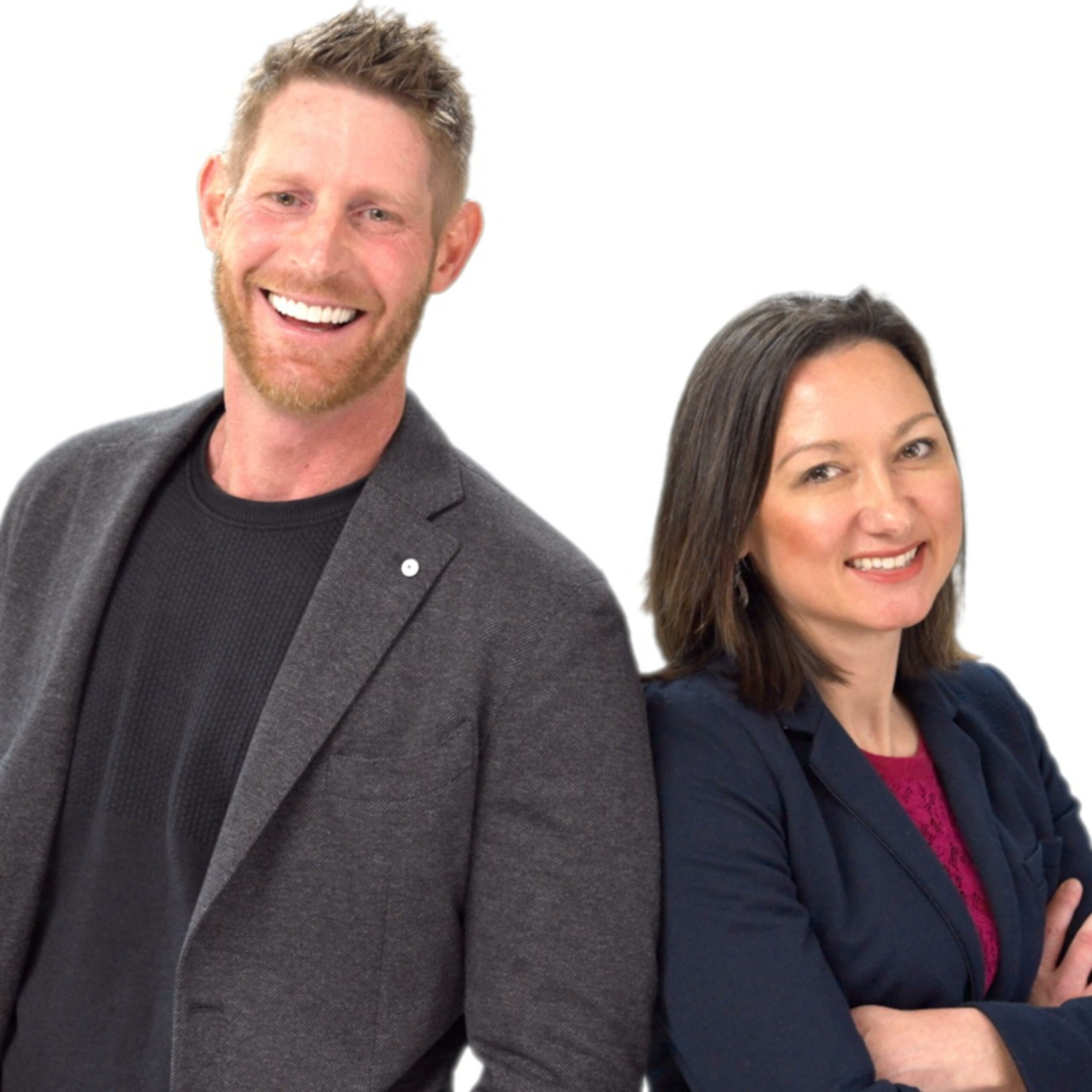
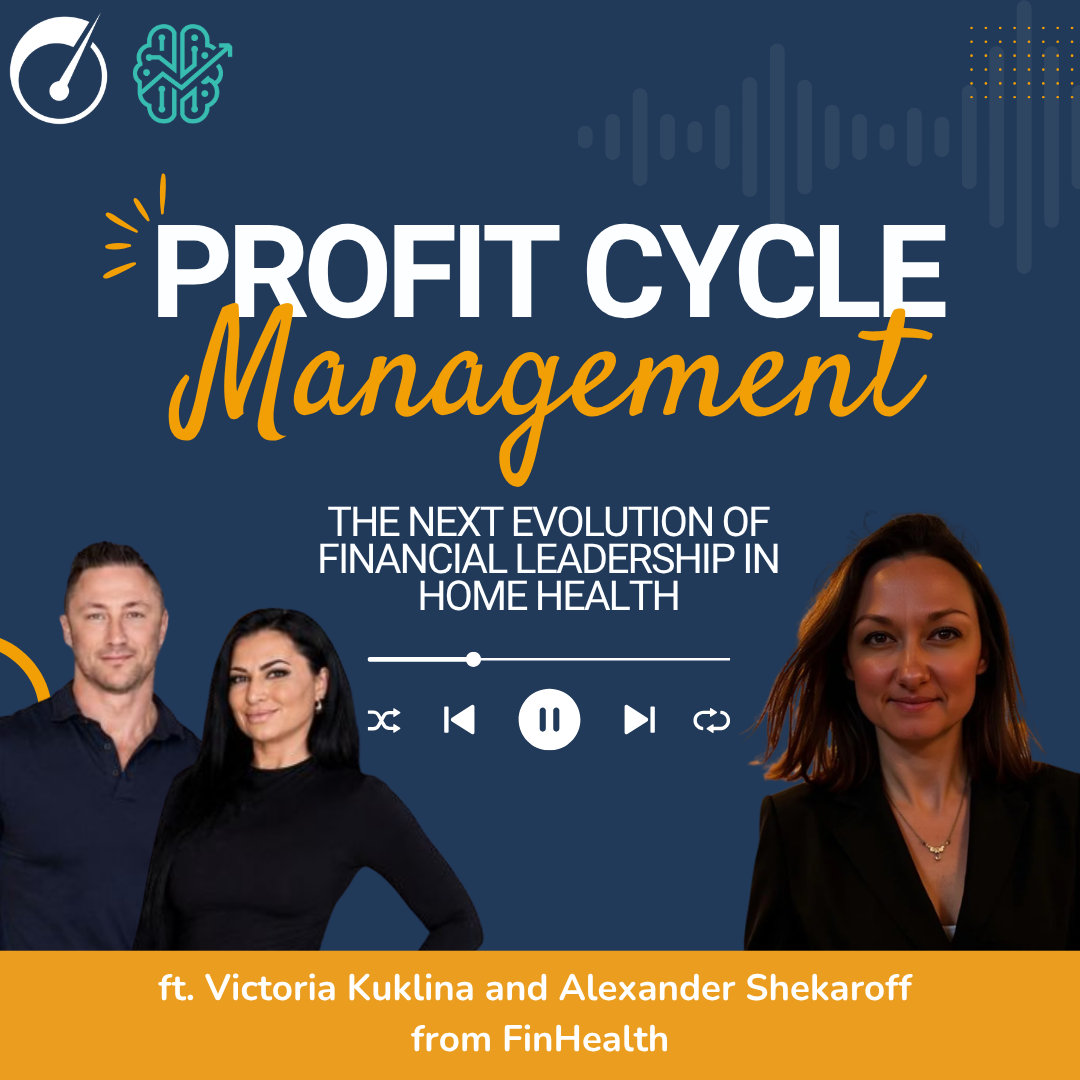
[00:00:03] Speaker A: Welcome to Home Health Revealed, the podcast for home health and hospice leaders who want to stay connected to the industry and ahead of what's next. Welcome back to Home Health Revealed. Today we're talking about something new that is beginning to gain attention in home care and that is profit cycle management, or pcm. Joining me today are Victoria Kuklina and Alex Shikarov, founders of Fin Health Incorporated. Welcome.
[00:00:29] Speaker B: Thank you, Hannah. We're excited to be here.
[00:00:32] Speaker C: Thank you for having us.
[00:00:35] Speaker A: I've heard both of you talk about profit cycle management and what struck me is that it doesn't just sound like software, it sounds like a different way of thinking altogether. So let's start there. What is pcm, Hannah?
[00:00:51] Speaker B: I think PCM is a new management discipline, is the idea that capacity, revenue, margin and cash are not separate functions. They're part of interconnected economic engine. And we believe that healthcare has been missing a framework that helps leaders connect those pieces together.
[00:01:11] Speaker A: Before we get into pcm, tell us a little bit about yourselves and how your backgrounds came together.
[00:01:18] Speaker B: What's interesting is that when we look back, our story is almost 20. 2020 story. I've spent more than 20 years in financial leadership. The decade was consulting, helping organizations solve financial and operational challenges across many industries. Then I spent seven and a half years as a CFO of a large home healthcare organization, helping scale the company from 17 to $200 million in revenue and 1,000 to 10,000 census. For 20 years, I've been studying how organizations create financial performance and not just how they report it, but how they create it.
[00:01:55] Speaker C: I've spent more than 20 years building complex websites and applications for different customers. My career has been focused on taking complex problems and turning them into scalable solutions through technology.
[00:02:09] Speaker B: And we've been married for 20 years.
[00:02:13] Speaker C: Yeah, so for 20 years, we've been having many conversations around dinner table about business leadership, systems, technology and problem solving.
Neither of us knew those conversations were preparing us for this.
[00:02:28] Speaker A: Well, congrats on 20 years of marriage. All of that is very remarkable.
[00:02:34] Speaker B: Thank you, Hannah. When we look back, PCM is really the intersection of those three 20 year journeys. 20 years financial leadership, 20 years of weapon app development and 20 years of building a life and solving problems together.
[00:02:49] Speaker A: So when did those paths finally come together?
[00:02:53] Speaker C: About a year ago.
For years, I watched Victoria from the sidelines. I watched her solve incredible, complex problems.
She would identify an issue, find a root cause, build a solution, improve performance. Then another challenge would appear, and another and another. And then we realized it was really the same problem appearing in different forms
[00:03:19] Speaker A: what do you mean by that?
[00:03:21] Speaker C: Well, that's when we realized that information wasn't connected.
The industry couldn't clearly see how capacity, revenue, margin and cash were influencing one another.
Every organizations were trying to answer the same question. Can we afford growth?
Why is margin changing? Do we have enough capacity?
What happens to cash if admissions increase?
Different organizations, different people, same questions.
[00:03:51] Speaker B: That's when I said something that changed everything. I told Alex, I think we can fix this if we connect all the dots I've been seeing for 20 years into a platform that I believe you can build. Because I had reached the realization I could continue consulting, I could continue helping one company at a time, but there would never be enough of me to help the entire industry.
[00:04:14] Speaker A: That sounds like a big realization.
[00:04:17] Speaker B: It was. The challenge facing health care is much larger than one company.
Over the next 20 years, our industry will need dramatically more capacity to care of an aging population.
This isn't simply a business challenge, it's a national challenge. The organizations caring for our parents, grandparents and loved ones need stronger financial foundation if they're going to meet that demand.
[00:04:42] Speaker C: That's when we realized the solution had to scale. And not through consulting, but through technology empowering leaders, giving them visibility that never existed before.
[00:04:54] Speaker A: So, Alex, you brought the technology piece. Victoria, what did your experience in home care teach you?
[00:05:01] Speaker B: One thing that became very clear to me is that healthcare has incredible leaders, incredible organizations, incredible systems. Everyone is working hard. Operations, clinical finance, revenue cycle, human resources, everyone. Yet many of the most important leadership questions remain surprisingly difficult to answer.
[00:05:22] Speaker A: Yes. Why do you think that is?
[00:05:25] Speaker B: Because the information exists in different places. If margin drops, finance looks at one report, Operations look at another report. Clinical leadership looks at another. Everyone is trying to solve the same puzzle from a different angle.
[00:05:40] Speaker C: Most organizations don't have a data problem. They have a visibility problem. They have dashboards, they have reports, they have meetings. What they're missing is a way to see how everything connects.
[00:05:54] Speaker A: Let's talk about pcm. What exactly is profit cycle management?
[00:06:00] Speaker B: Profit cycle management is a new practice of managing capacity, revenue margin and cash in one integrated system. Not four separate systems. One system, one engine.
[00:06:13] Speaker A: Can you give me a practical example?
[00:06:16] Speaker B: Let's take growth as an example. An agency wants to add 100 patients. Traditionally, that's viewed as a referral and revenue conversation. PCM asks additional questions. Do we have clinical capacity? What is the payer mix? Will labor costs increase faster than revenue? What happens to productivity? What happens to ebitda? And what happens to cash flow?
[00:06:39] Speaker C: The goal isn't to stop growing the Goal is to understand the consequences of growth before they happen.
[00:06:48] Speaker A: So PCM then is really about cause and effect.
[00:06:53] Speaker C: Exactly.
Most organizations manage outcomes. PCM helps leaders manage drivers financial statements.
[00:07:01] Speaker B: Tell us what happened. PCM helps us understand why it happened and what is likely to happen next.
[00:07:09] Speaker A: Why is this conversation becoming important right now?
[00:07:14] Speaker B: Because the healthcare is entering a new era. Margins are tighter, labor costs are rising, reimbursement pressure continues, complexity continues to increase. So organizations really need greater visibility more than ever before.
[00:07:29] Speaker C: And at the same time, demand is growing, the aging population is growing, the need for home base care is growing. The question is whether demand exists. The question is whether organizations can build the financial strength needed to meet that demand.
[00:07:48] Speaker A: So where does Fin Health fit into all of this?
[00:07:52] Speaker C: Fin health is the SaaS platforms that enables real time PCM. Profit cycle management.
PCM is a management discipline. Finhealth is a platform designed to help organization put that discipline into real time automated practice.
[00:08:11] Speaker A: Could someone practice profit cycle management without Finhealth?
[00:08:16] Speaker B: Absolutely. Think about accounting. Before QuickBooks, online accounting existed long before the software people managed it. Using ledgers, spreadsheets and manual processes. QuickBooks made accounting easier to operationalize and scale.
PCM is the same. FinHealth helps organizations put profit cycle management into practice more efficiently.
[00:08:40] Speaker A: What do you hope happens next?
[00:08:44] Speaker C: Well, we hope healthcare leaders begin looking at their organizations differently. Not as separate departments, not as separate reports, but as one interconnected economic engine.
[00:08:57] Speaker B: And ultimately stronger financial performance create greater capacity. Greater capacity means more patients served, more families helped, more access to care. And that's why this matters.
[00:09:10] Speaker A: So if listeners remember just one thing from today's conversation, what should that be?
[00:09:18] Speaker C: I think every healthcare organization already has an economic engine, whether they can see it or not.
[00:09:26] Speaker B: For decades, healthcare has measured performance. The next era belongs to leaders who can engineer performance.
And that's the promise of profit cycle management.
[00:09:35] Speaker A: Victoria, what is the thing that you are most excited about with this platform and how does it impact the decisions that agencies can make through profit cycle management?
[00:09:46] Speaker B: It's really more exciting to me. Hannah is seeing our clients seeing the information clearly for the first time since they running the business. And we have people that have been running these businesses for decades. The visibility it provides, it opens up all of the visibility into the profit and the revenue leakage that they couldn't see before. And as soon as they start solving those leakages, things start aligning and everything flows much better. And so it's really impressive how fast these operators can turn their business around by having this information at their fingertips.
[00:10:27] Speaker A: Yeah. And Alex, you Said something about data and how much data we have. But I think having data we pull up an app for payroll, right. We're looking at QuickBooks online, we've got our EMR. We have data that's just spread out amongst so many platforms. And maybe even spreadsheets. Golly, just maybe even sticky notes sometimes, right? Oh my gosh. To even think about it. But you take with your platform, with this fin health platform, it synthesizes all of this information to put it into one place. How do you feel, Alex, when you see the light bulb go on for these agencies when you're talking to them?
[00:11:05] Speaker C: I love it. I love it. I, I've, I've, I've done good things, great application software for other clients but this is the first time where we are helping majorly. Or it's, it's, it's, it's significant. It's, it's not little improvements here and there. It's almost like how is it possible that we were leaving millions of dollars on the table for all these years and we didn't know why it was happening? So I believe that because the visibility is there now, agency can really see how to avoid doing that and start accumulating cash in the bank. Because once you accumulate cash in the you can do a lot of great things with your business. You can scale, you can hire, you can expand, you can do a lot of things. But when you're struggling with payroll, which is very common.
[00:12:00] Speaker A: Yeah.
[00:12:01] Speaker C: It's very difficult to think strategically when you're dealing with day to day grind of keeping the business afloat.
[00:12:12] Speaker A: Victoria, you look at things in 13 week increments. 13 is my favorite number by the way. It's also a very lucky number. But why in your mind do you break the those things out into that 13 week time frame?
[00:12:27] Speaker B: It happens so that 13 weeks represents a quarter. So that's why we put it into those 13 weeks for cash flow forecasting. And we want to see a cash flow forecasted for the next quarter so we could foresee where we're going to be with our cash flow reserve in the next three months.
And by having that visibility of your actual weekly performance of cash money coming in, money coming out, nothing accrual accounting related at all, pure cash, we now can have prediction of what we can do if we're actually pushing on the rcm, collecting on the unbilled and getting that cash in a bank. And there is nothing more satisfying than to see all of the departments push on their pieces and all of that turn into a Positive accumulation of cash in the bank. Like Alex said, now we can use that for scaling, now we can use that for growing the business.
[00:13:26] Speaker A: Yep. So also within the profit cycle management platform for Finn Health, one of the things that I've noticed that you talk about is the ownership of the different pieces. And I think you've mentioned four various departments. We think about our businesses in silos, especially divided amongst that clinical, maybe even the operational and the financial pieces. But when each person or significant department can push the button that they are responsible to push, it helps everybody across the agency see where we can make even minor improvements that over time are going to have a trickle effect and cascade into.
Alex, you've mentioned millions of dollars and I think there are agencies who are probably listening who think, oh my goodness, millions of dollars that could be impacted and maybe even if we bring it back down to scale, we may have some agencies who are listening who are struggling to make the next payroll and the next payroll. And so millions of dollars, even thousands of dollars percentage wise, what kind of impact are you seeing with those?
The ability for each of those departments to push their button, so to speak.
[00:14:41] Speaker B: That's one of my favorite things really about managing a business is creating that accountability for teams and giving them clarity what they're managing. Everybody has KPIs, and our business, our industry does have a lot of KPIs to measure. But I believe that when everything is important, nothing is important, as the old saying goes.
And when everybody is managing more than a couple, more than 3, 4 KPIs at the same time, it becomes overwhelming. And then at the end, what happens is none of those KPIs really move the needle. So if we take a number of KPIs, let's say 12, and we break it down into a senior leadership team or people that are influencing the business, running the business and give everybody just a manageable amount of KPIs. And if everybody does their job, then the whole picture comes together as the whole pieces of the puzzle come together and you get your engineer EBITDA working, as you have expected that. And that's the beauty of it, that you want to create clarity for people and simplify their focus.
[00:15:53] Speaker A: I talk a lot about this industry being simply complex because I do think when people think through post acute home health care, there is an idea that it is simple. But truly under the surface there's so much that you have built that can help make the decision making simple, but it affects a very complex system. So thank you guys so much. And if and if someone is listening and they just think, I want to explore this topic a little bit more, I want to talk with Victoria and Alex about what Finn Health does. Where can they find you?
[00:16:29] Speaker C: They can find us on our website. There is a demo request, a demo link, www.fin-health.com.
[00:16:41] Speaker A: okay. And if you haven't seen this platform, do yourself a favor, go over to the website, look around, poke around, book a demo and see what kinds of changes you can make that would bring positive ebitda, positive marginal improvements to your business.
And ultimately our goal here with home health revealed, with Health Rev Partners, with Finn Health and these partnerships that we create, we know that what happens impacts patients and that's what we are about.
[00:17:11] Speaker B: Absolutely.
[00:17:13] Speaker A: Victoria and Alex, thank you so much for joining us.
[00:17:18] Speaker B: Thank you for having us, Hannah.
[00:17:20] Speaker C: Thank you, Hannah.