Episode Transcript
[00:00:02] Speaker A: You're listening to Home Health Revealed, where the business of home health comes to life. Hosted by Hannah Vail, each episode brings real conversations with the leaders, innovators and experts shaping the future of the industry. From reimbursement and technology to leadership and growth. This is Home Health Revealed.
[00:00:20] Speaker B: Hey, hey, everybody. This is Hannah Vail with Home Health Revealed.
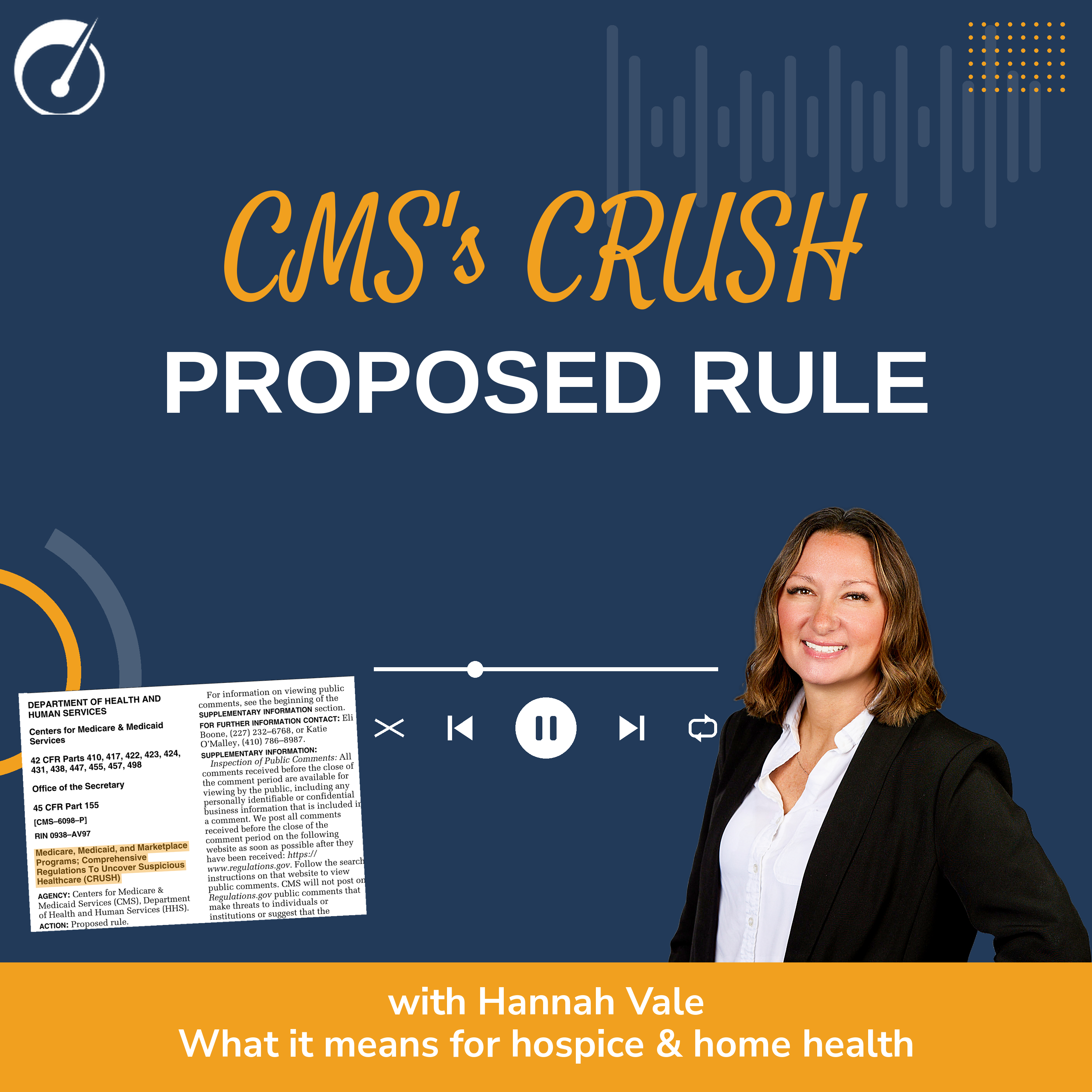
CMS has dropped a big new program integrity proposed rule and they named it crush.
That stands for Comprehensive Regulations to Uncover Suspicious Health Care.
Even the acronym sounds like I should be reading this in a WWE announcer voice.
In this corner, weighing in at 167 pages of tiny triple column Federal Register print, making its official debut on November 19th, the undisputed heavyweight proposed rule of the year, Crush.
Okay, I'm done. Mostly. I think I was only going to do that one time. But for the record, the preview version CMS posted before publication was 545 pages.
So 167 is the compact edition.
And you may not have time to read all of it. So stay with me and by the end you will know what this could mean for hospice and home health, what's already on the books, and what I would check this week if I were sitting in your office.
Before we jump in, three things. First, this is a proposed rule file code. Is CMS 6098P? CMS released it on November 16th and it is officially published in the Federal Register as of November 19th.
So nothing in crush is final. Nothing takes effect until CMS issues a final rule after it takes comments and responds to them.
Second, the comment deadline is now locked in. I believe the published rule says comments must be received by Tuesday, January 19, 2027.
That looks like the official date, so put it on your calendar if you plan to respond.
Third, this is not legal advice. None of this is legal advice. I am just walking you through what the rule says in plain English as I understand it and what I would be asking my team.
So for decisions about your enrollment, your ownership, your leadership structure, I would talk to council and your compliance folks before you change anything or do anything.
There is a lot in this package that's not in our lane. I consider our lane Home Health Hospice.
And so Marketplace Brokers, Durable Medical Equipment Marketing and big Medicare Advantage audit reforms are included. CMS's press release says the whole thing could save nearly 90 billion with a billion B, big B, $90 billion over 10 years. The rule itself describes that as about $90 billion in transfers, almost all of it from Medicare Advantage audit recoveries. And says CMS's actuaries not a job I have ever coveted, but thank goodness they exist. Have not scored the budget impact yet, so I'll leave that math to the accountants.
But here is a fun one. CMS's fact sheet says it plans to do program integrity rulemaking like this every year going forward.
So CRUSH may not be a one time match in our WWE match here. It may be an annual event like WrestleMania.
Okay, one more piece of advice. On November 16th, CMS published federal Register notices extending the nationwide freeze on the new Medicare, home health and hospice enrollments for another six months. The moratorium new enrollments are still blocked, including ownership changes that require a brand new enrollment so agencies that are already enrolled can add branches or practice locations. Again, talked about that in a previous episode and that is completely separate from crush, but it is still all in the same theme. CMS is watching who gets into these programs and and then who is running them.
So let's get into the rule. If you heard our episode on the 2027 Home Health Final Rule, some of this is going to sound familiar. The final rule, which published November 9, already gave CMS the authority to deny a new hospice enrollment in a few leadership situations.
CMS may deny if the medical director is the medical director of multiple other hospices or practices that are so far away and they used the example of a different state that they could not realistically do the medical director job. The hospice regulations require same idea for the administrator, multiple other hospices or too far away to realistically do that job.
And CMS may deny if the medical director does not have an active physician license in the state where they are practicing.
That denial authority is already final.
CMS was careful, it seems, about the scope. It is not a formal ban on serving at more than one hospice. There's no mileage limit, there's not a cap on the number of hospices, and it doesn't change the hospice conditions or participation. CMS said it would use this in limited instances after a careful look at the facts.
What they're aiming at is one person listed as a medical director or administrator at a stack of hospices, sometimes across the country, or a medical director without an active license.
So what does CRUSH add?
Two things. First, CRUSH would take those same leadership issues, multiple hospices, distance licensure and make them a reason to revoke a hospice that is already enrolled, not just getting in the door, but staying in the building.
And second, a brand new one. And this is the one I would circle if I were a hospice administrator or a board chair.
CMS is proposing the authority to deny or revoke a hospice's enrollment if the hospice changes ITS administrator within 36 months of its initial enrollment or within 36 months of its most recent administrator change.
And I can feel the announcer voice just wanted to come back in here and you cannot change your administrator for three years. But that's not exactly what it says. CMS says pretty plainly here that this would not be an across the board prohibition. People retire, people take another job. CMS knows that what it wants is the discretion, the ability to act when turnover looks like a pattern it has seen in fraud schemes.
Someone opens a cluster of hospices, sometimes in the same building, bills Medicare leaves, goes, does that again somewhere else. So hospices start with the basics this week.
Pull your leadership roster. Who is your medical director, who's your administrator? How many other hospices are they serving, where are those hospices located? And whether the medical director's license is active in the state where they're practicing. Of course, if an administrator change is coming, and you know that, look at two dates.
When did you first enroll and when did you last change administrators? A change inside that 36 month window is not necessarily forbidden, but it may cause you to get a closer look. So be sure to document the reason and make sure you're proactive with that.
All right. Ownership. Because home health is squarely in this one too. So talking about ownership changes in home health and hospice, there is already a 36 month rule for home health agencies and hospice. So if you have a change in majority ownership within 36 months of initial enrollment or of your last change in majority ownership, you generally have to enroll as a new provider and go through surveyor accreditation. Again, the point is to stop flipping where someone gets enrolled and then quickly sells so the buyer skips the scrutiny. The 2027 home health final rule also lets CMS deny or revoke when an agency does not follow that rule.
Crush then would go further than that. CMS is proposing a new section and the Number here is 424.536 that would let it deny or revoke the enrollment of any provider or supplier involved in a change in majority ownership. If one of these two things is true, one, the seller, the buyer or any provider involved failed to comply with Medicare enrollment requirements.
Think about a sale that never got reported.
Ownership changes already have to be reported within 30 days.
And CMS walks through an example of a hospice sold after five years.
So they're outside of the 36 month window where nobody told Medicare and the old owner is still the one on file under this proposal, CMS could then revoke that hospice and deny the new owner if they try to re enroll it.
2 so going back to this, if one of these two things is true, so the second thing CMS determines that the deal itself, the seller, the buyer or any provider involved poses an undue risk of fraud, waste or abuse.
A few details A change in majority ownership here means someone acquiring more than 50% direct ownership, including through the cumulative effect of asset sales, stock transfers, consolidations or mergers.
It would apply to every provider type inside or outside the 36 month window and changing the name, identity or location would not get you out of it. CMS says that that was done on purpose so a name change cannot be an escape hatch.
This would not replace the existing 36 month survey and accreditation rule it would set. On top of that, if you are planning a sale, a merger or any deal that could cross that 50 percentile line, you want to get counsel involved early and make sure the reporting is clean. The reporting is on time.
Do not assume that being past 36 months makes it a paperwork exercise and nothing more. If you are not selling anything, still make sure that the ownership CMS has on file is the ownership that actually exists that you actually have. Because an unreported change is exactly what this proposal seems to be written to reach.
Let's talk then about Medicaid evv.
So if you bill Medicaid for home health or personal care, this next piece may apply to you. States already have to use electronic visit verification EVV for Medicaid, personal care and home health services.
EVV captures really six things. The type of service, the person receiving it, the date, the location, the person providing it, and then the start and end time. Guess you'd count that as seven if you separate the start and end time. What crush would change is how states use that data.
CMS wants states to check it before they pay.
During prepayment review, the state would have to verify that a billed in home service subject to EVV is supported by an EVV record for those same 67 elements.
That covers services under the federal EVV requirement plus any extra services a state chooses to put under EVV.
CMS calls this, and I'm air quoting here, cost avoidance instead of what they have called pay and chase.
In plain English it means match the visit data, then release the payment.
States would also have to review EVV records as part of a preliminary investigation. When there is a fraud or abuse concern involving EVV services, CMS gives examples of what it is hunting for billing for two patients in different places at the same time, improbably large volume of services and same day visits. That would be geographically impossible.
Two footnotes so I do not overstate this as written. The prepayment piece applies to Medicaid fee for service. CMS is asking whether to extend it to managed care.
CMS is also asking whether states need a transition period and what should happen when a legitimate claim does not have an EVV record.
Those are exactly the kinds of operational comments to send in.
And then one other related piece. CMS would require states to Collect and use NPIs for every Medicaid provider that is eligible to get one across enrollment claims and managed care oversight. CMS specifically calls home health and community based services and personal care attendance where inconsistent IDs make it hard to catch things like overlapping shifts.
So if I were you I would not wait for the final rule. I would look at a sample. Now line up your EVV records with your claims service, patient date, location, caregiver start and end times and if those do not match what you billed that is already a concern. That's already a problem.
It would just become a more immediate problem if the state has to catch it before paying.
Let's talk about Medicaid money and Medicaid enrollment.
Staying on Medicaid for a minute here because there are three more pieces. Most of the summaries skip overpayments. You probably know that Medicare the Medicare 60 day rule. Once you identify an overpayment you report and return it within 60 days.
That law has always applied to Medicare too, but CRUSH would finally write down the rules for Medicaid fee for service.
You would report and return the money to the state through the state's process with a written reason within 60 days of identifying it, or by the cost report due date. If that is a later date, there would be a six year look back period and holding on to it past the deadline is a False Claims act problem. If you have Medicaid credit balances sitting on your books, consider this your nudge payment suspensions.
States could rely on a credible allegation of fraud finding made by CMS or another federal agency to suspend Medicaid payments and a state could keep a suspension in place during its own investigation even if law enforcement does not take the case as long as it rechecks and documents that at least every quarter for enrollment.
CRUSH would add new grounds for states to deny or terminate Medicaid enrollment, which that largely mirrors Medicare. But then unlike most of the Medicare grounds, these would be mandatory for states with best interests exception for most of them. So for example, a state would have to act if an excluded or debarred person is among your owners, your managers, your staff.
And that does include contractors, not just your W2 employees.
So make sure your monthly exclusion checks cover everybody.
All right, Zooming back out here to Medicare Some of Crush applies to every provider and supplier identity checks. CMS says its current tools for verifying who is on an enrollment application are pretty limited, mostly a name and a Social Security number check. And it has seen a rise in identity theft.
So it could require an individual provider, owner, managing employee, partner or officer or director to submit a driver's license, a passport, a Social Security card, a birth certificate or some kind of similar document.
The qualifier so nobody panics.
CMS says it would not ask as a matter of course, only if another verification fails or it suspects identity theft.
It says the overwhelming majority of providers would not have to submit them, but that CMS could also deny or revoke it or revoke if a domestic or foreign owner, managing employee, managing organization, partner, officer or director cannot have their identity or location confirmed or poses an undue risk of fraud, waste or abuse. CMS says directly that it is not banning foreign ownership.
Next Faster reporting of enrollment changes today. Ownership practice, location and final adverse actions are generally due in 30 days and most other changes get 90. Crush would make it 30 days for everything.
For every provider type a new managing employee, a new corporate officer, a new DBA doing business as name, a new billing agency, a new bank account 30 days.
CMS says this does not mean it plans to revoke everyone who misses the deadline. Revoking for late reporting is discretionary, but here is the part I really think you should hear.
CRUSH would also strip out the factors CMS currently has to weigh before denying or revoking. On a long list of grounds today for late reporting, CMS has to consider whether you reported how late and how material the information was.
CRUSH would delete those factors and CMS says those factors have tied its hands. So we were only a little late would carry a lot less weight in this case.
Two more new revocation grounds 1.
CMS could revoke if you engage in improper activity is the quoted words improper activity related to your Medicare enrollment, any billing number or your electronic funds transfer setup. CMS says it would use this only in exceptional circumstances.
And then two this month's Home Health Final rule lets CMS deny a new enrollment in the same suite as a revoked provider and revoke when an area is packed with an excessive number of providers CRUSH would make both of those work for denial and for revocation.
If you share an office building, make sure you know who your neighbors are then Medicare Advantage CMS is proposing that every provider and supplier billing Medicare Advantage be enrolled in original Medicare in an approved status in network or out of network.
If finalized, it would not apply until January 1st of 2030.
So you've got a few trips around the sun, but if you already bill original Medicare, you're probably fine on this. I say probably. But if you do not, make sure you put 2030 on your planning calendar. Because timing is going to matter. Timing Unless a provision says otherwise, CMS proposes that crash provisions take effect 60 days after a final rule publishes.
The Medicaid overpayment rules would apply to states six months after the final rule, and the Medicare Advantage enrollment requirement still waits until 2030 until there's a final rule. None of this is in effect. But if and when, those are the dates that you need to have in your brain.
Okay, highlighter out then for this lightning round Checklist if you will.
1. Hospice Leadership Roster, other hospices they serve where they're located, and an active medical director license in the right state.
Denial is already final revocation is what Crush would add.
2.
Administrator changes know your enrollment date and your last administrator change and document the legitimate reason for any change.
3.
Ownership make sure what CMS has on file matches reality and get counsel early on for any deal that even comes close to that that 50% line number. 4. Enrollment reporting who updates picos and files the 855 and how fast. Plan for 30 days on everything with less room for we were close and 5. Evv if you bill Medicaid, home health or personal care sample claims against EVV records and fix any gaps that you have right now.
6.
Medicaid overpayments and exclusion checks. Work down old credit balances and screen your employees and your contractors.
7.
Medicare Advantage not enrolled in original Medicare Then start that conversation now. You do have until 2030 if this goes live or takes effect, but might start thinking that direction. 8 Comments if any of this would create a problem for a compliant Agency for Rural Leadership for a legitimate administrator succession plan for your EVV edge cases the 30 day clock time, write it down and send it in.
Please submit your comments, submit your thoughts and take part in this conversation.
So that is Crush C R U S H a wrestling poster name on a very serious rule for hospice and home health. The parts to watch are your leadership, your ownership, your Medicaid EVV and your overpayments faster enrollment reporting with less wiggle room, tighter identity checks and original Medicare enrollment for anyone billing Medicare Advantage one more time without my announcer voice. I will try this is a proposal. It is not in effect.
This may be a different conversation in a few weeks, but CMS still has to take in comments, still has to write the final rule and set the effective date so you do have a say in what this final version looks like. To comment, go over to it is regulations.gov and the docket is CMS2026 0826 and use the file code CMS6098P.
Comments have to be received by January 19th. So while you're eating turkey, while you're opening gifts, celebrating holidays, jot some things down on a napkin and get them turned in. Think about what you want to say to cms. You can also mail them if you love to lick an envelope and stick a stamp on there. The addresses are also in the rule, so leave time for mail if you want to do that.
I'm going to link the Federal Register notice in the show notes.
And if you want to talk more about this, if you want to talk about your process, that's the kind of work that we do with agencies every day, really more on the billing side. But I think these things, these rules are going to touch many pieces of operations within home health and hospice.
Start with your own roster, start with your ownership, talk with your council.
Get things in order. This is a great time to start thinking through how as an industry, we are all together mitigating fraud, waste and abuse.
I'm Hannah Vale. This is Home Health Revealed.