Episode Transcript
[00:00:03] Speaker A: Welcome to Home Health Revealed, the podcast for home health and hospice leaders who want to stay connected to the industry and ahead of what's next.
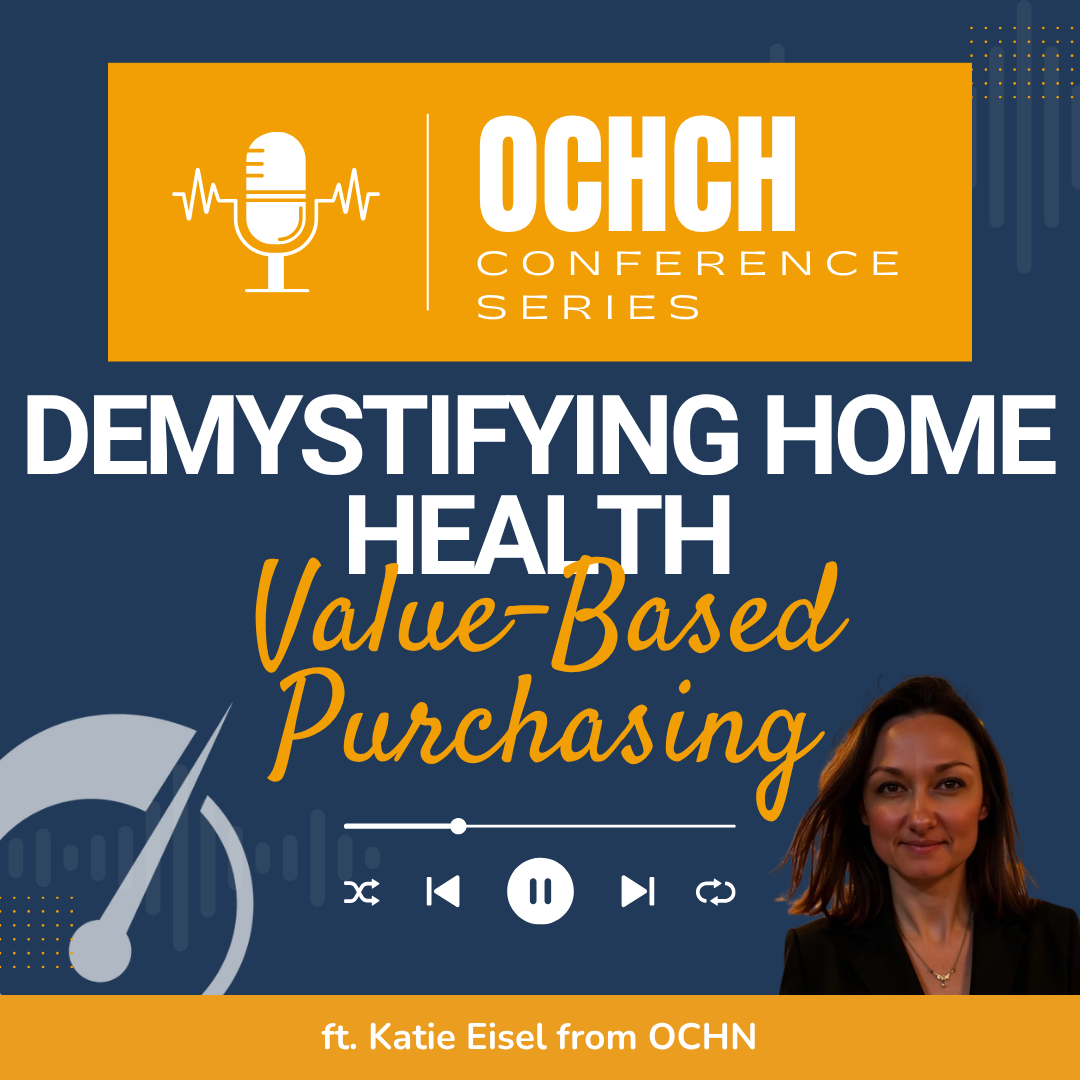
[00:00:11] Speaker B: Hi, I'm Katie Eisel. I'm the director of payer relations for the Ohio Community at Home Network. We're a subsidiary of the Ohio Council for Home Care and Hospice.
[00:00:19] Speaker A: And you spoke yesterday on a topic that has continued to come up and is still right at the forefront of what we're doing, and that is value based purchasing.
[00:00:29] Speaker B: Yes.
[00:00:30] Speaker A: Tell us about your presentation. Give us some of the key highlights.
[00:00:35] Speaker B: Home health value based purchasing is really the true measurement. While I think a lot of agencies view it as just another way for CMS to make them jump through hoops, I think that home health value based purchasing really has hit the mark in contrast to the star rating. So this presentation, because home health value based purchasing, those reports can be really cumbersome. They can be intimidating.
This presentation breaks it down in a very simplistic way.
And when I start the presentation, I preface it with we're not going to get into the granular level. We're not going to understand all the calculations. I'm going to show you how I look at these reports in a very simplistic way that you could even have your field staff understand where you are as an agency. And then with the presentation as it progresses, I end up teaching the agencies how to not only look at those reports in a very simplistic way, but I give them tools for their tool belt. Right. So what can I do with this information?
Very easily to change the course for my, for my agency, the more the
[00:01:44] Speaker A: field staff can be involved and understand, I think it's better for the agency overall because they know how their actions and their work impacts the value based purchasing measures.
What are some of the maybe two or three top things that you say?
If this number or if this metric looks like this, this is what you do.
[00:02:06] Speaker B: So that would be for your home health value based purchasing, that would be your overall score. So if you're above the 50th percentile, you as an organization are doing okay, but you have to also determine how close you are to that 50th percentile. So if you're sitting just above the 50th percentile and everybody else improves over the next year, you improve too, but they improve more. You could actually find yourself in the 40th percentile. So that's, that's difficult. And so yes, I did talk yesterday about making sure that your field staff are aware of where you are as an agency, but also I think with field staff. And I see this in a lot of agencies, there's a disconnect between the field staff and the air quoting here at the office or the leadership. And so they believe that just going out and seeing patients and taking care of patients is their job. But at the end of the day, we can't improve our home health value based purchasing scores without our clinicians understanding what role they have in our home health value based purchasing score. So this presentation gives the agency leaders tools and how to communicate to the staff so that they understand that it really starts with them as far as how we perform as an agency when
[00:03:21] Speaker A: we're determining like the staff that we have, they're out there in the market, right? They are. They are the agency, truly. I mean, most patients are never going to interact with the back office staff. So it is such an important piece of delivery to make sure they understand that. They know that and what they do impacts not just the back office, but the bottom line, the growth that the agency is able to have for the future.
Because they're affecting margins and costs.
[00:03:47] Speaker B: Right.
[00:03:49] Speaker A: So there were some. Well, in value based purchasing, some of the measures are weighted.
[00:03:54] Speaker B: They are.
[00:03:54] Speaker A: Right. And so a lot of maybe, I won't say a lot agencies who maybe don't understand the weights. What do you see as the biggest aha for when you're describing all of these? And they say, oh, I didn't realize that had such a big impact trying
[00:04:12] Speaker B: to go through these weights in my head here.
I would say the management of medications. And then so not necessarily the weight in that. I think that that one is positioned to fourth in the weights if I'm thinking correctly and seeing it correctly in my head right now. And I think that that's really appropriate because we cover that in the presentation. That that is one of the top reasons that patients go back to the hospital is that they just simply can't manage their medications.
What shocks me a little bit with the weights and I think does also do the same for providers is the improvement in upper and lower body dressing.
So those, those categories where we're looking at the overall physical function of the patient, they carry overall a very low weight. But what we talk about and what I talked about in the presentation is that those kind of roll up into, you know, the discharge function score and potentially preventable hospitalizations. And, and the way that that happens is, is if we physically improve the ability of our patient so their ability to take care of themselves naturally you're going to better Avoid a hospital stay, you're going to have a better discharge function score. So although those don't carry a ton of weight, if you don't pay attention to them, you're going to struggle in the higher weighted or items like the discharge function score. If that makes sense.
[00:05:31] Speaker A: Yeah, it does.
So all things kind of play together.
What about star ratings? I know that was on the list. What else? What else was on the list?
Trying to think of your slide yesterday and kind of as I was bebopping through my brain.
[00:05:46] Speaker B: Yeah. So we talked a little bit about star ratings and when I talked about star ratings it was really to just try to have the agencies understand why we now have HHVBP when we have the star ratings already.
And we covered that. We covered. And this is really my brainstorm, my thought, my opinion on that. But I think star ratings just because at the end of the day, agency reputation, the care of the clinicians and how the patients feel about them and in their particular communities that can supersede the star ratings. And home health value based purchasing gets really, really granular and it's more difficult to, I guess per se skew the results. Right. And so I think, and when star ratings came out, the intention was that patients would go online and look at the star ratings and the agencies would then go out of business because people saw that they maybe they're one or two star and they would choose all the four and five stars. But because people were a little bit more, I guess, able to skew those, you know, that, that data, you know, we had situations where again the reputation superseded that one or two star rating or vice versa. We had a five star agency that really, really wasn't a five star agency. And so with home health value based purchasing, yes, it still ranks everyone, but there's payment tied to it. Not just you aren't going to get referrals, it's you can still get referrals but your payment will suffer if you do not, you know, take notice and you do the things that you need to do to improve.
[00:07:24] Speaker A: I don't think the average person knows to look at star ratings. I think my parents, people I know, if they were looking for care for someone, they would go to Google, they would look at Facebook.
[00:07:38] Speaker B: Yes.
[00:07:39] Speaker A: Some of those places where you can read reviews that are very, very specific.
I don't, I think some of those measures, if you will, that have nothing to do with value based purchasing.
But I think there are own social measures for things that we look at to determine where we would send our Loved ones for care. That. And then of course, word of mouth is the most powerful when it comes to referrals, I think.
What else about value based purchasing, should I ask you or do you want to share?
[00:08:10] Speaker B: If I were looking at the three sections, number one, I think what is easiest for most agencies to address are the OASIS based measures.
You know, that's what we do as clinicians is we try to make our patients better overall.
The second category, which is, you know, hospitalizations and you know, the Medicare spending per beneficiary, those, those are a little bit more difficult. And for whatever reason, we all as an industry continue to struggle with the hospitalizations. I think we'll see better scores now that we're moving to the potentially preventable hospitalizations.
But still, I think we as an industry struggle with that. And I give a lot of tools in my presentation on how to address the hospitalizations, not just telling agencies where to look to see what they're doing, but I. E. One of the examples I gave is utilizing urgent cares and making sure your clinicians know all the urgent cares that are in their areas and the urgent cares that can do blood work or do chest X rays, because that doesn't count as a hospitalization, it doesn't count as an ED visit, and the cost is much less right. For an urgent care visit. And then in that third category, which is HH caps, I think that's just often overlooked. And like you just said, Hannah, word of mouth, right. So hhcahps really is that word of mouth. How does the patient feel or their family member feel about the care that you delivered? And because it's only 20%, I think sometimes we think it's kind of not worth it.
But 20%, and getting those points from HHCAHPS could make a big difference where you're at 48 percentile and then you're finding yourself at perhaps the 52 percentile. So it could throw you over. So I think when agencies try to. And a lot of my presentation is looking at the weights and working smarter, not harder. Right. And being strategic. But at the same time, I don't want people to miss the message that it's important all of these tie together. And so don't think that you can't and shouldn't focus on one particular section.
[00:10:20] Speaker A: And I think as an agency it's
[00:10:22] Speaker B: easy to say like, we have to
[00:10:24] Speaker A: do all of these things, but if you start with one or two.
[00:10:29] Speaker B: Yes.
[00:10:29] Speaker A: And for me, I think OASIS based measures is a logical place to start because that can be Systematized to some degree operationally within your organization. You can make sure that you're checking your OASIS documentation, you're educating your nurses on what needs to be there, you know, within those, you know, your functional improvement scores, your things like that that can be compared to guidance really, truly sticking to, you know, your bible of the regulations and then showing the improvement of that patient. Right. Some of the claims based measures, like you said, get a little more, I don't know, maybe convoluted and take a little more time. Although it's not that you can't address those things.
[00:11:15] Speaker B: Right.
[00:11:16] Speaker A: As part of your training for what goes on in the home and the education that you give to the patient.
Some. And I feel like we do surveys everywhere also. I'm Melanie and you know, I'm circling this right here and we would love it if you do the survey for us and you get whatever some of it is educating the patient on the fact that you want to deliver the best care possible. And so they're going to be rating you. Can you, you can say that, right? You can absolutely say that. Is there anything that, you know, I need to do differently for? You can.
Why would you not ask those questions?
[00:11:47] Speaker B: Yeah, so I think with hhcahps, a lot of agencies shy away or they get a little nervous when they are using actual words from the HHCAHPS survey. And you can do that. You just can't replicate the survey and actually have the patient, you know, fill out a survey that you've created off of that, you know, things like that. But you can use what I call, and I talk about this in the presentation buzzwords.
So actual words that are within the survey. So if in one example I gave yesterday is just having your clinicians, when they enter the home and when they leave the home say, you know, Mrs. Jones, we always want to be a 10 for you. So, you know, we're going to get started with your, with your visit today, but just keep that in mind. If there's anything, you know, else that you think of that we need to address while I'm here today, let me know. And then as they're leaving. All right, Mrs. Jones, remember, we always want to be a 10 for you. Is there anything else you need before I leave?
That's simple. And then when the patient goes to fill out that HHCAHPS survey, they've heard it day in and day out, you know, that you want to be a 10. And when you tell someone that you want to be something, it's very hard, I think As a human to not follow through on that. So you say you want to be a 10, you better be a 10, right?
[00:13:08] Speaker A: Yeah.
[00:13:09] Speaker B: You can't just say, I want to be a 10, and then provide care that's at a level two or three. Right.
So I think it also.
Pressure is not the right word, but it encourages the clinicians to deliver that 10 type care for the patient.
[00:13:24] Speaker A: And it puts the responsibility on the patient to vocalize if they're not receiving that care, which empowers them as well.
Because when the clinician is asking or saying, I want to be a 10 out of 10, keep that in mind. Is there anything I can do so that, you know, I'm fulfilling my 10 out of 10 responsibility, whatever. However they say that. Right. That gives the patient the opportunity to say, well, you know, I'm wondering about this, or could you do this? What about this? So they have the opportunity and it becomes a responsibility of theirs to bridge that gap for anything they would have needed.
[00:13:58] Speaker B: Yes, correct. Right.
[00:14:00] Speaker A: Which is great because I think it gives them an opportunity to say, hey, I was wondering about this because you have to remember, the patient is in such a place of vulnerability.
They are homebound, they are dependent. They're looking to the expertise of these home health nurses, aides, caregivers who are coming into their home.
And so they may have had a couple of sleepless nights with a lot of questions about what their own future looks like to have the ability to have a conversation that's meaningful.
I can imagine as a clinician, it could be easy to go in the home to get the vitals, to do the things to almost like, check mark, you know, what's on your visit list and fulfill your duties. But it also gives you that moment to pause and address them as a human being and say, what else can I do for you?
[00:14:51] Speaker B: Yes. And I think also, you know, there's isolation that we see in home health. So patients, sometimes our clinicians are the only person outside the home that, that they see and they get to interact with. I think it's really important that we have our clinicians take the time and that the patients don't feel like we're rushed. I have an example. This was years ago, but a clinician was doing wound care. And I think the Visit was maybe 25 to 30 minutes. So it wasn't very long at all. And so we were just questioning how is that care done? She had a good relationship with the patient.
And so, you know, I'd asked her, I said, well, you know, that that's a pretty extensive wound. How, how did you do, you know, the medication reconciliation? How did you do education with the patient? And she said, oh, well, I was, while I was doing the wound care, we covered those things.
And lo and behold, this wound was on the patient's backside. So, you know, that was concerning to me. So we have a clinician that's talking and doing education, talking about any medication changes and whatnot, and the patient is clearly not facing them. Right. This is, you know, and so I think that it's really important that again, our clinicians understand the. That importance. I say importance a lot. Right. That, that is important for them to have that face to face conversation and make sure that they are doing the right things to be a 10 for that patient. Now that nurse, you know, did a great job. Again, she had a great rapport with that patient, but she was also not talking to that patient face to face. And she was able to obviously have good satisfaction. But at the end of the day, I think we have to be careful and we make sure that we are taking the time to ask face to face how we're doing. I think we as wouldn't say an industry, but just as a people within this country, we are definitely getting more and more comfortable with not having face to face conversations.
So.
And then we, we deal with a generation that is still craving the face to face interactions as well.
[00:16:58] Speaker A: Yeah, we, I was talking yesterday with somebody about just the generational kinds of spectrum that we're working with, especially in home health. We're not always dealing with an elderly population, but much of the time we are.
And so we're dealing with people who are not as comfortable with technology, but we're dealing with their children who may be very involved in their care, who are much more comfortable with technology. And we were talking about telehealth visits and telemonitoring and things like that to the point where I said my kids are going to expect probably nothing but phone call, virtual visits, those types, and even myself using virtual visits rather than going into the urgent care for my kids when it's things that I'm like, you're gonna be fine, but you know, we're gonna make sure that you are. They are so much more comfortable with that. I never did that growing up. It wasn't, it didn't exist then.
[00:17:52] Speaker B: Correct.
[00:17:53] Speaker A: So we have such a unique spectrum of expectations across those generations right now.
And the employees that we have are in a generation below, generally.
[00:18:07] Speaker B: Yes.
[00:18:07] Speaker A: And so it's just being aware of the needs of your patient, aware of their desires. Because some of it's not need, but it is a barrier. If you're not able to communicate in a way that they understand it, they're able to absorb it, make sure that they know what you're talking about, what they're doing, how to best take care of themselves. So it's just, I think it just really does come down to that awareness piece.
[00:18:32] Speaker B: Agreed.
[00:18:33] Speaker A: Well, you get to do really cool things within the Ohio council. And I've gotten to talk to several people who are very, very involved in the council, doing a lot of really great work through ccbc. We didn't even talk about OCHN, which you're very involved in as well.
[00:18:48] Speaker B: The OCHN is the Ohio community at home network.
And we are a network of.
We're close to 60 agencies, over 70 locations across the state of Ohio. And what we do is we work with all of these locations for their contracts with managed care payers across Ohio. And then we also help them on anything and everything payer from intake all the way to adrs, billing authorizations, any payment projects that they may have with the payers, we help the agencies work through those. Even if an agency wants to contract with a payer, but it's not one of the contracts that the OCHN has, I will link arms with that agency and walk them through that process, give them tools to use in their negotiation process with those payers.
But I think for the OCHN and what we hear a lot from the agencies is, I'll be honest, you know, we do a good job of having some really good contracts and terms within those contracts with the payers across the state of Ohio. But where I think the biggest value add comes is from, quite frankly, the communication for me, the communication from all of the agencies at once. So being able to figure out very quickly whether or not there's a pattern, there's a trend with a payer, there's significant issues that we need to take as a counsel to that payer and as the OCHN to that payer to raise the red flag.
We've had several examples specifically, specifically at the beginning of the year over the last couple years where we've identified a significant payer issue with payment for the agencies and we're able to get that rectified very, very quickly. Where we've had non member agencies let us know that it's been six months now and they still have not received payment for this beginning of the year issue that they've had with that payer. So that's when we're like oh goodness gracious, we'd love for you to be a member so we can help, you know, escalate those problems and get them fixed very quickly. So I think responding the response time and then also being able to help agencies at a very granular level. I'll be honest.
Patriot Home care is, Patriot Home is one of our, one of our members. And their, their CEO Greg has said he doesn't really interact with me a whole lot, but he knows his, his office staff and his leadership interact with me on a weekly basis and which they do. So again, it's not just limited to the contract at the ochn. It really is expansive to anything and everything payer related.
Again, with any departments, I talk to authorization staff at an agency, I talk to billing staff and help them at times and I enjoy it because I learn along the way as well. So again, yes, I'll stop there. But anybody who's ever interested in reaching out and finding out more about the ochn, we would love to have them do that.
It just only helps our presence, if you will, in the state of Ohio and with the payers, you know, the more members we have and then again the efficiency and effectiveness of working with the payers increases as, as we grow.
[00:22:00] Speaker A: Yeah, there's power in numbers. There is and it gives you negotiating power.
Conversation power.
[00:22:06] Speaker B: Conversation power I think is the biggest.
Another thing that we do at the OCHN is we have a clinically integrated network.
So we have a smaller group of that large group of agencies that are now part of our clinically integrated network. And so this group is a group that is committed to improving their process processes, their clinical care delivery. So being a nurse, that's something where although I work with the payers, there is a translation that needs to happen. You can't just ask for better rates and better terms and not deliver better care or proper utilization of that care within your contract so you can have a great contract. But if at the end of the day your clinicians are delayed delivering way too many visits on patients when it's not appropriate, we have to fix that. So these agencies have also committed to working together. So there's peer to peer meetings every quarter, there's one on one meetings with agencies and then there's group meetings and they share best practices. So together, this clinically integrated network group is ideally what we believe will take us, you know, into the next level with the payers. So when a payer comes to us and wants to do a pilot type program or a value based contract with some risk involved in it. This will be the group that we can take to that payer and say this group of agencies is going, is committed, they're committed to working with us on these particular additional contracts and projects, if you will, with the payers. And you know, I'd love to have our entire membership be able to do that. But full disclosure, you know, we have a whole big spectrum of agencies so some that are, that are really just not there yet to do the value based and risk based type contracts and some that are quite frankly just learning more about managed care. And then we have a lot that are just getting into managed care because of the duals where they, they didn't really dabble in the Medicare Advantage plan because they were strictly Medicaid and now they're finding themselves they need to be able to do that and it's just a whole nother animal for them. So again, I think that's really exciting too is that we, it does help having numbers for discussion but also having the sin as well, being able to have that for higher level discussions with the payers is fantastic.
[00:24:40] Speaker A: Where can somebody find out about the OCHNO so they can look up the ochch.org yes. Is it on the website connected to the Ohio Council?
[00:24:51] Speaker B: It is.
[00:24:51] Speaker A: Okay.
[00:24:52] Speaker B: And but I will tell you we're currently working to revamp the OCHN's website. So and we're going to have more information for that coming soon. We have a marketing committee that's working on that and then also for the members so there will be like a separate section of that site for the, the members to see all the archived education, our meeting notes. So that's the other thing that we do at the OCHN is we have monthly meetings and we cover anything and everything payer that's been happening federally, state and locally for the agencies across Ohio and any new best practices perhaps that we've come across.
And then I also do, at about every other monthly meeting I do an education piece. So this last meeting we cut covered the HHCAHPS survey and I actually pulled out the new survey that's coming up and went through it question by question and gave agencies tips and tricks on how perhaps they can inject those questions into their everyday interactions with the patients without, you know, crossing that line of actually, you know, verbatim regurgitating those questions.
[00:25:57] Speaker A: Yeah, no, that's great.
[00:25:58] Speaker B: That's very practical advice too.
[00:26:00] Speaker A: Well, thank you so much Katie, I appreciate it.
[00:26:02] Speaker B: Yes, thank you, Hannah.