Episode Transcript
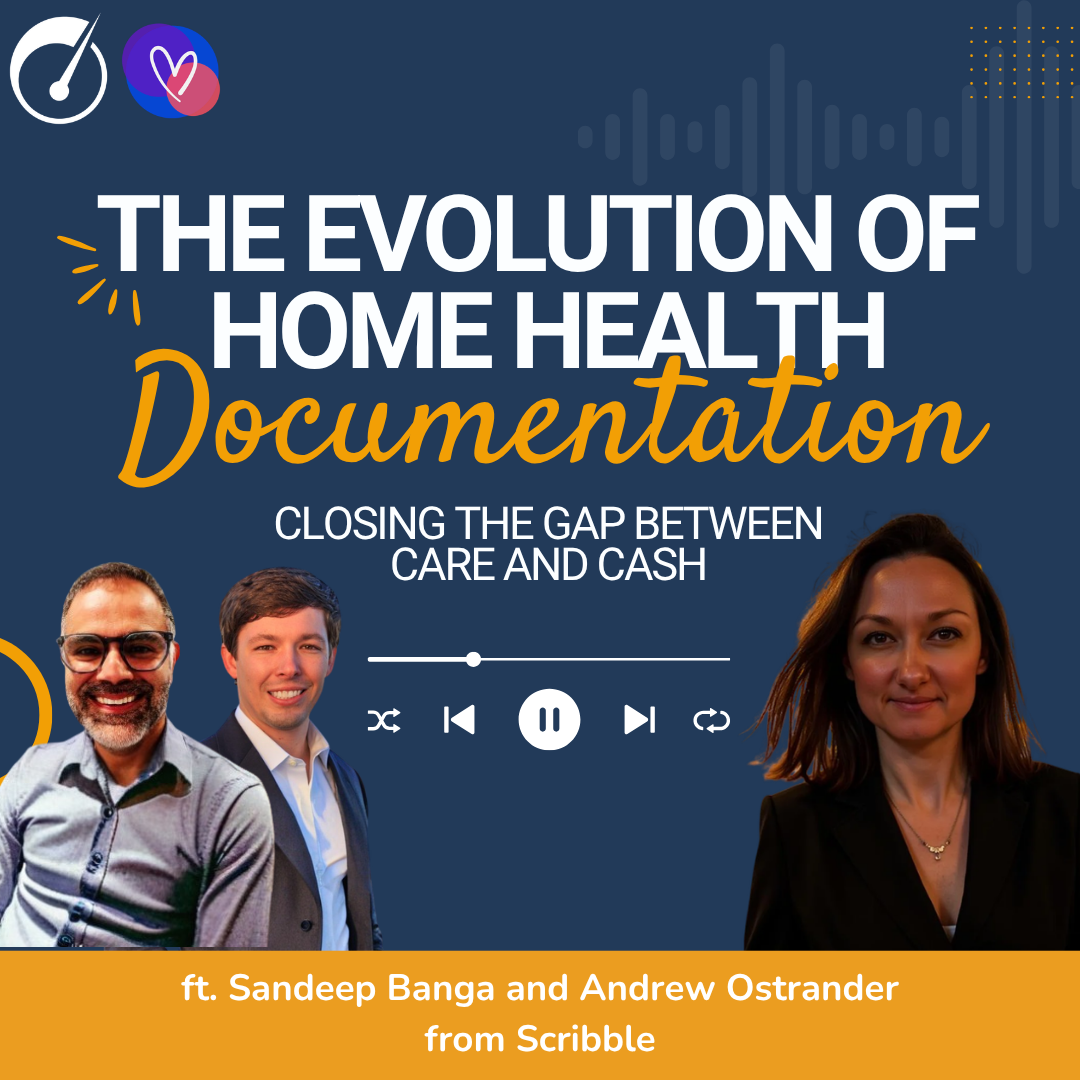
[00:00:03] Speaker A: Welcome to Home Health Revealed, the podcast for home health and hospice leaders who want to stay connected to the industry and ahead of what's next. Well, welcome to the Home Health Revealed podcast. We are so excited to have everybody here and today we are going to get into a little bit of Charles Darwin theory, so to speak, with the evolution of home health documentation. It's going to be a really fun conversation. And I have Sandeep and Andrew with me from Scribble Labs and I'm going to let them do own intro because I just wouldn't even do it justice. So, Sandeep, will you start with an intro?
[00:00:37] Speaker B: Sure, sure, Hannah. Thank you for having us both here.
So my name is Sandeep. I am the CEO and founder of Scribble.
Fell into home health maybe two and a half, three years ago.
I've had experiences building tech, so that's where I come from in the healthcare and human services, but knew very little about home health.
So I'll talk more about that as we go. But excited to be here.
[00:01:02] Speaker A: Yeah.
[00:01:05] Speaker C: Great. My name is Andrew Ostrander.
I've been in software for a while. I got into the post acute care side of software technology in 2017.
I've worked for multiple technology companies since that time and those companies have supported both home health and hospice agencies. And I started with Scribble in 2025 to lead sales. And thank you for having us.
[00:01:28] Speaker A: Yeah, so glad you guys are here. And this is a topic that we do talk kind of a lot about, I think, between the two of us in our spaces. But really, documentation has always been the backbone that props up home health. But the tools have changed dramatically and they really sped up over the last little bit of time here. So, I mean, Sandeep, I know you kind of gave a background of your tech stuff, but you have some really great connections to the healthcare field through your wife too.
[00:02:01] Speaker B: Yes, absolutely.
So, yeah, my wife is a physician, works at the VA and like I mentioned, for the last 15 years I've been developing tech and like for healthcare and for human services. So I've been familiar with the pain point a little bit.
You know, two things happened. One, my wife complained about it more furiously than she did otherwise. So that brought attention, was like, okay, something got to be done about it. And the other thing that happened was this whole gen AI right before that, the only options that we had as technologists were to build like better dictation tool.
[00:02:42] Speaker C: And.
[00:02:44] Speaker B: And we're not that.
[00:02:46] Speaker A: Yeah, right. I mean, you and I talked about dictation tools Even like Dragon, which I used in college, and it just, it brought back some ptsd.
[00:02:58] Speaker B: She sent me a text with the picture of Dragon on her, on her computer and said some not so nice words about it.
I'm happy that we have a way of solving this problem in a different way.
[00:03:16] Speaker C: And
[00:03:18] Speaker B: I think our clinicians are, they tell us that they're loving the way we're solving it and so it's really exciting for us and for everybody in this space.
[00:03:30] Speaker A: Yeah, I know. It's been even described as, in home health, the documentation problem is, quote, unquote, 10 times worse than in other care settings. And I don't know how you actually get to that number of 10 times worse than in other care settings. But I think there are some real obstacles that we've had to solving the documentation problem that aren't present in other healthcare spaces. Definitely not in other industries, for sure. And so we were kind of joking about this. Darwin's theory of documentation and how you can trace the journey from paper and pen. And it's not even been that long ago. And if we have listeners who are still on paper and pen, we do not judge, but we can help you. And so even sticky notes, you know, writing temperatures down on your hands and crossing the mountain pen as you go to your next, next appointment with your patient.
And then all the way through to now, best practice, which to me is bedside charting and dictation tools, EMRs that have some things built in. But we've progressed even further than that and now we're into this world of ambient AI. And I have to be honest, I. I didn't even realize that ambient as a word.
I remember the first time I heard it a couple of years ago, and it was just this light bulb that went off because I know that my phone is always listening to me and sometimes I don't even know if it's listening. Sometimes I think it's like inside my head I can think of something and it appears on my screen and I'm like, whoa, that's. Yep, it's a little scary, but we're going to use those tools to our benefit and each era, so to speak, of that, like paper and pen and then through dictation tools, EMR tools, the things that we've mentioned, each era solved a problem and progressed into what was next and what was next. But in some ways it also left it a little broken. We've still had gaps in between what's happening at the bedside, what gets charted, and we know for sure that all of These things impact cash, which, you know, was. Is where my world revolves around. And you have gone into this thinking you could solve the problems, and maybe the problems you thought you were solving are not as important as what you're actually solving.
[00:06:01] Speaker B: That's true. And Andrew and I, when we talk to people, like, it's almost, I'd say, like, Andrew, every week we learn about something that we hadn't heard before. Right. So very first, Hannah, when I was, like, learning about the space and talking to home health agencies just to vet out the problem, like, is this really a problem? Is this not a problem? Like, we just don't want to go on sound bites. We want to actually see it. So I, you know, I was shadowing clinicians, talking to clinicians. Tell me, like, what do you do day by, like, minute by minute in this day? Tell me what you do. Exactly right? And then I'll do the calculation.
Not like go off of some blog or something. And then. Right, so, so, so we're doing that and it was very clear, like, they're spending a third of their time in documentation. And there's got to be a better way of doing it. Right. And then we started getting into the problem itself. And there are multiple, multiple ways to solve it. And some people are doing it one way, some of the other way. We chose ambient AI because what we didn't, what we wanted to do was to stay as close to the action as we.
Because in our opinion, in my opinion, the farther you get away from it, the more data you lose. Right. The whole goal is here again, like in how we think about it, is to capture it right at point of care. Not like 5 minutes away outside the house or 10 minutes away in the car or, I don't know, miles away at your home. Right. Because things then fall through the cracks. And then like you said, Hannah, they inaccuracies creep in. There's all kinds of side effects, and that affects reimbursement. So, yeah, it's very interesting, for sure.
[00:07:47] Speaker A: And, you know, sometimes I walk into the next room and I can't remember why I went there.
So the closer you can get to the point of care and you're not spending that gap of time thinking about what you're going to do next.
Anytime we can get closer and closer to the patient care, we're going to get documentation that provides accuracy. And then accuracy on the back end impacts documentation. It means complete coding.
It also can mean complete reimbursement and care plans, all of those things. It's a domino effect. There so the gap in the middle, if I can put it that way, is what Scribble really does.
So talk to me a little bit about Medicare, what they're looking for. And we know they never see a real patient.
They only see a documented record.
And why is it so important to you that this ambient listening drives that complete and accurate documentation?
[00:08:52] Speaker B: Right. And you call it a paper patient. That's the first time I'd heard that.
[00:08:57] Speaker A: Yeah. That's my own. That's not official anything. That's just Hannahville, I call it. You gotta build your little paper patient.
[00:09:03] Speaker B: I'm a newbie. Just, you know, that's the first time I heard it.
But yeah, in terms of why, you know, it's important is it's important because the clinicians are doing the work while, you know, they're with the patient. Right. They're seeing the patient.
They're talking about what's going on.
They're observing things with the patient.
And can we actually create something that's smart enough that we capture what's going on and so they don't have to do the work again? Right. That's the whole idea, is if we can condense whatever is happening as much as we can during that visit that's happening, then they don't have to do it again.
And then you go further down and starting to get into the valley where QA happens, folks like Health Rev play a part and then further back as well.
When the data that was captured, it's not. I mean, it gets to you.
You're missing, you know, bits and pieces of it. There could be important information that was missed that could affect the patient, that could impact definitely the reimbursement. So that middle area is what we see, what we find is very interesting. And also the area that I think has a lot of potential for us to actually help clinicians and both agencies and, you know, us working together, like bridge that gap in somewhere.
[00:10:50] Speaker A: And when you started selling ambient listening and scribble, you went about it, selling the time savings, probably based on. Based on your wife's.
Let's see, what's. What's the nice way she really drove your. Why. Probably in listening to her, listening to her pain points, you started selling time savings. But there were some other things that came up that really were top concerns for other agencies. Can you talk a little bit about that?
[00:11:22] Speaker B: Yeah.
Andrew, if you want to talk about retention as being one of them, when we were first talking to customers. Right. And then the things that they play back to us, would you say, Andrew, Retention is one of those things too.
[00:11:36] Speaker C: Yes, I think retention is definitely one of those things.
Like Sandeep said, we have new conversations every week and learn something new about what people are having challenges with their documentation, kind of the ripple effect of those challenges.
So retention is definitely one of those.
Documentation quality is a really big one.
There's EMRs out there that allow for like copy forwarding and even if the EMR doesn't do that, we see clinicians take old information from old visits and apply it to new ones and it creates really weak verbiage and that can lead to adr. There's this big ripple effect for documentation and the quality of it.
[00:12:20] Speaker A: And when a clinician is coming in and they have these tools, it shows support from the agency in helping them do their job faster, better, more accurately, it respects their time.
Because then we're saying, hey, we understand you're a clinician and this may be your life work, but you also have a life, a family, things to do after that. And we know clinicians, they're very dedicated to the work that they do and the work that agencies do and leadership can do is remove any friction that is causing their job to be harder than it should be. That's getting a closer connection between what's happening in the patient home and then the function of running the agency. And we don't always like to talk about that because it's not, it doesn't feel very purpose driven.
But all of these tools, these things scribble, health, rev, the back office functions.
The more we can automate, the more we're able to make these patient facing encounters matter more and take the mundane, if you will, off the plate of the clinician.
And so it's a great recruitment tool as well. I don't know, you talked about retention, but even on the front end, if you have that, like I may want to go there, versus somewhere that doesn't offer any type of tool that helps me do my job easier.
[00:13:47] Speaker C: That's right. We were at a conference recently and one of the stats that we heard from this conference is, you know, burnout rates are contributors or 60% of burnout rates are contributed to documentation. And so clinicians are looking for agencies that have solutions that help them with their pain points and challenges. And one of the big pain points and challenges that's been consistent for a very long time has been documentation.
And I, and actually Hannah, I wanted to talk a little bit about kind of the evolution of documentation because as I was getting prepared to do this podcast, I dove into pre1999, which I was in elementary school, so I have no experience with documentation. But times, yes, good times, great. Elementary school was wonderful.
I do have some friends that are clinicians that are well experienced and they were clinicians in 1999 and were pre 99. That was before Oasis and EHRs. Right.
And so this one friend of mine was sharing a story of how he would drive around, go do his visits. He if he had to do a visit and he didn't have his paper form, he would have to go by the office, pick a stack up of these very nice thick forms and then he would drive to his visits and fill out these forms with his sloppy handwriting. And then when he was done, you know, the office is calling him, hey, get your forms in. So he's driving back to the office and he drops the forms off and then someone has to sit there, you think, for like a larger size agency. Someone's sitting there and they're taking all these forms in and they're figuring out which you know, patient to file this away to which manila folder. Like just think about how mundane of those tasks are.
Right?
[00:15:30] Speaker B: Yeah.
[00:15:31] Speaker C: And kind of if we talk through the evolution of this, the common denominator is really the same. Like the technology has changed and the, you know, Oasis post 99 that changed a lot of things. But still it's. People are spending a lot of time there's their up until recently hasn't been a great way to complete documentation efficient, efficiently. And then there's a big issue with quality. And all these things have been here even though there's been a bunch of changes since 99.
[00:16:04] Speaker A: Yep. And you know what? I just did my renewal of my HIPAA training this morning. You know, those are really fun, but it brings up some good questions because when you had all these paper. We've come a long way with not only being able to provide an avenue for getting this completed, creating some safer places to do this, because having a bunch of stack of papers in your car is also seems like maybe a huge HIPAA violation, potential catastrophe.
But also talk to me about the HIPAA component of Scribble and how you guys have gone about making sure that it's safe and secure.
[00:16:45] Speaker B: Yeah, I mean, you know, if you're working in health care, you know that compliance, I mean there's no getting around.
It's integral to whatever you're developing.
Security has been really a high priority for us.
We're soc to align. For example, the way we build our systems, they're encrypted in multiple ways.
So my team tells me it'll take a billion years to crack that code, so it's not really possible to do that.
I don't even know who comes up with these calculations, but still.
So they're very secure. We wanted to make sure. And all the way through, like from the beginning, where the clinician takes the app to the patient home, to when it gets out of the home to us, to then finally processing it, then sending it back to the clinician to the emr. There's so many touch points here.
And so, you know, we've really been careful in kind of evaluating them, assessing them, and continue, continue to do that on a. On a regular basis because, yeah, security is very important.
[00:17:59] Speaker A: Yes. Amen to that.
Can you talk a little bit about how Scribble works, specifically if somebody wants to experience it? See, it is in an app. What does it look like? What does it feel like for a clinician?
[00:18:11] Speaker C: Sure. So I can answer that, Sandeep. So Scribble is an app and it works really well into existing workflows for clinicians.
So they're going to go to their visit, they open up the Scribble app.
Once they do that, they're going to see that visit and that visit type on their app. So we pull that in from the emr, it's extremely easy to see. In fact, all the technology companies I've worked for, this app has to be the easiest I've worked with in terms of usability, which is great.
Yeah.
[00:18:43] Speaker A: Always good news.
[00:18:44] Speaker C: Yeah. Yes. It helps a lot with implementation training as well.
So once the clinician selects that visit type, they start the Active Listening Recorder, which uses that ambient AI technology to pick up the conversation between that clinician and the patient. And the technology is really great. If there are caregivers in the room, dog barking, TV on. It identifies the speakers in the room. If there are thick accents, which everyone talks a little bit differently. Right. So with those thick accents, it can pick those up really well. And I remember Sandeep, we had someone with a very thick Southern accent on a call recently, and Sandeep was like, I could barely hear that person and I could hear them just fine. And so that's, you know, ambient AI can pick up all those accents really well.
And then as it picks up that conversation, it does a really good job also of taking information that's not relevant and not using it, because we know patients or even caregivers can come in with a story of some sort and has nothing to do with the care that day. So it does a really good job of leaving that information out. And then at the conclusion of the visit, the clinician can pause that active listening recorder and once they go to their car, use their windshield time, they can resume it and add in their observations. Because we know that patients sometimes say, oh, I can get up and move 30ft to the bathroom just fine, but really they can. So this is their opportunity to address those things.
Then we take the entirety of the conversation. So it doesn't have to be in any order. We don't have to like go question by question to answer the OASIS documentation. We take the entire conversation, it goes through Scribble's AI reasoning engine, and then we put the outputs out into the answers for the clinician to review. And at that time we've got a really simple user interface for them to be able to review the answers as well as make any changes. And we keep track of all that information and data and then we push it to their EMR where it fills out the documentation.
[00:20:58] Speaker A: What percentage of the documentation is typically filled out based on the visit?
[00:21:04] Speaker B: It's day by day, it's more and more. So it's, it evolves fast. We're right now, I'd say for Starter care as an example, probably like 300 plus items that we're filling out.
Okay, so. And then there's always more in there. Yeah, absolutely. Like we're, we hear clinicians saying, they say 45 minutes took them hour and a half. Some are more, some are less.
And we've heard from customers saying, they're saying, don't take this away from me ever. Or so that's really great to hear.
But yeah, it is always evolving. AI moves fast. We have to keep pace with it.
We have to keep pace with customers expectations too because they're asking for so much, which is great. Right? Like that's. So when we build technology, right, Hannah, like we in the past, it's almost like you're imagining features and things that you need to do for a customer and then hope that they use it in this space. Like, what is different is it's driven by customer demand so much they're asking us, can you do this? Can you do this? Can you do this? Because we need it, which makes our job so much easier as product developers.
[00:22:21] Speaker A: They want it done now.
[00:22:22] Speaker B: Yeah, and now. Exactly.
[00:22:26] Speaker C: It's fun to hear their ideas because AI is making room for possibilities that weren't available a few years ago. So they're really dreaming up these grand ideas and then sharing them with Us and we're like, yeah, I mean, this is actually possible. We just need time and resources to make it happen.
[00:22:45] Speaker A: And we have come a long way with that development. I know. You know, starting with paper and then like you were saying, going to, we're going to implement EHRs, that was a whole transfer.
I'll say nightmare, but some, I mean, it caused good, good documentation practices to continue evolving.
Every stage has had its struggle.
And then when laptops became a thing, right to now most people have iPads that they're taking along with them. We've continued to give.
And to their credit, they've put them in the hands of the end user.
And that to me is also a very important piece if an agency wants to try Scribble. And I do encourage, I do encourage agencies, especially when I'm talking to leaders, because we love to, we love to think that we can solve everybody's problems. And we do it in a little bit of an idealistic way. And so when you come across something like a Scribble lab, you think, oh my gosh, like, yes, if this actually does what we think it can do, then it's going to solve all of our problems. And to experience it is really the true test. So I do tell people, get it in the hands of your end user so that they can experience the wonder of what it really is.
Where can somebody reach out to you if they want a demo or they want to try Scribble? Where can they find you? Where can they reach you?
[00:24:18] Speaker C: Okay, yeah. So if you're interested in reviewing Scribble and get your hand getting your hands on the solution, recommend going to our website, which is Go Scribble.
And then there's a simple form there that you can fill out where we will receive your contact information and we can reach out to you to schedule some time for a demo. And then you guys can also trial the solution as well.
[00:24:43] Speaker A: That's great.
[00:24:44] Speaker B: Andrewscribble AI.
[00:24:46] Speaker C: It's.
[00:24:46] Speaker B: Or Sandeep Scribble AI.
[00:24:50] Speaker A: Very good. Yeah, just reach out directly. Is that okay if they reach out directly to you?
[00:24:54] Speaker B: Absolutely.
[00:24:55] Speaker A: Get it scheduled. Well, I know we had some exciting news in our partnership. We released just in March, so very recently, our partnership. And the reason I'm so excited about that is because Health Rev, we review documentation that's. We're up to our eyeballs in it and we love it. And a lot of the struggle that agencies have is with complete, not copied and pasted documentation that is not just accurate, but complete has that full picture of that paper Patient that I love to refer to because we don't see the patient. And so we are depending on that painted picture in our review. And so anytime we can help agencies refer them to partners who have solutions, who can make their lives easier, who can take some of that burden off of those clinicians. The end game is to boost patient care. So if we're able to do that, then we know that that also affects the patient. Being able to make eye contact when you're in the home, to truly listen, knowing that documentation is still going to be what it needs to be when you walk out and that changes happen. But they can be minimal. They don't have to be so cumbersome and tedious and time consuming.
[00:26:15] Speaker B: Right. And you know, the, the, sometimes the delays care too. Right. Because we, as we talk to some of our folks that we talk to, like, it can take them days to turn that documentation around. And it's totally understandable. Like, if I had to do it day in and day out, sitting at the diet, you know, dinner table, spending four hours every day, every day, every day I'll be like, okay, I'm a human being, right. I need a break.
[00:26:41] Speaker A: Yeah, yeah, yeah. So human beings need their machinery.
[00:26:46] Speaker B: Yeah.
[00:26:47] Speaker A: Where do you see the future of technology going? I know we always feel like we're on the next best thing. We're on the next best thing. But as you look ahead, what solutions maybe like this do you see in the future of home health?
[00:27:02] Speaker B: Well, there's so much opportunity here in this space. Right. Like, it's whichever.
Whether you're solving at the front end like we are, you're solving at. In the middle of the back end like you guys are. There's so much option for everybody. Right. Whether it's like I've been to home health agencies just kind of shadowing, and I've seen one person copying and pasting from one app to the emr and that's their job the entire day. Right.
I don't know. I mean, if that person lost that job, would they be really mad? No. They could do something better. Right. Like, there's always room for us to improve and do something that's more meaningful.
So I think there's so much opportunity, honestly, it's hard to even fathom, like, where we could go next. Because, like Andrew mentioned too, we hear about new problems and new ways to improve something that's broken almost on every other call right now.
[00:28:07] Speaker A: Yeah. So true. We do. We have a lot of problems to solve. Oh, well, it's been great talking with you guys, is there anything I've. I haven't asked you that you would like to say to any of the listeners,
[00:28:19] Speaker B: Andrew?
[00:28:20] Speaker C: No, not on my side.
[00:28:23] Speaker B: Well, I just want to say that, you know, we're so thankful for the opportunity to, like, for, like, the opportunity that we get to work with clinicians, with home health agencies, and even if we can solve just a little bit of something for them, make their life a little bit easier, I mean, that just is, like, it means so much more than any amount of money that somebody could pay us to do. Right? So. So when I, like, last night, I was, you know, looking through our app, and one of the clinicians had said, you know, this new feature that you released, it's saving me even more time. I love it.
Right. And we really appreciate you all, and that means so much to us. So we're so thankful for having these opportunities and even to work with folks like you, Hannah, like health rep partners, just like. Yes. You know, we're in the same space. I think we work together to. We're solving the problem for the same kind of group. Right. But it's just a different angle that we're approaching it from.
[00:29:21] Speaker A: Well, thank you so much for jumping on this podcast with me. It's been really good talking to you guys. It's been fun seeing you at conferences, and we got to be at ACHC together. We'll be at another conference soon. Looking forward to being at the Agile Access conference and seeing a lot of other people in this space. It's really cool. It is kind of like a family. We get together, we have a good time and eat some good food, usually, and talk about all our problems. So families do, right?
[00:29:46] Speaker C: That's right.
[00:29:47] Speaker B: That sounds great. We appreciate it. Hannah, thank you so much for having us.
[00:29:50] Speaker A: Thank you.
[00:29:51] Speaker C: Thank you so much.