Episode Transcript
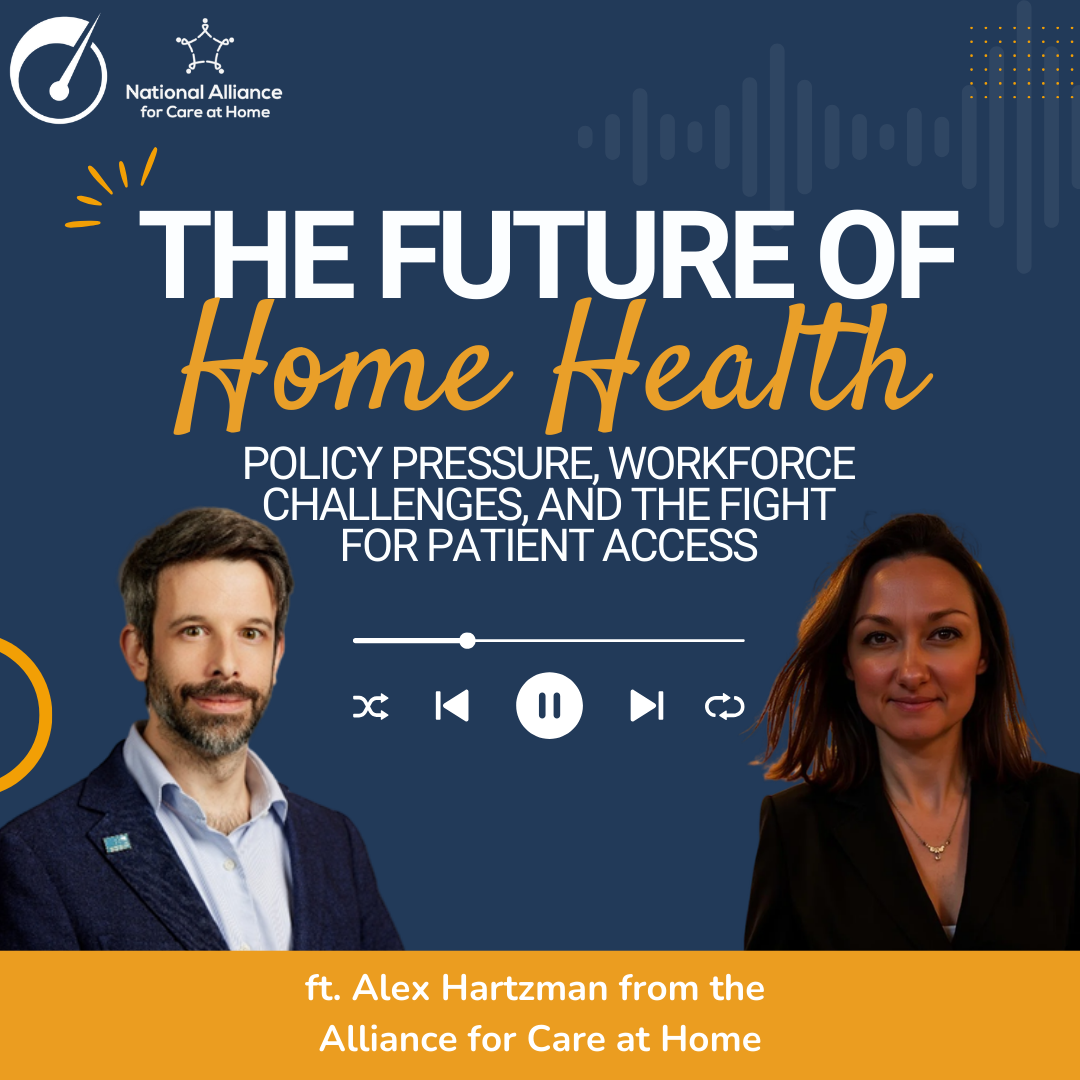
[00:00:03] Speaker A: Welcome to Home Health Revealed, the podcast for home health and hospice leaders who want to stay connected to the industry and ahead of what's next. Hey Alex, so glad to have you on Home Health Revealed this morning. I would like for you to get the chance to go ahead and introduce yourself, talk about all the really cool things that you're a part of and what you do.
[00:00:23] Speaker B: Oh, thanks so much, Hannah. I'm really excited to be here. Hey everybody, my name is Alex Hartzman. I'm the vice president for research and analytics at the national alliance for Care at also the head of operations at the Research Institute for Home Care and get to lead a whole bunch of different data driven strategies to support evidence based policy and home care reliance and work to drive the research agenda and funding through the research institute. I've spent about the last decade working in health services research and policy consulting, especially in the Medicare space. I've spent a lot of time around home health and hospice and other home care. And then before that I've got a background in research and research oversight.
[00:01:00] Speaker A: Yeah.
[00:01:01] Speaker B: Wow.
[00:01:01] Speaker A: You've gotten to do a lot of cool things and I think there is a little bit of like mystery around what goes into policy influence and regulation influence. We kind of wait around for the proposed rule, give input and then get the final rule, but you really get to be on the ground influencing a lot of these changes. And so it's really exciting to get to talk with you and if it's okay with you, I'd just like to dive into a few questions.
[00:01:27] Speaker B: Sounds great.
[00:01:28] Speaker A: Okay, so looking specifically at Medicare home health, which upcoming policy or payment changes do you believe is going to most disrupt our agency margins in the next two to three years? And then second part of that question then, how should leaders start prepping now to offset some of that impact?
[00:01:50] Speaker B: Yeah, there's a lot going on right now in the policy environment. I think we just got through a really scary rate season, rate setting season with the home health pps.
I do want to take some amount of credit with the alliance where we pushed very strong, we pushed back very strongly on the administration and I think they listened and the result of which is we should have less hits to the pps and hopefully we're anticipating net positive adjustments from here out with the closures of them. So while the rates won't be increasing as quickly as we would like per se, I think we're hoping we have seen an end to the era of massive cuts.
I think there are of course going to be ongoing spillover issues with Medicare Advantage. As well as spillover issues from things happening in the home and community based services world inside Medicaid. And those are going to continue to be a challenge, but hopefully the traditional Medicare side is calming down a little bit when it comes to.
I think there's also, with his administration, there's also the possibility of enhanced oversight, especially with noted fraud happening in LA county and other places and administrative shin actions in Minnesota. I think there is certainly a possibility, although we're tracking those possibilities, what the center for Program Integrity may or may not do. Those could include things like pre claim review or moratoria, but we're tracking it now to see what might happen there.
I think in terms of what can providers and home health agencies do, it's really about maintaining quality staff.
I think that's more frankly that in our economic position right now. I think that's the hardest thing and probably the most essential to maintaining a high quality agency is maintaining your clinical workforce especially and maintaining your relationships with your referral partners. I think that's true at all times, but I think especially now where reimbursement, where the overall total reimbursement picture is still shaking out, I think that's extra critical.
[00:03:54] Speaker A: Yeah, almost like that. Refocus on the basics. Right. Like do the things, do them well, maintain them well.
[00:04:02] Speaker B: Right. And especially the clinical things. You got to get the clinical out and we'll, we'll hopefully get to talk about quality in a bit. But the clinical quality outcomes are exceedingly important. And making sure that you have the right mix of RNs to LPNs and all of that and maintaining that mix in a way where you keep people with experience and who know how to work in your system. It's all crucial.
[00:04:22] Speaker A: Very. And I think it's good news that I'm hearing, you know, that maybe our era of rate cuts is coming to a close and we're going to start seeing some growth. I think it's been much needed from definitely a budget standpoint, but also just a morale standpoint to really put some value around the home health agencies, what they do, what they're providing in their community. Because I think it is much more foundational than maybe we've given it credit for in the past.
[00:04:48] Speaker B: Absolutely. And I think you can see that in the mergers and acquisition picture. Right. So even while traditional reimbursement sources like Medicare may have been going down, you saw health systems and private equity groups and insurers buying up agencies to try to assure this really essential service for their subscribers or members.
And so I think people are making a bet that this is going to, that this is a critical part of our economy and our care system, even if it isn't being reimbursed appropriately at this exact moment.
[00:05:21] Speaker A: Right. There's hope that we'll get there.
[00:05:24] Speaker B: I think so, yeah.
[00:05:26] Speaker A: Which is very.
It's great to hear.
So you're in the data a lot. That's kind of your life. And when you look at top performing home health agencies within their data, what operational or clinical behaviors consistently separate the good ones from the pack? So beyond just the visit utilization, how can an average agency realistically start to emulate those top performing patterns?
[00:05:58] Speaker B: Yeah, well, I'm going to kind of break this up into like a little bit about how the scoring system itself works, which is a little pedantic and I'm sorry about that. And then I'd love to get a little more big picture about what the research to date shows and maybe a little bit about the future case that we're building here.
So at least your question to me brought up the home health value based payment system or value based purchasing system along with the related caps measures, claims based measures and oasis based measures within that system. And I'm just thinking about the people who receive the highest quality bonuses as sort of our top performers here.
It's really hard because the ones who are getting the biggest bonuses do well and almost at the top of every single measure.
And that isn't heartening. And because it's a budget neutral system, that means that everybody's graded on a curve and so you have. It's not just that you have to perform well and improve over yourself. Historically, if you want to improve your quality payment score related score, you're going to have to improve beyond what other agencies are doing.
So that's how to get to the top of the top. And you're going to have to perform exceedingly well on basically every measure. I think if you're transitioning from the middle of the pack or from the bottom of the pack or whatever in terms of your quality score, pay a lot of attention to how those scores are weighted.
Really the system. There's a lot of measures out there and there are different domains that are unrelated. The clinical and experiential domains are especially not super related to one another.
But if you look at the weights, you can see where CMS is really telling you they want you to perform well. And I think the biggest weight is certainly re hospitalizations. And I think clinically that's also. And cost wise that's the hardest to perform on and that's really where the system is telling folks to focus.
There are of course some other quirks. So like sample size is a huge issue in the system.
If you don't get at least and a surprising number of agencies have too small a sample size to make it into the system.
Competition is actually harder among the smallest agencies too. So you really need to get at least 60 caps survey responses that are valid in order to make it into that larger tier and have a slightly easier time.
Also, it's worth noting that system is very lagged. So your 2024 performance is affecting your 2026 payments, meaning we expect your performance this year to affect 2028. It's really hard when there's that much lag. You really have to lean into your clinical performance and do what you can.
Looking at the research, the research is really limited and at the research institute we're trying to do something about that. But what I found so far is just higher RN to other staff ratios is associated with higher quality.
Use of employed staff over contract staff is associated with higher quality.
Agencies that provide a comprehensive set of services rather than specializing have higher quality scores.
And then things like agency ownership, being part of a chain, being for profit, being private equity owned accreditation, all of these things are really just signals that the agency is sending. They don't really necessarily have to do with how that agency is performing. It's more like what is that agency say it is.
We're looking to the future.
We really need more research because the claims and the existing quality data we can get from CMS don't let you unpack this. And so the research institute is taking the very first steps down the path of asking providers and EHR vendors to come together to develop a data cooperative so that we can start to answer these questions a little more systematically.
But you know, that's it. That's the thing we're, we're starting on
[00:09:35] Speaker A: and it's, it's very interesting to me. A lot of these data points that you've just listed off, right? Obviously, yes. Rehospitalization being kind of a top indicator.
What are some of the things that you're seeing agencies do or if you are that are really mitigating that rehospitalization risk.
[00:09:56] Speaker B: Yeah. So I think, I think that's a great question. I think that's something we need more information on. That's where I'm seeing the sort of. The studies are really not getting that level of specificity just yet.
I suspect looking through the system and the way the points add up, I think you have to do really well on the readmission measure in order to have those quality scores. So I suspect when we're talking about those top lines, like you have to have a strong RN to LPN ratio, I think that really is going to reflect in your, in your re hospitalization rates as well.
But getting that level of specificity is a place we're trying to push the research.
[00:10:35] Speaker A: And then I'm thinking about the lag and the fact that, you know, 2024 data is impacting payments. Now, given that with our high staff, continued volatility within staff turnover and things, you know, a lot of agencies are having to really invest in that continuous education of how staff are talking with their patients, how they're educating them on some of the rehospitalization risk risks, maybe giving them some alternatives to reaching out, talking with someone to prevent some of those.
How do you feel like that is impacting some of these data points that we're looking at?
[00:11:13] Speaker B: Oh, yeah, workforce turnover underlies all of it. And it's again, it's a thing we have effectively no information about today.
But your ability, you know, it's not like the RN that's really critical to the practice is one that's going to come right out of undergrad or something. You're talking about experienced personnel and need that experience to be able to operate independently in the home and then to have a high turnover rate on top of that, it is really hard. So I think in a lot of ways it maybe feel like building sandcastles, but, but a lot. But the most you can do to keep your clinical staff happy and keep the, keep them on board is going to serve you well through the future. I don't have easy answers, though.
[00:11:56] Speaker A: No. And I think that's the thing, nobody does have easy answers. And it's that consistent looking at quality, looking at how am I keeping my staff to maintain that continuity of care within the patient because it ultimately does trickle down to the patient and there, there are so many factors. So I, you know, I love this conversation, I appreciate this conversation and it just, the more that we're in this, I think, man, we don't have the data we need just yet.
Although I think we have a lot of data that's causing within a home health agency some paralysis on what to do. If we can really nar it down to some of these specific focuses and start there, maybe we can take some of that paralysis away of. I don't know what I'm going to do. So I just do nothing to. All right, these are the things I'm going to focus on.
[00:12:48] Speaker B: Yeah. I think there's so much data in this world right now, and it's, it's kind of great and it's kind of terrible.
And with, you know, AI getting more and more accessible, people can make good inferences and mistakes much, much faster than they used to be able to.
It's one of the reasons I'm still a big fan of, like, distinguishing research and data and why I think, like, you're right, people in these home health agencies, they've got more, they've got a bewildering amount of data to look at right now. And that's why I'm hoping that, you know, some of this peer review, published research gives some, some signal that's tried and true and that people can also, like, go to their guts. I think, like, I don't think anything I said was especially controversial about, you know, higher licensed clinical staff is going to. A higher ratio of that is going to lead to better clinical outcomes. I don't think that's, you know, a surprising thing to say. I also don't think it's surprising to say that employed versus contract staff feel better outcomes. But, like, I think sticking to some fundamental truths and like, these folks out there are independent business owners in a, in a business that's never been especially easy. So we kind of, I feel like it's just focusing on the fundamental, like you said, focusing on those fundamentals.
How do you keep those clinical quality levels up? But how do you treat your staff well and make sure that they feel appreciated and stay around and make sure that. Because that's really what's going to keep people, what's going to keep these businesses going is keeping staff where they can.
[00:14:14] Speaker A: Yeah. Amen.
And then, you know, there's also the next step, which is reaching the policymakers. So I want to talk about that. Also, from your work with national home health data sets, what story about the value of home health is still not reaching the policymakers and hospital partners? And then what types of metrics or outcomes should agency leaders be tracking to help change that narrative?
[00:14:40] Speaker B: Oh, I love it. I mean, well, so my struggle and this is in working with the home health industry over the last decade, and I'm working with medpack and stuff is there's just not this understanding among the policymakers that access is hard for patients right now. They just don't want to see it.
Medpack's measures right now are pretty naive and don't really tell any sort of story. And so it's been very, very hard to convince policymakers that there's actually something wrong happening here, which has been frustrating. And I think, you know, you can see it in all sorts of ways.
You can look at, you know, I think anybody who's operating a home health agency knows they have to turn away a huge chunk of people. They can't get that like a large portion of the people who want their services and access has been declining, not insignificantly overlap, you know, since they implemented this PDGM system in 2020 along with the pandemic. So like there's a bunch of things that are going awry in the system, but it's been very, very hard to get policymakers to see that. I think there's like a sort of whole genre of long term care and services and supports work that just they don't want to plan for. And we're about, it feels like we're about to go over a cliff.
[00:16:02] Speaker A: Yeah, I was actually at the ACHCU and one of the speakers there who I was listening to gave a statistic that really kind of brought things down to my level and said 10,000 people a day are turning 65.
Our population that needs home health needs critical care. Services in the home is increasing and yet we still have an access to care issue.
It is related to staffing, it's related to insurance payers, to payment reform types of things.
The way that I think about it is it's simply complex.
We have so many things that are contributing to these barriers to care, but yet the demand continues to increase.
And so coming together with the alliance with people who can influence some of these policies and things is so important.
I don't know that the average rn, the average agency owner knows how to get there. Do you have practical steps or ways things they can do to feel informed and to feel like they matter in this ecosystem?
[00:17:16] Speaker B: Well, yeah, I think so much of what's going on for the individual agencies is about their local area. I don't think the individual agencies shouldn't be trying to have to talk to policymakers about why they can't serve everyone, although it would, you know, when we do our fly in days and whatnot on the Hill, that's extremely useful to have people come and tell their stories about not being able to get to every client. Right. I think getting that those story, that's one of the ways that we get that's most effective is actually bringing individual anecdotes of like what's happening in the field to the policymakers is incredibly important.
And I think you're totally right about the increasing.
I think the best what agencies are doing is really showing the referral partners the clinical quality they're bringing. Showing, you know, when people, you know, in general, we know that when people prefer to be in their home and they're seeing their home, they do better. And so if you can bring that and bring the operational ability to actually see the people in their homes, you bring quite a lot to a health system.
I mentioned this earlier on this sort of, this trend we've seen of health systems insurers and private equity purchasing home care agencies is really about that difference in the valuation between what's the value that it brings, the health system versus what's the value that Medicare is willing to assign to it.
And we see that the health systems are taking that on because they understand it's an essential thing. They understand that community, that community service, that having people see people in the home is critical to keeping people out of the hospital.
And so right now it's critical to maintaining just even the readmission rate statistics for those hospitals. Even just keeping those statistics in the black is worth it for a hospital to own an agency often.
So there are different economic incentives at play.
But I don't see anything sort of writ large that looks like we're going to fix our aging, you know, the impending problems with housing and caring for our aging population.
[00:19:16] Speaker A: Yeah, completely agree.
Side note, because this is something I'm passionate about is hospitals who take on a home health component. The coding and the billing is very different.
And so if there's a hospital system out there, just a plug, you know, hire the right people to do that coding and that billing because it is very different, you're going to have better success if you have somebody who specializes in that. Okay, rabbit trip, I'm coming back on the trail. That rabbit trail is gone.
[00:19:49] Speaker B: Absolutely. Well, and the thing that people don't think about a lot with this aging of the population, I think you're, you're over, you know, 10, 000 people a day turning 65 in this country. That's absolutely right. I think about the proportion of the population that's 85 and up because that is like being truly like media and very often hospice users and so on.
I also think about what proportion of our clinical workforce is in that demographic band and I think perhaps an uncomfortable proportion. Right. So like, and so, and then on top of that, there's also not enough middle market housing for like supportive housing. So within, if you look at the, if you look at the assisted living industry and so on, there's been an overbuild in like the high intensity units.
There's some amount of Medicaid pay, skilled nursing, but then there's just simply an inadequate amount of middle market pay, private pay housing, hence the cost being so astronomical, economically high. And so people need to be in their homes. If they can't get a home, if they can't get the supportive services they need in their home, then they're pulling a family member in. And then we start seeing issues around informal caregiving and other impacts on the economy, say where people are doing informal caregiving or their loved ones rather than doing something that supports the economy.
So there's a whole bunch of other levers that this, this all affects and it's going to become more and more an issue. I don't see a lot of solutions right now.
[00:21:12] Speaker A: Nope. Need for more data, need for more problem solving measures. Right. Where we can come together and think about solutions that meet the needs of all of these things as we grow and as we look at supportive care at every level of where we're providing it.
Thank you, gosh for this conversation. This has been a lot to think about.
And if you know, is there something I haven't asked you that you think I should ask in our audience of home health leaders would need to know that would be valuable.
[00:21:46] Speaker B: I mean, there's a lot to talk about here. We covered so much really quickly.
Yeah, I think just maintaining that link to your workforce, I'm just going to reiterate it. Maintaining that linkage to your workforce, doing what you can to find ways to keep them engaged and working with you is going to be just ever more critical.
[00:22:07] Speaker A: Yes. Well, thank you so much. I really appreciate you taking the time, the incredible work that you're doing.
If anybody is not involved with the national alliance for Care at Home, you know, I'll link that along with some of the other information that you provided. And then when is the next Capitol Hill day?
[00:22:25] Speaker B: Oh, that's a great question. Our next find, it's usually in September. I don't know that we have dates for it together, but if you're on the alliance mailing list, you'll get those dates. I'll also make a plug. The research institute just came out with it's annual home health and hospice chart books. So there's fresh data out there for, for helping folks to benchmark their practices. And then if you're an alliance member, you have access to the, to the hospice facts and figures as well. And we're working on producing that for home care as well in the next year. And just more and more data for folks.
[00:22:57] Speaker A: Nice. Love some good, fresh data.
[00:23:00] Speaker B: Yeah.
[00:23:01] Speaker A: Makes the world go round. Well, thank you again, Alex. Thanks so much for being here.
[00:23:06] Speaker B: Thank you, Hannah. Appreciate the opportunity.